
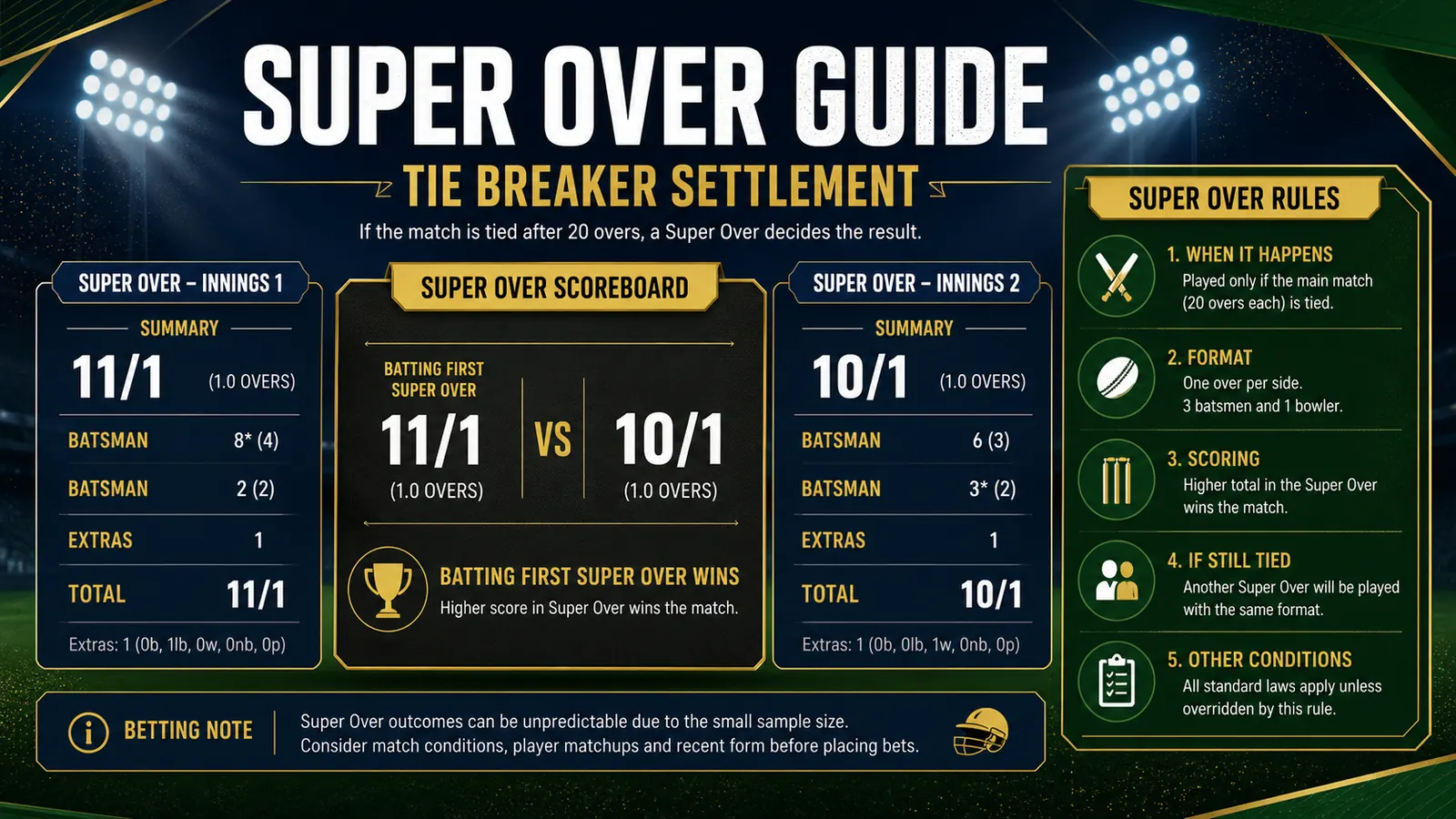
A Super Over is a tie-breaker, not simply another normal over. The event has its own sequence, selection rules, and market questions, so a reader should check the exact wording before treating a price as familiar.
The practical focus is settlement clarity. Competition rules and operator rules can use different definitions, especially when a market refers to the match result, the tie-breaker itself, or a specific player action.
Editorial note: Reviewed by IPL Betting Editorial Team. Last updated: August 2026. Evidence method: compare published competition rules, current match information, and the exact market terms shown by your chosen platform. Match information, team news, weather, prices, and market terms can change, so keep every decision within a planned limit.
Separate the Match From the Tie-Breaker
First identify whether the market covers the regulation match, the Super Over, or the final winner after the tie-breaker. Those labels may appear close together but they do not ask the same question.
If the main match is tied, the emotional pace rises quickly. Keep the market label visible and avoid switching from one scope to another because the score feels urgent.
| Market scope | Question it may ask | Check before reading price |
|---|---|---|
| Regulation match | Who leads after normal play? | Tie handling |
| Super Over | Who scores more in the tie-breaker? | Player and over rules |
| Final winner | Who is declared the winner? | Competition and settlement terms |
Check the Rule Set
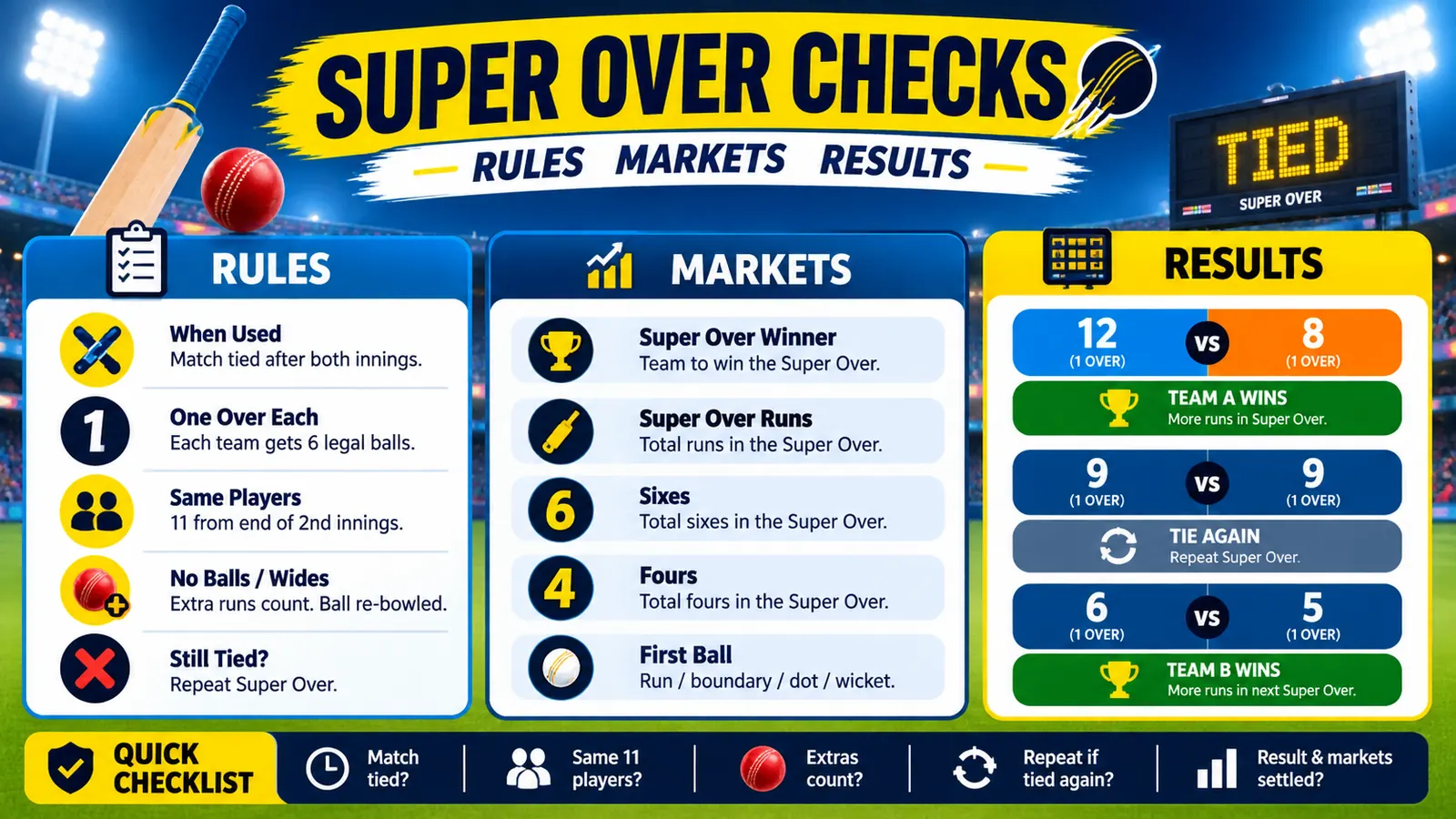
The number of balls, nominated batters, eligible bowlers, and the handling of another tie can be defined by the competition rules. Do not fill in a missing detail from memory if the market screen provides a specific rule.
A rule summary should be treated as a guide to the question, not as a replacement for the current competition notice or operator settlement page.
| Rule area | Why it matters | If unclear |
|---|---|---|
| Nominations | Opportunity may be limited to selected players | Do not assume every player is eligible |
| Balls and wickets | The tie-breaker can end early | Read the early-end language |
| Second tie | A further method may apply | Check the competition rule set |
| Settlement | Market may differ from final winner | Pause until terms are clear |
Do Not Reuse a Normal-Innings Read
A Super Over creates a small sample with extreme pressure. A batter’s normal-innings role may not describe the nominated role in the tie-breaker, and a bowler’s usual phase may no longer apply.
Use the available information to understand the format and selection, not to claim that a short tie-breaker is predictable.
Settlement Is the Final Check
Before any decision, write down whether the market is settled on the tie-breaker score, the official match winner, or another stated outcome. Check how void or abandoned conditions are handled.
If the market wording is unclear during a tense finish, stepping away is a complete decision. Speed is not a substitute for knowing what the market asks.
FAQ
Is a Super Over the same as the main match?
No. It is a tie-breaker with its own sequence and may be separated from the regulation match in market wording.
Can normal player roles be reused for a Super Over?
Not automatically. Nominations, the short format, and the pressure context can change the relevant opportunity.
What should be checked before a Super Over market?
Check the market scope, current competition rules, player eligibility, early-end wording, and settlement terms.
What if two screens use different winner labels?
Pause and compare the definitions. A final winner market and a Super Over result market may not settle on the same event.
Source and update note: This evergreen guide should be checked against current official match information, published competition rules, and the exact market terms shown by your chosen platform before you act.
Related Reading
- IPL Betting Prediction Checklist ↗
- How to Read IPL Betting Odds ↗
- IPL Abandoned Match vs Void Bet ↗
- IPL Wicket Markets Betting Guide ↗
Take a pause when a material input is unconfirmed or a market rule is unclear. Clear information and a planned limit are more important than forcing a decision.