
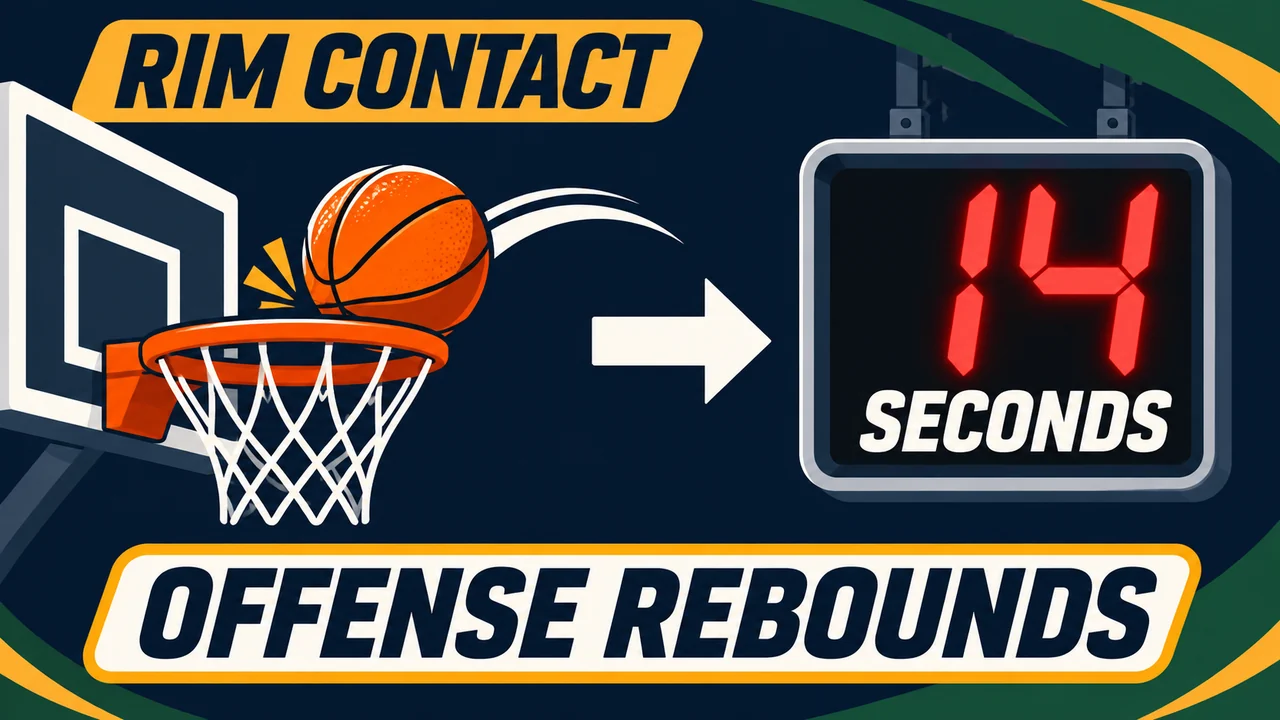
A shot misses, the attacking team gets the rebound, and the clock above the basket jumps to 14. In the NBA, that 14 can be the correct reset: an offensive rebound after a missed shot that touched the rim normally starts a 14-second shot clock. If the shot missed the rim altogether, however, the same team recovering the ball does not trigger that reset just because it got the rebound.
To follow the clock, watch the sequence in order: did the ball touch the rim, who gained possession, and why did the officials stop play? The examples below are invented and describe NBA rules; another competition may use different procedures. If the broadcast angle does not show the full sequence, wait for the officials’ ruling before drawing a conclusion.
Start with the shot and the rim
The NBA shot clock generally gives a team up to 24 seconds to attempt a field goal after gaining a new possession. On a missed field-goal attempt, whether the ball left the shooter's hand before time expired and contacted the rim can matter to the ruling and the subsequent clock. A made basket is a scoring event: do not mistake a clean shot through the basket for a missed attempt just because you did not see it touch the rim. See NBA Rule 7 and Rule 5 on scoring.
That distinction matters even before anyone rebounds. A shot can be in the air when the horn sounds, so the buzzer alone does not tell you the final ruling. Check when the ball left the shooter's hand and, for a miss, whether it reached the ring. Officials may also have to consider a foul or another event during the sequence.
The game clock is separate. It counts down the period; the shot clock governs the attacking opportunity. Neither display tells you by itself whether the ball hit the rim or which team established possession. For a historical example of how defense can leave an offense facing a late-clock shot, see the Celtics–Mavericks Finals defense analysis.
A missed shot, then an offensive rebound
Imagine Team A shoots with eight seconds on the shot clock. The ball strikes the rim, stays in play and is recovered first by Team A. The shot clock resets to 14 seconds. The same 14-second rule applies when the offense first gains possession after an unsuccessful free throw that remains in play.
Now change one detail. Team A's shot misses the rim entirely and a teammate collects it while the ball is live, time remains on the shot clock, and no other stoppage or violation has occurred. There is no rim-contact reset simply because the attacking team touched the ball again, so the existing shot clock continues. If too little time remains to release a valid attempt, the possession may end in a violation. A defensive touch that does not amount to possession also does not, on its own, start a fresh clock.
A broadcast may call both plays offensive rebounds, but only the first included rim contact. For clock purposes, that detail changes the outcome. If the video angle is inconclusive, do not infer contact from the new number alone; wait for the replay or official decision.
What if the other team gets the ball?
If Team B gains possession, the teams have changed roles. A change of possession ordinarily resets the clock to 24 seconds, subject to the game-clock situation discussed below. A defender touching or deflecting the ball is not automatically the same thing as gaining possession: the NBA rule distinguishes a defensive touch from the opposing team gaining possession.
Consider a pass deflected by a defender and then recovered by the original offense. If the defender never gained possession, do not treat the deflection as a turnover followed by a new possession. The remaining shot time can still matter. Watch for whether the officials judge that the defender actually gained possession. The NBA defines team control separately: it can end on a defensive deflection even when team possession does not change.
A frontcourt foul is a different kind of reset
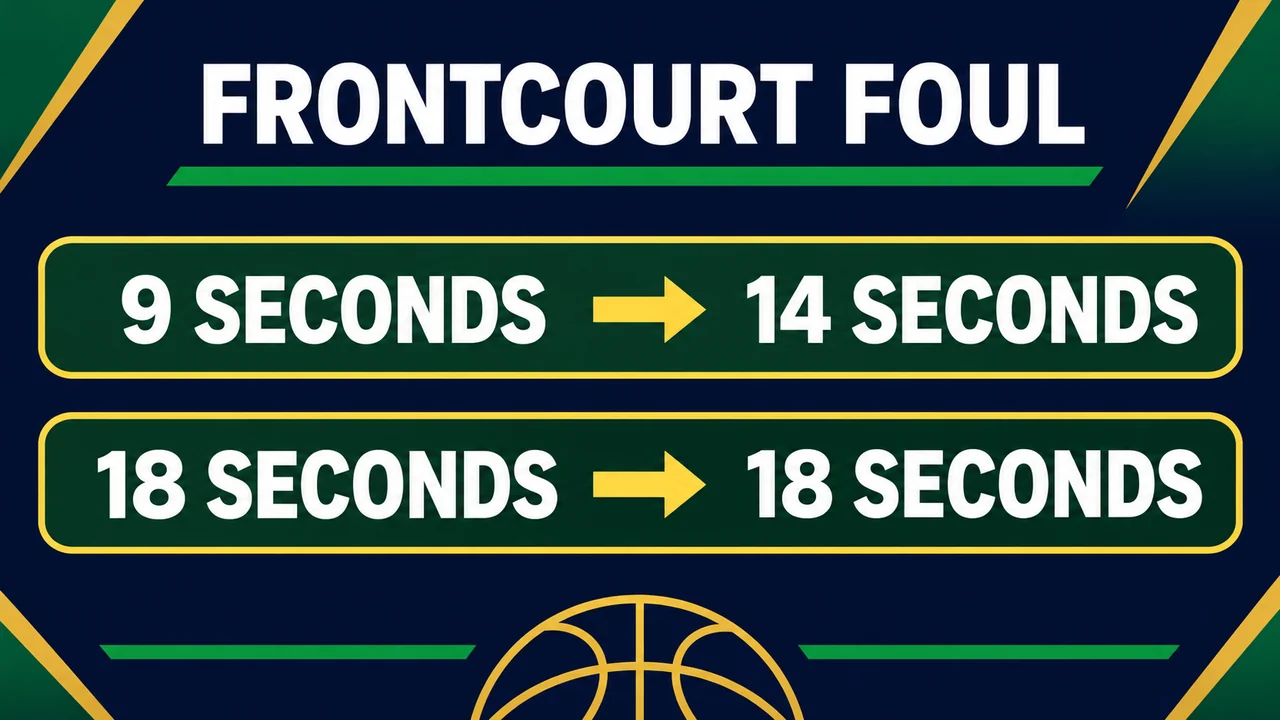
Suppose a defender commits a personal foul and the offense will inbound in its frontcourt. Under the ordinary frontcourt provision, the shot clock stays at the interrupted value or is set to 14 seconds, whichever is greater. If nine seconds remained, the display becomes 14. If 18 seconds remained, it stays at 18; it does not drop to 14 merely because a frontcourt foul occurred.
There is an exception to that frontcourt example. A defensive loose-ball foul in the sequence immediately after a qualifying miss that hit the rim has its own 14-second provision when the resulting inbound is in the frontcourt. A defensive foul resulting in a backcourt inbound falls under a different provision. Free throws, other foul classifications and unusual sequences also need the full rule and the officials' ruling. Do not apply the simple frontcourt example to every whistle.
| Situation in this example | What to look for | Shot-clock result |
|---|---|---|
| Miss hits rim; offense first gains possession | Rim contact and control | 14 seconds |
| Miss does not hit rim; offense recovers while time remains | Ball remains live, with no other stoppage or violation | Existing clock continues |
| Defense gains possession | Actual change of possession | Ordinarily 24 seconds |
| Ordinary defensive personal foul; frontcourt inbound at 9 | Foul type and inbound location | 14 seconds |
| Same frontcourt example at 18 | Foul type and inbound location | 18 seconds |
These are teaching examples, not a complete list of reset rules. In particular, out-of-bounds decisions and loose-ball fouls immediately after a rimmed miss can have their own provisions.
Why can the shot clock disappear near the end of a period?
When 24 seconds or less remain in a period, the NBA rule says the shot clock does not function following a change of possession. That does not mean timing rules cease to matter. A 14-second clock can be reactivated for the qualifying situations listed in Rule 7, including certain offensive rebounds after the ball contacts the rim. The game clock still determines when the period ends.
For example, a team with a new possession and 20 seconds left in the period may see no functioning shot-clock display. If it misses, the ball hits the rim and the offense first gains possession, check the remaining game time and the applicable 14-second provision rather than assuming a full 24-second display must appear. A close sequence may need an official clock adjustment.
A quick way to check the next confusing play
- Identify which clock you are watching and how much period time remains.
- For a missed field-goal attempt, look for contact with the rim; touching the backboard is not the same observation. A missed free throw that remains live has its own provision.
- Identify which team first gains possession after the ball is loose. A deflection does not necessarily mean the defender gains possession.
- If there is a whistle, identify the call and where the ensuing throw-in is awarded.
- Compare the sequence with the current NBA rule and allow for an official review or correction.
If a clip starts after the shot or cuts away before the ruling, the information may be incomplete. If you cannot see the full sequence, wait for the officials' ruling.
Common questions
Does every offensive rebound give the team 14 seconds?
No. For the ordinary missed-field-goal example, the shot must have contacted the rim before the offense first gains possession. A missed shot that does not touch the rim does not trigger that particular reset.
Does a defender tapping the ball reset the clock?
Not by itself. A defensive touch without the opponent gaining possession does not create a change of possession under the NBA rule.
Does a foul always reset the clock to 14?
No. In the ordinary defensive personal-foul example with a frontcourt inbound, the clock remains at its previous value or moves to 14, whichever is greater. Other foul and inbound circumstances may be governed by different provisions.
Is the game clock the same as the shot clock?
No. The game clock tracks the time remaining in a period. The shot clock limits the time for the offense to attempt a field goal, subject to the rules for resets and late-period display.
For a wider introduction to the league, read the NBA guide for Filipino fans. The official NBA shot-clock rule is the right place to check the full list and its exceptions. Rules and competition procedures can change.
By IPL Betting. Source and review: This guide was checked against the NBA rules linked above. The viewing scenarios are invented teaching examples, not accounts of actual games. The guide does not attempt to list every possible exception.
Promotional link. Gambling involves financial risk and may be restricted where you live. Participation is for eligible adults.