
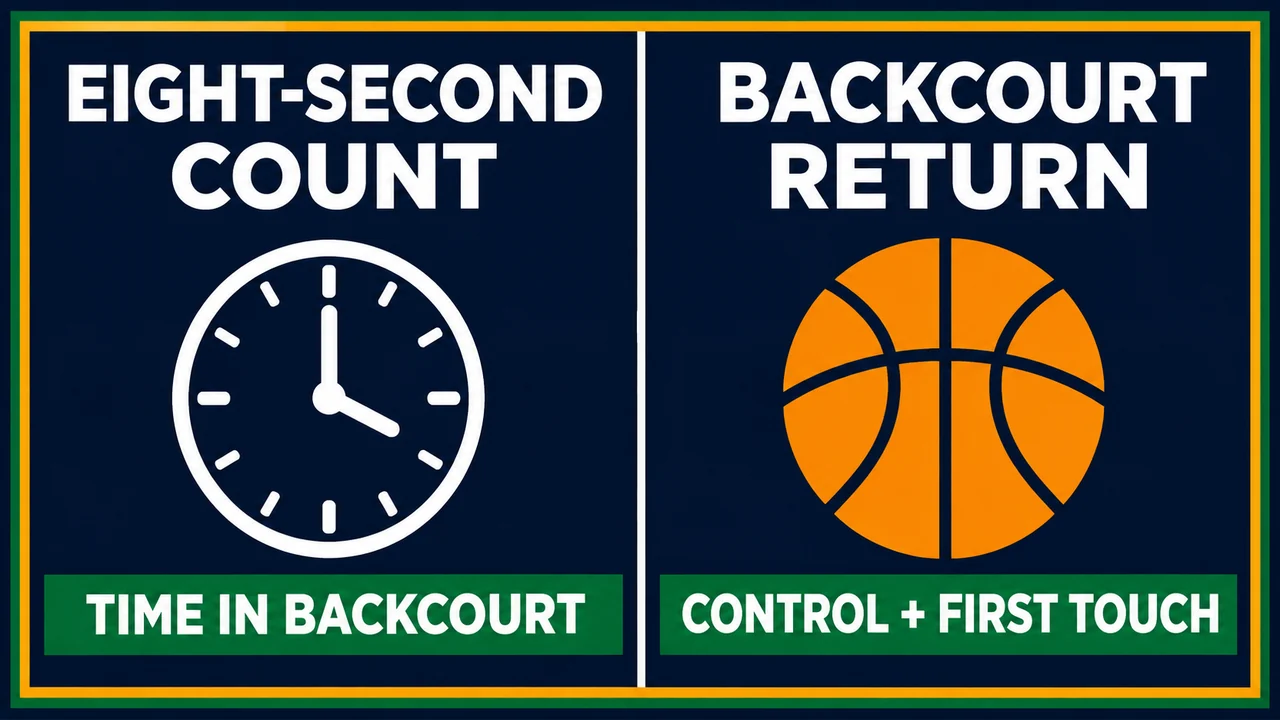
A team hears a whistle near half court and loses the ball. Did it take too long to advance, or did it bring the ball back after establishing control in the frontcourt? Those are different NBA violations, even though both can occur around the same line.
Start by asking when the team controlled the ball, where the ball and player were, and what the officials called. A tight crop may hide an earlier touch or a foot on the line. If it does, wait for the full sequence or ruling rather than deciding from one frame. The examples here are invented and concern NBA rules, not every basketball competition.
Two questions, not one
The eight-second rule concerns a team remaining in continuous possession of a ball in its backcourt for more than eight consecutive seconds. The backcourt-return rule concerns a player being the first to touch a ball that the player or a teammate caused to go from frontcourt to backcourt while the team controlled it. Both are addressed in NBA Rule 10, but they address different parts of an offensive possession.
Think of the first question as “How long has this team remained in its backcourt?” The second is “After frontcourt control, who caused the ball to go back and who touched it first?” Officials consider the details of the play, not just the direction in which someone runs.
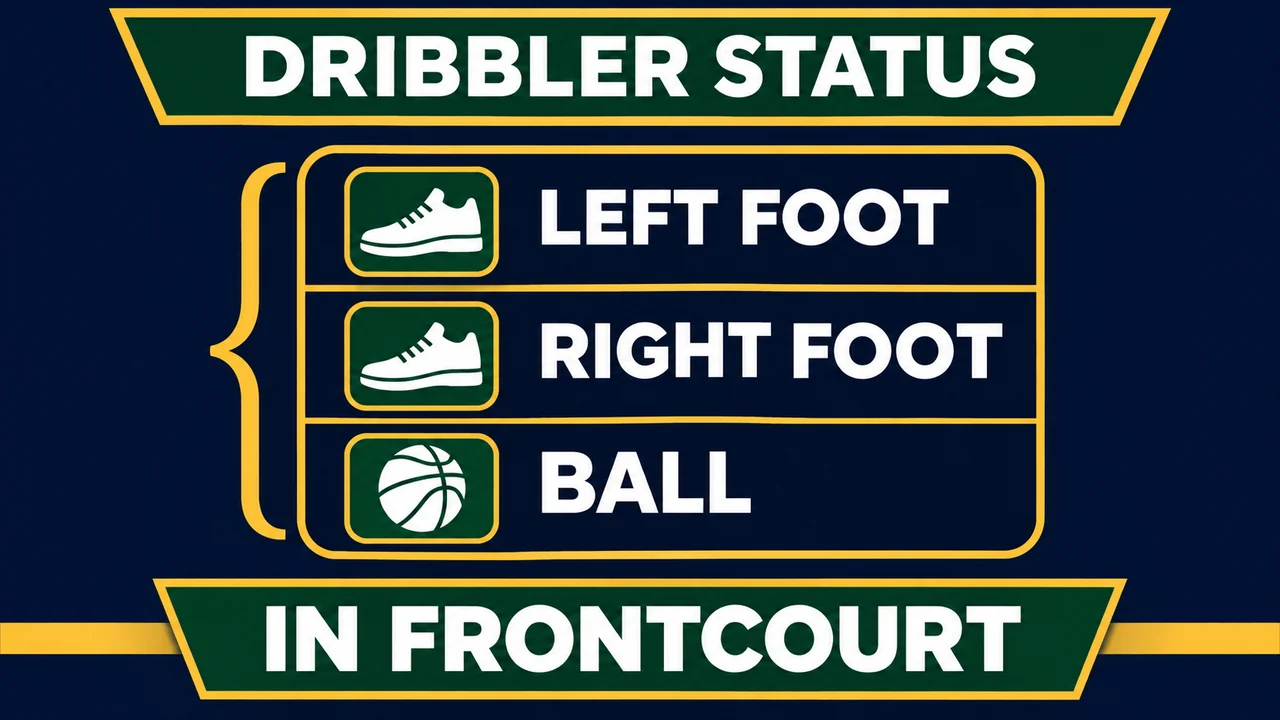
A team's frontcourt is the half containing the basket it attacks; its backcourt is the other half. Under NBA definitions the entire midcourt line is part of the backcourt. For a dribbler, the ball and both feet must be in the frontcourt to establish frontcourt status.
The eight-second count: advancing the possession
Imagine Team A gains possession in its backcourt and takes the ball up the floor. If it remains in continuous possession of a backcourt ball for more than eight consecutive seconds, the officials can call an eight-second violation. The penalty in the NBA rule is loss of the ball, with the opponents awarded a throw-in at midcourt.
Do not assume that any interruption starts a fresh eight seconds. The NBA rule lists specific circumstances that award a new count, including certain defensive actions such as a defensive personal or technical foul. Other situations are treated separately. The exact call matters more than a general impression that “the clock stopped.”
The shot clock and the eight-second count are related to the same possession but answer different questions. The shot clock limits the time for an attempt at the basket; the eight-second rule concerns continuous possession in the backcourt. A changed or partially used shot clock does not by itself reveal every fact needed to reconstruct the eight-second count.
Crossing half court: watch the player and the ball
For the dribbling example, the NBA's video rulebook explains frontcourt status in terms of both feet and the ball being in the frontcourt. That is more precise than saying “the ball crossed the line.”
Imagine a dribbler bounces the ball in front of the centre line while one foot remains behind it. Do not instantly assume that the player has established frontcourt status just because the ball appeared to cross first. The NBA provides a separate legal-play example where the player with the ball had not established frontcourt status before a pass back.
Now imagine both feet and the ball are in the frontcourt under the dribbler's control. If that player then causes the ball to return to the backcourt and is the first to touch it there, the situation can meet the backcourt-return rule. These examples concern a dribbler; a loose ball, a pass, a jump and a throw-in can require additional rules. Avoid extending a single footwork shortcut to every play.
Who caused the ball to go back?
The return rule is not simply “the ball went backwards.” It matters who caused the ball to go from frontcourt to backcourt while the team controlled it and which player touched it first after that. A routine pass by an offensive player from an established frontcourt position to a teammate in the backcourt is a clear situation to examine under the rule; the NBA provides an illustrated video example.
If a defender touches a pass, take care. NBA rules distinguish team control from team possession: a defensive deflection ends the former, but does not necessarily mean the defender has gained the latter. The direction of the ball and the identities of everyone who touched it may be obscured on television. Follow the officials' decision and consult the applicable rule rather than assume that any defensive touch automatically makes every return legal.
Three viewing situations
| What you see | First question | What remains uncertain |
|---|---|---|
| A team brings the ball up slowly | How long has it held continuous possession of a backcourt ball? | Whether an earlier event gave a new count |
| A dribbler reaches the centre line, then passes back | Were both feet and the ball in the frontcourt for the relevant dribbler? | The exact positions at the time of control and pass |
| The ball goes into the backcourt after a contested pass | Who caused it to go back, and who touched it first? | Control, deflection and any applicable exception |
Use these questions to follow the play; the officials make the call. A replay that starts after the original possession or ends before the whistle may omit the decisive event.
A practical replay checklist
- Find the centre line and identify which basket the team is attacking.
- Follow possession from the previous inbound, rebound or turnover instead of starting at the final whistle.
- Ask whether the official is considering elapsed backcourt time or a return from the frontcourt.
- For a dribbler near the line, check the positions of both feet and the ball. For other situations, consult the relevant rule rather than assuming identical footwork.
- Note defensive touches, who has possession, and whether team control ended. If the recording does not establish who caused the return, leave the play unresolved.
Common questions
Is an eight-second violation the same as returning the ball to the backcourt?
No. The first concerns the time spent in continuous possession of a backcourt ball. The second concerns a return from the frontcourt and the first touch, under the conditions in the rule.
Does the ball crossing the line automatically establish frontcourt status for a dribbler?
No. In the NBA's dribbler example, both feet and the ball must be in the frontcourt to establish that status. A still image of the ball alone may not show enough.
Does every whistle reset the eight-second count?
No. The NBA rule lists particular events that award a new count. Identify the officials' call and check the applicable provision.
Can a defender touch the ball without taking possession?
Yes. Under the NBA definition, a defensive deflection ends the offense's team control even if the defender never gains possession. For a disputed return, the complete sequence and the officials' ruling matter.
For the league's structure and a broader introduction, see our NBA guide for Filipino fans. For a specific play, use the NBA rulebook and its video explanations; competition rules can change.
By IPL Betting. Source and review: This guide uses the linked NBA rules and video-rulebook descriptions. The scenarios are invented teaching examples, not match reports, and do not cover every exception.
Promotional link. Gambling involves financial risk and may be restricted where you live. Participation is for eligible adults.