
A defender makes contact, the whistle sounds and the officials go to the monitor. When they return, the broadcast announces a flagrant 1. That announcement tells you more than a slow-motion clip alone: the officials have classified the contact and the game must be administered accordingly. If the call is unclear, wait for the officials’ ruling before drawing a conclusion.
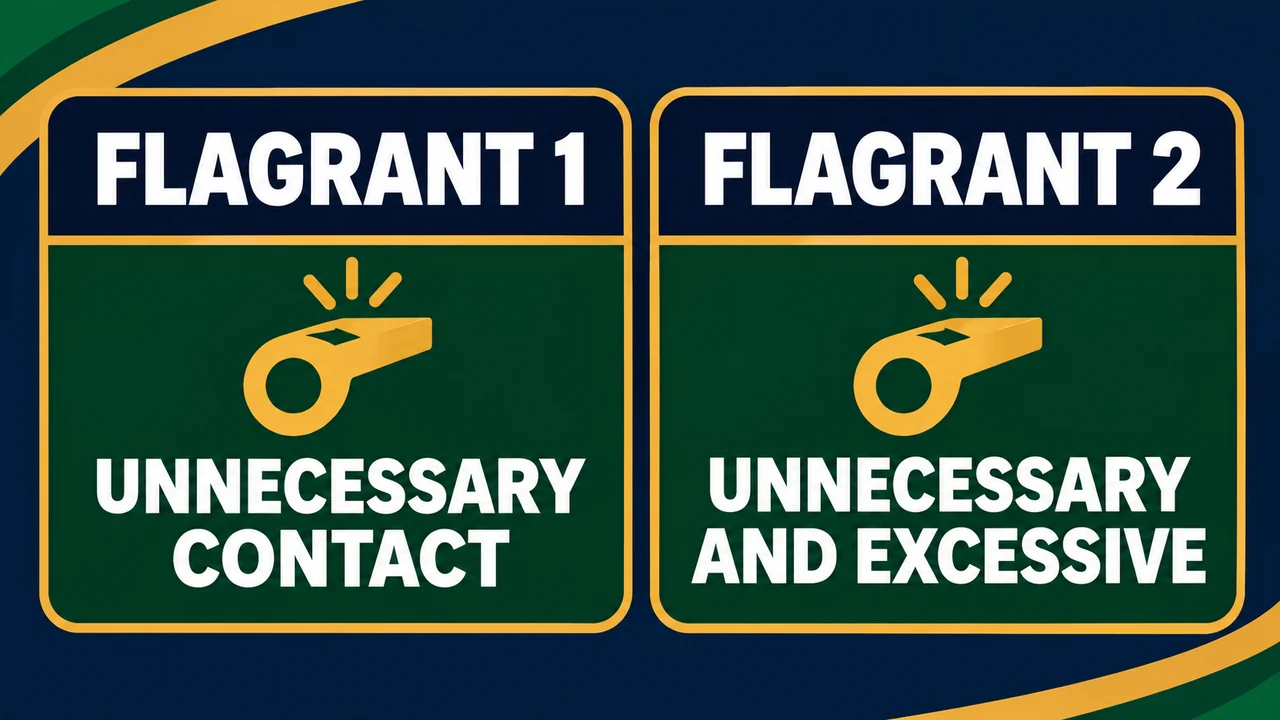
In NBA terminology, a flagrant 1 involves contact judged unnecessary; a flagrant 2 involves contact judged both unnecessary and excessive. A technical foul can address conduct or another rule violation; a common personal foul generally concerns illegal contact during live play. These labels are not all mutually exclusive: the NBA also charges a personal foul to a player assessed a flagrant. The examples below are invented, and the officials make the ruling on an actual play.
First listen for the foul that was called
The NBA's definitions describe a common personal foul as illegal physical contact with an opponent while the ball is live, subject to the rule's timing exception. The result depends on the circumstances: a shooting foul, an offensive foul, the team-foul situation and other details can lead to different administration. A whistle for contact does not automatically tell you how many free throws will follow.
A technical foul can concern unsportsmanlike conduct, but that is not its only use. NBA Rule 12 also identifies certain technicals that are not considered unsportsmanlike, including some delay-of-game and defensive three-second situations. Hearing “technical” alone does not establish that a player insulted an official or started an argument.
Suppose officials call a common foul away from a shot. Check the team-foul count and the restart before assuming free throws will follow. The answer can depend on facts the camera did not show.
Flagrant 1 and flagrant 2: the distinction
NBA Rule 12 describes a flagrant 1 as contact judged unnecessary. For a flagrant 2, the contact must be judged unnecessary and excessive. The difference is not a viewer's estimate of a player's intent or a simple test of whether someone fell. Officials assess the play under the rule and its guidance.
For the ordinary flagrant provisions in Rule 12, two free throws are attempted and the offended team receives the ball, with further details and exceptions in the rule. A flagrant 1 does not automatically mean ejection on its own. A second flagrant 1 in the same game results in ejection; a flagrant 2 results in ejection on its own. Check the official ruling and the exact circumstances rather than assuming every foul that looks serious has the same consequence.
Both flagrant categories are charged as personal fouls to the offender and team fouls to the team. This is why a flagrant is not simply a third category standing outside every personal-foul record. It also explains why the broadcast may discuss the player-foul total and the flagrant classification at the same stoppage.
| Announced ruling in an invented example | Main question for a viewer | What the label does not establish by itself |
|---|---|---|
| Common personal foul | What happened, and was the player shooting? | That free throws must always follow |
| Technical foul | Which conduct or rule violation was called? | That the technical was necessarily unsportsmanlike |
| Flagrant 1 | Did officials classify the contact as unnecessary? | That the player intended to injure an opponent |
| Flagrant 2 | Did officials classify the contact as unnecessary and excessive? | The player's unverified motive |
Use the table to follow an announced call. A short clip cannot replace the officials' ruling or the full rulebook.
Why officials review a foul
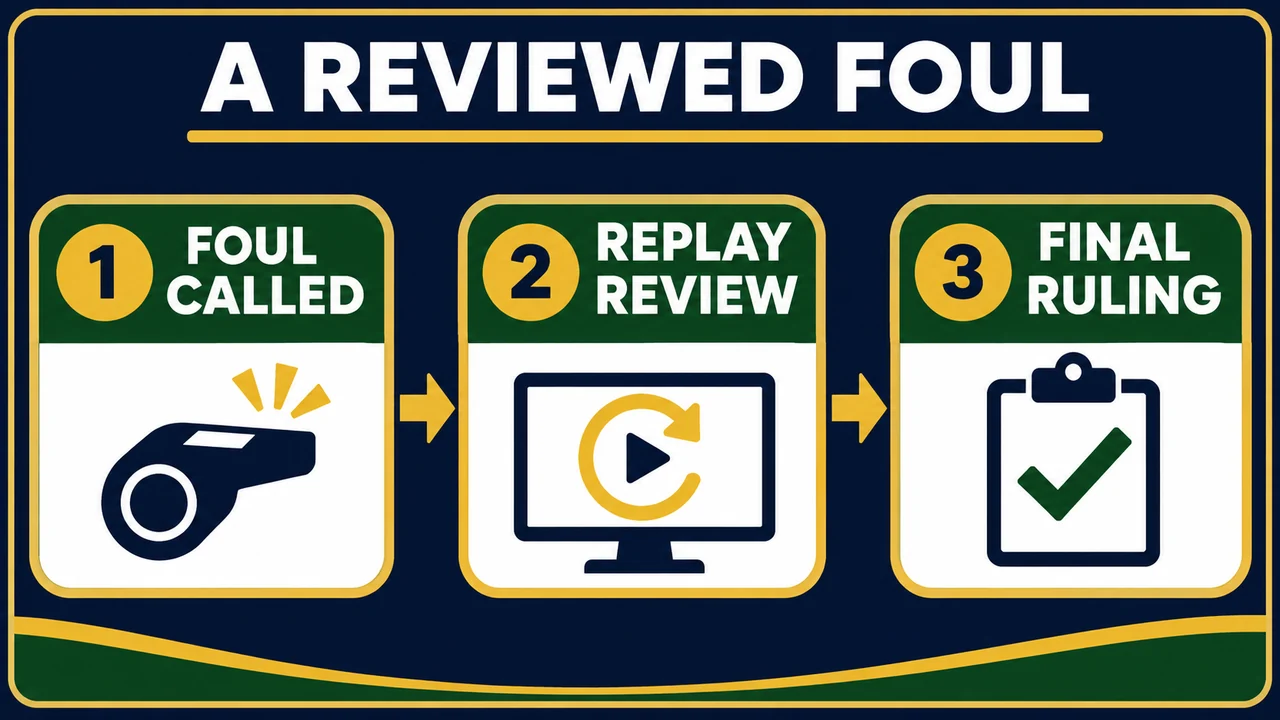
The NBA replay explanation says officials may review a called foul when they are not reasonably certain whether it meets flagrant criteria. The review can leave the original personal foul in place or result in a flagrant 1, flagrant 2 or technical ruling. Rule 12 states that a foul must be reviewed to confirm a flagrant classification.
Suppose a broadcast first says “personal foul” and later reports “flagrant 1.” Do not record that as two separate contact incidents merely because the description changed. Follow the final announcement and the administration: the initial call can be reviewed and its classification changed. If there are separate incidents or additional fouls, the officials' explanation and game record matter.
The league's comments on the rules discuss factors officials consider, including the severity of contact and whether the player made a legitimate basketball play. Those factors require judgment. A single camera angle, the loudness of the crowd or the fact that a player was hurt cannot, alone, settle the classification.
Technical does not always mean the same thing
Imagine a team is assessed a technical during a stoppage. It is tempting to decide that the coach's reaction caused it, but a broadcast may show the coach while the actual call concerns another player or a different violation. Wait for the official announcement or game record before assigning responsibility.
Rule 12 specifies one free-throw attempt when one technical foul is assessed, but double technicals and other special situations have separate provisions. This guide does not try to enumerate all combinations. If a broadcast's free throws and possession seem unusual, look for the complete set of fouls and the order in which officials administered them.
A short checklist while watching
- Identify the final announced call and which participant was charged.
- Separate a foul on the play from an additional technical, if one was actually assessed.
- Check whether the play was reviewed and whether the original description changed.
- Watch how officials administer the free throws and possession, then check the foul totals. A cropped clip may omit part of the ruling.
- If the call or prior incident is not visible, leave the classification unresolved until an official source confirms it.
Common questions
Is every hard foul flagrant?
No. The NBA's flagrant criteria concern contact judged unnecessary, or unnecessary and excessive. Officials assess the circumstances; a forceful-looking replay is not a complete ruling.
Is a flagrant foul also a personal foul?
Under NBA Rule 12, a personal foul is charged to the offender and a team foul to the team for a flagrant 1 or 2.
Does a flagrant 2 mean ejection?
Yes, the NBA's flagrant 2 provision calls for the offender's ejection. The final official classification matters; a proposed review is not itself the final ruling.
Are all technical fouls for unsportsmanlike conduct?
No. The rule identifies some technical fouls that are not considered unsportsmanlike. Look for the actual reason announced by the officials.
For more on the league, see the NBA guide for Filipino fans. For a particular incident, use the current NBA fouls and penalties rule and the officials' final decision.
By IPL Betting. Source and review: This guide uses the linked NBA rules and replay explanation. The scenarios are invented teaching examples rather than reports of actual games; special cases and rule changes require the applicable current rules.
Promotional link. Gambling involves financial risk and may be restricted where you live. Participation is for eligible adults.