
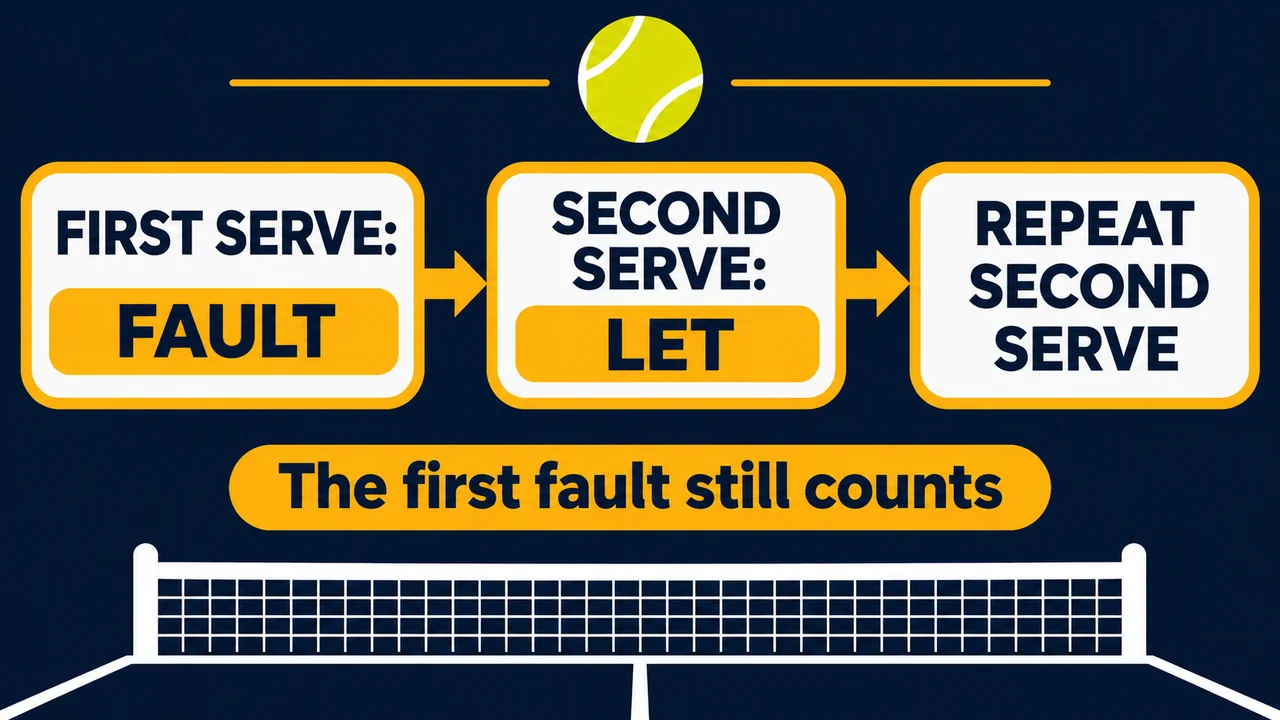
A serve clips the net and lands in the correct service box. Under the standard ITF rules, that service is a let and is served again; it is not automatically a fault or a lost point. But if it was the second serve after an earlier fault, the earlier fault still counts. If the broadcast does not show what happened before the net contact, wait for the official call before deciding which serve comes next.
This guide uses the 2026 ITF Rules of Tennis, particularly Rules 17–24. Examples are invented. Some events adopt authorised alternatives, so the competition's rules matter.
First serve, fault, second serve
The server starts a point with a first service. In the ordinary case, the serve must pass over the net and land in the diagonally opposite service court before the receiver returns it. A receiver who returns it before it bounces loses the point; separate service-let rules can apply. If the first service is a fault, the server normally has a second service from behind the same half of the court, unless the first was served from the wrong half.
For example, imagine Alex serves and the ball lands beyond the correct service box. The first service is a fault. Alex then serves again from the same half, following the rules for the second service. A second fault on that point means Alex loses the point; this is commonly called a double fault.
The server does not lose the point merely because the first service was a fault. After the first fault, a good second serve keeps the point in play unless another rule ends it.
What makes a service a fault?
A serve that lands outside the correct service court is a familiar fault, but it is not the only one. Other rules apply if the receiver touches or returns the ball before it bounces. Rule 19 includes violations of the service rules, missing the ball when attempting to hit it, certain contact with a permanent fixture or net post before the ball hits the ground, and the ball touching the server or the server's partner or their equipment.
A foot fault is another service fault. During the service motion, for example, the server must not touch the baseline or court with either foot. The rule contains further position and movement restrictions; a camera angle may not establish whether a foot touched the line at the relevant time. Officials make the call.
There is a distinction between missing a ball while trying to hit it and deciding not to hit a toss. The ITF's Rule 19 example says a player who decides not to hit a tossed ball can catch it or let it bounce; that alone is not a service fault.
A service let repeats that service
Under Rule 22, a service is a let if it touches the net, strap or band and is otherwise good. A service can also be a let when the receiver was not ready. Under Rule 21, a receiver who attempts to return the serve is considered ready. The particular service does not count and is taken again.
Return to the invented example. Alex's first service was a fault. The second clips the net and lands in the correct service court, and the official calls a service let. Alex takes the second service again. The let does not erase the earlier first-service fault. If the repeated second service is good, play continues; if it is a fault, Alex loses the point.
Net contact on a serve is not by itself enough to determine the outcome. If the ball clips the net and then lands outside the correct service court, it is not “otherwise good”. Follow the officials' call and the complete sequence rather than assuming every net touch is a let.
| Invented sequence | Immediate result | What comes next |
|---|---|---|
| First service is a fault | First fault | Second service |
| First fault, then second service is a let | The let service does not count | Second service is repeated |
| First fault, then second service is a fault | Two consecutive faults | Server loses the point |
| First service is a let | That service does not count | First service is repeated |
These rows describe service lets under the standard method. They do not cover every kind of let during a point.
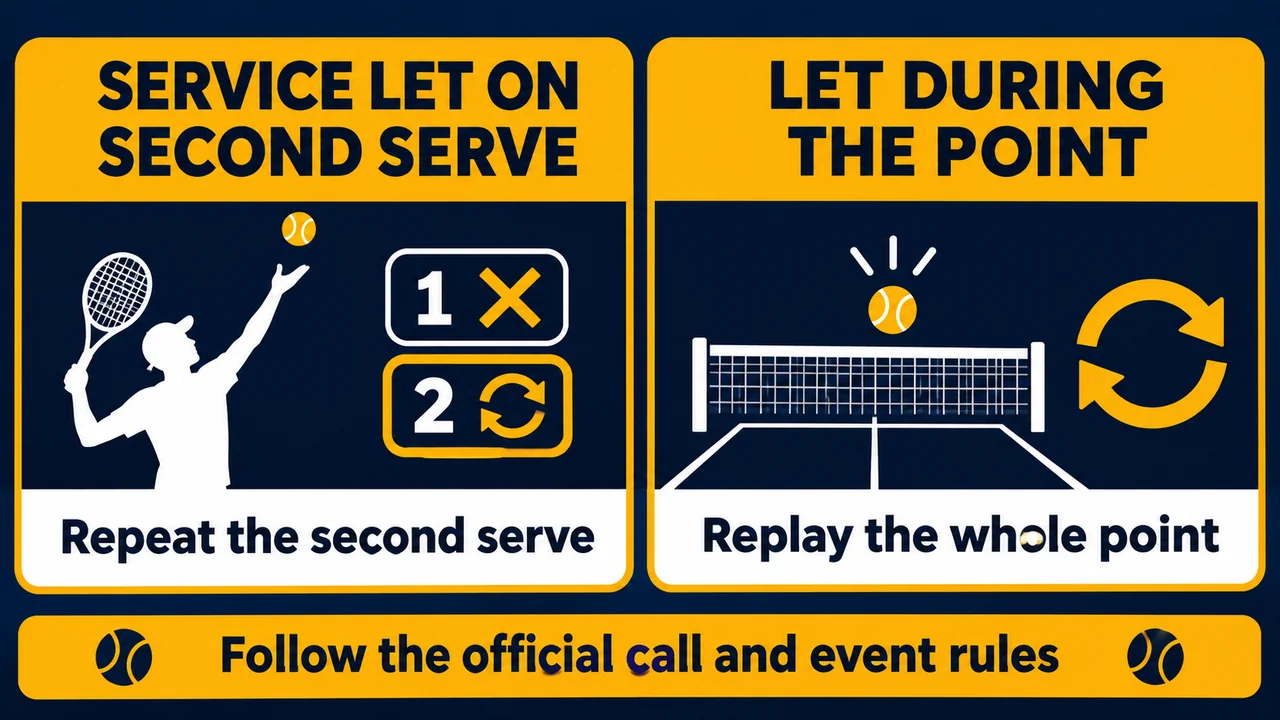
A let during the point is a different situation
Suppose a first-service fault has occurred, the second serve is good, and another ball rolls onto the court while the point is being played. If a let is called for that interruption, the ITF example under Rule 23 says the whole point is replayed and the server is entitled to a first service. That differs from a service let on the second service, which does not cancel the first fault.
The call and the timing decide which service comes next. A short highlight may show only the interruption, omitting whether play had already begun or which serve was being taken. Check the full sequence before deciding how many serves remain.
Check the event's format
The ITF rules list authorised alternatives, including a no-let service procedure in which play may continue after a serve touches the net, strap or band if it is otherwise good. An event may use a different approved procedure; the name of a tournament or a clip alone is not enough to establish which one is in force.
If you are following a betting market, a stream can lag behind the official point record, and settlement follows the operator's accepted terms. If the score, call or terms are unclear, pause and check the official record and the relevant market rules.
A quick checklist
- Identify whether the server was taking a first or second service.
- Listen for the official call and check whether the ball landed in the correct service court.
- Distinguish a service fault from a service let and from a let called during the point.
- After a second-service let, remember that an earlier first fault remains.
- Check the event's rules before assuming that its service-let procedure is standard.
Common questions
Is a serve that touches the net always a fault?
No. Under the standard rule, a serve that touches the net and is otherwise good is a service let. A serve touching the net and landing outside the correct service court is not an otherwise-good service let.
Does a second-service let give the server two serves again?
No. A service let does not cancel the earlier first fault, so that second service is taken again. A separate let during a point can have a different result.
Does catching a bad toss count as a fault?
Not merely because the player decided not to hit the tossed ball and caught it or allowed it to bounce. Missing the ball while attempting to hit it is a different case under the service-fault rule.
Does every tournament use the same let procedure?
No. The ITF rules provide approved alternatives. Check the event's regulations before applying the standard service-let procedure to a particular match.
For more coverage, visit the tennis section. The ITF 2026 Rules of Tennis provide the full wording and examples; the event's applicable regulations and officials' decision govern the actual match.
By IPL Betting. Source and review: This guide uses ITF Rules 17–24 and the listed alternative procedures. The Alex example is invented for explanation and is not a real match record.
Promotional link. Gambling involves financial risk and may be restricted where you live. Participation is for eligible adults.