
Published by IPL Betting. Sources checked on 11 September 2026; examples are illustrative.
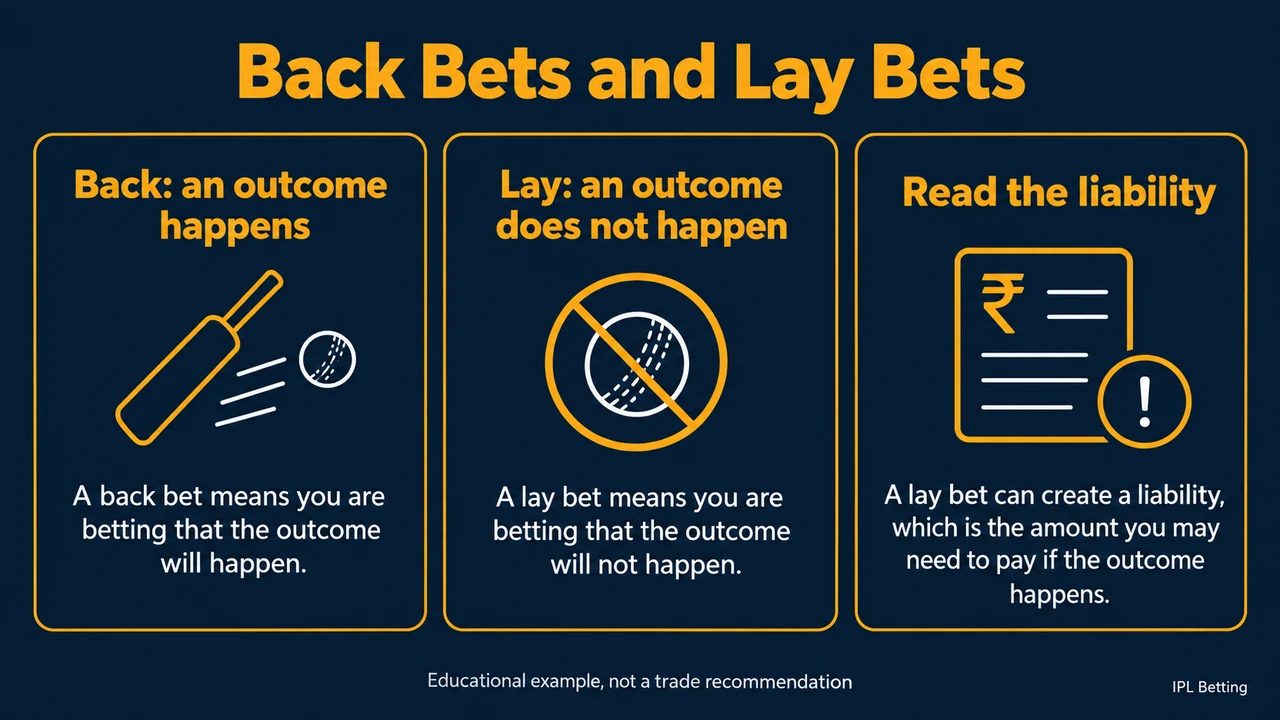
On an exchange, a lay stake of 10 can expose you to a loss much larger than 10. At decimal odds of 6.00, that stake carries liability of 50. The stake and the maximum loss describe different sides of the same transaction, so do not read the lay stake as the most you could lose.
This is an explanation of the interface and arithmetic, not an invitation to trade. Operator examples below refer to Betfair’s published help. They do not establish that any exchange is available or lawful for a reader’s location.
Back and lay describe opposing outcomes
The Betfair Exchange introduction explains a back bet as supporting an outcome and a lay bet as opposing it. It also distinguishes accepted, matched amounts from unmatched requests. A matched bet cannot simply be cancelled; an unmatched amount has not yet found the other side. Always identify the exact market before translating “does not win” into possible results.
For example, laying a team in a three-outcome match-winner market means opposing that team’s win under the market definition. Do not silently replace that with backing its opponent: a draw or tie category can make the propositions different. Cricket settlement wording needs particular care around a tied match and subsequent tie-break play.
Calculate the liability before reading the possible win
For a plain lay bet, the illustrative liability formula is backer’s stake × (decimal odds − 1). Suppose the backer’s stake is 10 and odds are 6.00. If the selection wins, the layer pays 50. If it loses, the layer’s gross gain is 10 before charges. The layer does not win 60.
| Hypothetical lay odds | Backer’s stake | Layer’s liability |
|---|---|---|
| 2.00 | 10 | 10 |
| 4.00 | 10 | 30 |
| 6.00 | 10 | 50 |
The rows hold the stake constant. Liability grows as the odds increase because the layer is covering a larger possible profit owed to the backer. A visually larger price is therefore not automatically more attractive to someone laying. Which side of the market you are reading matters.
For comparison, a back stake of 10 at 6.00 has a normal winning total return of 60, including the stake, and a losing cost of 10. The backer’s possible profit of 50 is the layer’s liability. That connection is a useful check on the arithmetic.
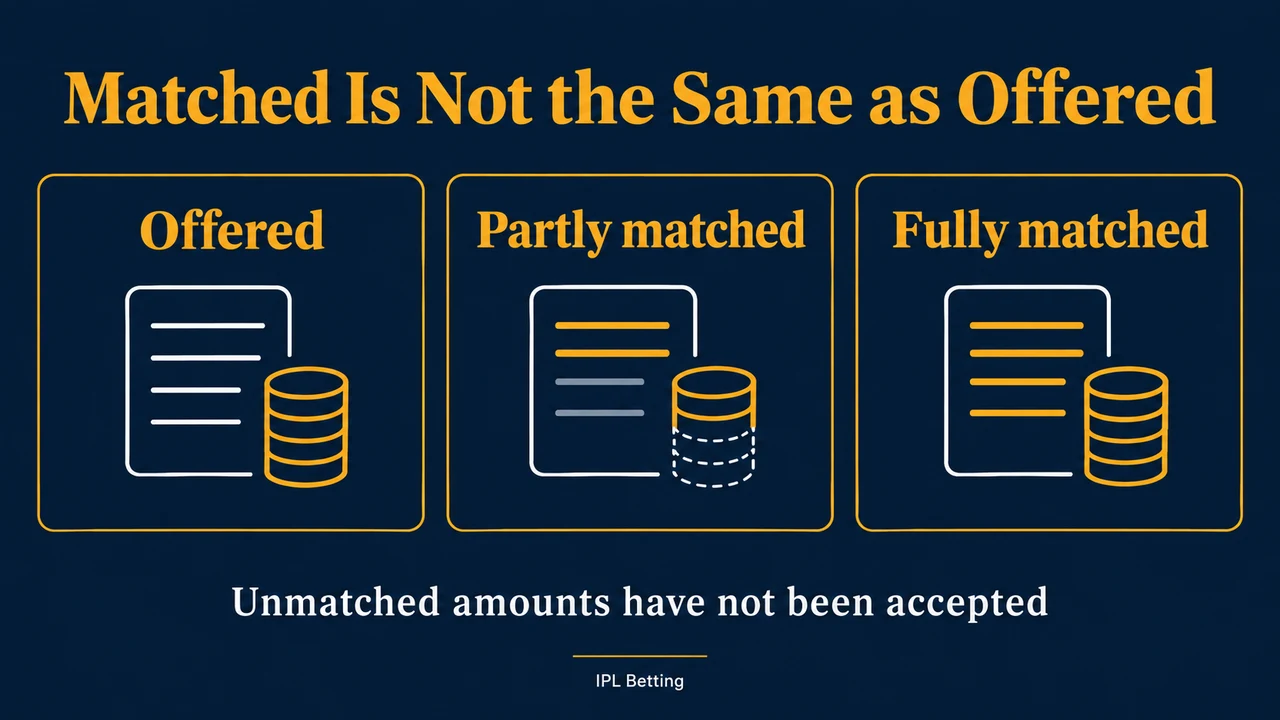
Only the matched amount has been accepted
Imagine a request to back 20 at 3.00. Only 8 is matched at that price. The remaining 12 is still unmatched. If the matched part wins under ordinary settlement, it returns 24; if it loses, that part loses 8. The request for 20 does not establish that all 20 was accepted.
Now suppose the remaining 12 is later matched at a separately accepted price of 2.80. Its winning return is 33.60, giving a combined 57.60 across both portions. You cannot use 20 × 3.00 = 60 once the receipt records two prices. Keep each matched amount with its own odds.
These are invented transactions to explain the ledger, not instructions to seek a particular price. Read the account’s current matched and unmatched fields before making another request. Available amounts can change, and a screenshot of a quoted price does not prove that your requested size was accepted.
Cancellation and closing are different
Cancelling the unmatched 12 in the first example would remove only that pending request. It would not cancel the already matched 8. An opposing transaction is a new transaction with its own acceptance, price, and charges; it should not be treated as an undo button.
Check what the selected persistence setting does when a market turns in-play or suspends. Do not leave an unmatched instruction active just because no money has yet been settled on it. If the status is unclear, resolve the account record before assuming that no exposure exists.
Commission changes the comparison
The Betfair charges schedule describes commission on net winnings in an Exchange market for most customers and also lists other possible charges. There is no universal rate to insert for every account. Use the applicable schedule and product, rather than a rate quoted in an old tutorial.
For a purely hypothetical commission calculation, suppose a market has a net gain of 40 and the applicable rate is 5%, with no other charges. Commission would be 2 and the resulting gain 38. The 5% here is an arithmetic assumption, not a current Betfair rate or an offer.
Compare like with like: the same outcome, settlement rules, matched size, and amount after applicable charges. A headline exchange price and a Sportsbook price cannot be meaningfully compared if one includes a different tie outcome or is available for only a fraction of the intended amount.
Check the maximum loss and any pending requests
Before treating an exchange screen as understood, state the maximum loss in plain numbers. For the 10 lay at 6.00, that number is 50. Then identify any remaining unmatched requests and the charge basis. If the screen cannot be reconciled with those three facts, stop and seek an explanation rather than testing it with real money.
Questions readers ask
How much can a 10 lay stake at 6.00 lose?
The plain-bet liability is 10 × (6.00 − 1) = 50. That is the layer’s maximum loss in the example, before considering any separate transactions or exceptional settlement rules.
Does cancelling the unmatched part cancel the whole bet?
No. The already matched portion remains accepted. In the example, cancelling the pending 12 does not remove the matched 8. Check each portion in the transaction record.
Should I deduct commission from every winning selection?
Use the applicable charging basis. The cited Exchange schedule describes commission on net market winnings for most customers, which differs from charging each winning selection in isolation. Do not assume the example’s 5% rate applies to your account.
Related reading
How to Read IPL Betting Odds: Prices, Movement, and Match-Day Checks; How Bookmakers Calculate IPL Odds: Margin, Price Moves, and Match Context; IPL Betting Odds Comparison Checklist: Market, Line, Price, and Settlement Terms.