
Published by IPL Betting. Sources checked on 11 September 2026; examples are illustrative.
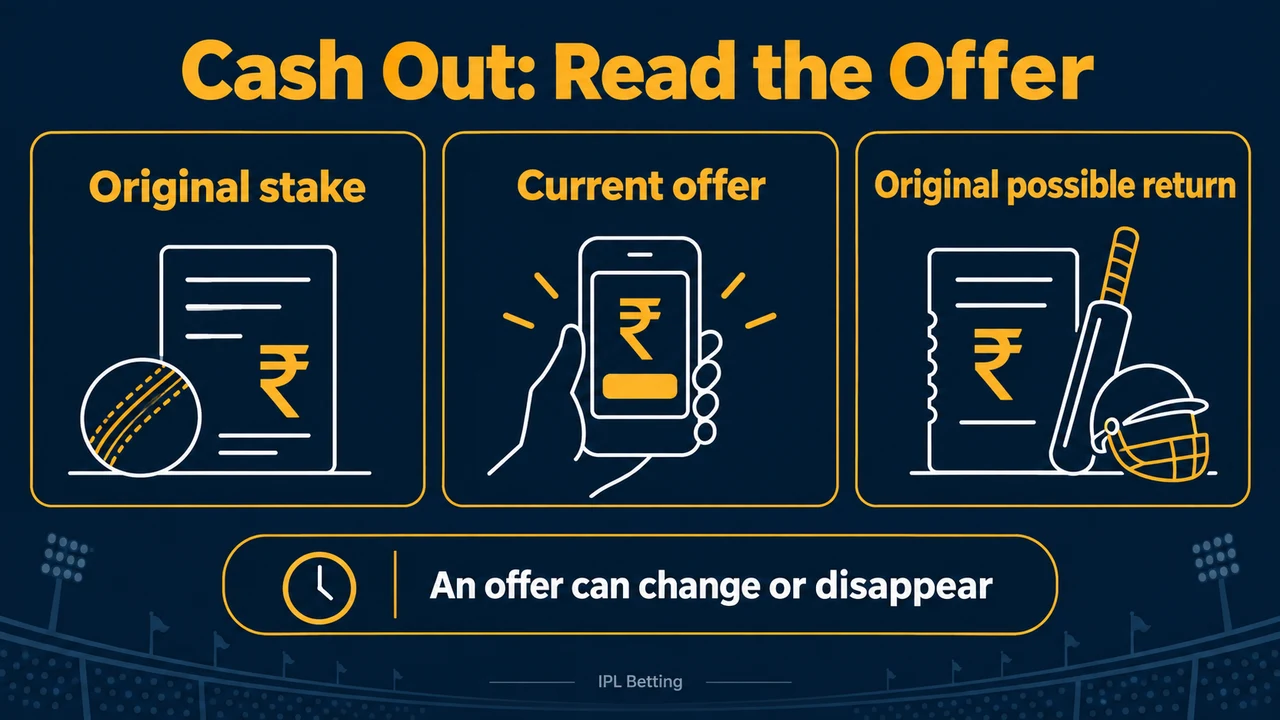
A cash-out button showing 24 does not necessarily mean a profit of 24. If the original stake was 20 and the offer includes that stake, accepting it returns 24 in total: a gain of 4. Check whether the figure includes your stake before treating it as profit.
Cash out is a proposed change to an existing bet. The useful questions are what amount would be credited, what part of the original bet would remain, and whether the request has actually succeeded. A number on the screen is an offer, not a completed account transaction.
Keep three numbers separate
Use a hypothetical cash-funded single with a stake of 20 at decimal odds of 3.00. Its normal winning return would be 60, including the stake, and its normal losing return would be zero. Suppose a full cash-out offer of 24 appears. These are three different outcomes for the same original 20, not three amounts you can add together.
| Outcome in this example | Total credited | Net against original 20 |
|---|---|---|
| Normal win | 60 | +40 |
| Accepted full cash out | 24 | +4 |
| Normal loss | 0 | −20 |
If the offer were 12 instead, the net result would be a loss of 8. Seeing money arrive in the account does not make the original bet profitable. Equally, the possible 60 was conditional on winning; it was never an account balance that you already owned.
What Betfair’s cash-out rules say
Under Betfair’s Sportsbook cash-out rules, the displayed return includes the relevant stake, success must be confirmed, and availability is not guaranteed. Partial cash out settles only part of a bet. The rules also allow corrections for settlement errors. This is a product-specific mechanism example, not an endorsement or a statement that the service is available where you live.
For another provider, start from its own wording. Look for “total return,” “profit,” and “remaining stake,” then check the account receipt. Similar-looking buttons can describe different products. Exchange cash out, for example, should not automatically be read as a Sportsbook settlement promise.
Partial cash out leaves two pieces to track
Imagine the same 20 stake at 3.00. For illustration only, suppose the provider settles half the stake for a credit of 12 and leaves a 10 stake open at the original odds. If that remaining portion wins, it returns 30, making the combined credit 42 and the net gain 22. If it loses, the combined credit stays at 12 and the net loss is 8.
The two possible totals are why “I cashed out” is an incomplete description after a partial settlement. Record the amount already credited and the exact remaining exposure. Do not assume a slider percentage maps to the original stake in the same way on every interface; use the confirmation details.
The price of ending the uncertainty
Accepting a full offer replaces the original unresolved outcome with the accepted settlement, subject to the terms. The difference between the possible winning return and the offer is not automatically a fee. In the example, 60 minus 24 equals 36, but the original bet could also have returned nothing. Treating the 36 as a guaranteed amount surrendered would misdescribe the choice.
Nor can the offer itself prove the true chance of winning. A displayed price is a commercial quote, not an independent probability assessment. Without a justified probability and the full terms, you cannot conclude that the offer is fair merely because it is above the initial stake or has risen since the last ball.
You may want to stop watching the price. That preference does not tell you whether the offer is good value. Keeping those two reasons separate prevents an emotional preference from being presented as a calculation.
A tap is not the receipt
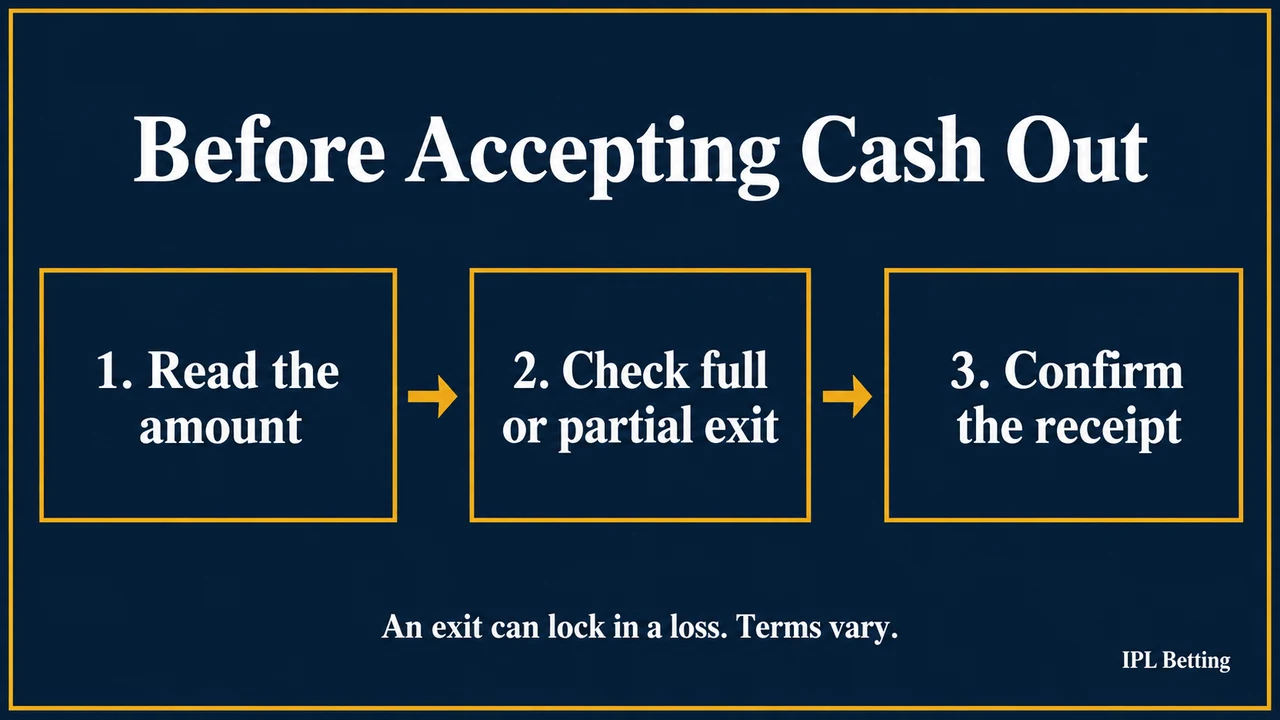
Suppose the screen shows 24, you tap, and a wicket falls while the request is processing. If the interface reports failure, do not enter 24 as settled money in your records. Check the open-bet screen and transaction history. If they disagree, save both views with times and ask support which portion remains active.
Avoid repeated taps while a request is unresolved. They make it harder to reconstruct what happened. A useful record contains the original bet reference, offered amount, request time, response message, and credited amount. A screenshot of the offer alone cannot show that it was accepted.
Before relying on the feature
Read what happens to promotional eligibility, partially settled stakes, and later corrections. Plan any spending limit on the possibility that the bet remains open and loses its full stake. A feature that may be unavailable cannot be the foundation of an affordability limit.
If monitoring the offer becomes a reason to keep gambling or to place another bet after an early loss, step away from the market. Cash out changes a ticket; it does not make repeated betting less costly or remove the possibility of loss. You do not need another wager to justify the result of the first one.
Questions readers ask
Does a cash-out offer of 24 mean I made 24?
Not if it is a total return including a 20 stake. In that example the net gain is 4. Check the product’s display definition and the actual credited transaction.
What happens if I tap cash out and it fails?
Do not record the offered amount as received. Check the open ticket and transaction history for the confirmed state. Save the response if those records disagree and ask support which part remains open.
Can a partial cash out still leave me with a loss?
Yes. In the worked example, 12 is credited and a 10 stake remains open. If that remaining part loses, the total credit is still 12 against the original 20, a net loss of 8.
Related reading
IPL Live Betting Guide: Triggers, Tempo, and Wickets-in-Hand Checks; IPL Betting Bankroll Management: Match Limits, Live Caps, and Season Discipline; IPL Betting Odds Comparison Checklist: Market, Line, Price, and Settlement Terms.