
A defender can block a shot while it is still rising, provided no other basket-interference rule has already made the touch illegal. Once a shot is descending with an opportunity to score, touching it is goaltending. A ball above the rim and inside the imaginary cylinder, or a shot with a chance to score after certain backboard contact, is also protected. Who commits the violation determines whether points are awarded or the other team gets the ball.
These are the NBA’s rules, not a universal guide to every basketball competition. The descriptions below follow NBA Rule 11, as available when checked on 20 November 2026. Each example is hypothetical; on a real play, the officials must judge the ball’s position, flight and chance to score.
When does a block become goaltending?
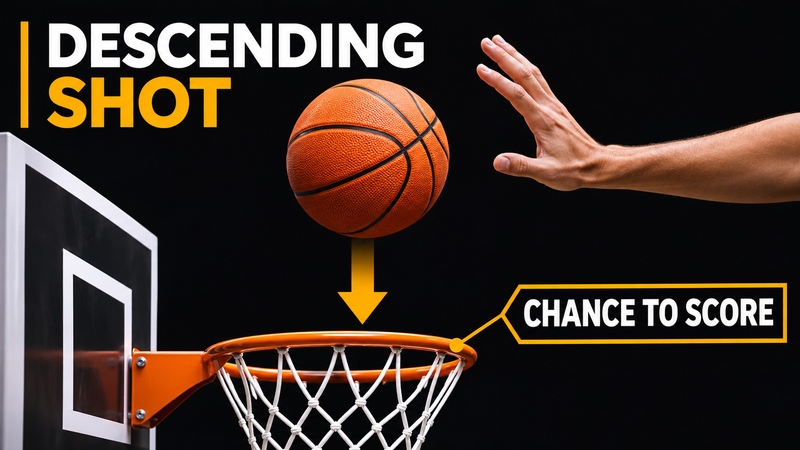
Start with the shot’s flight. Rule 11 prohibits a player from touching a ball on its downward flight when it has an opportunity to score. The rule applies to a player from either team: an offensive player cannot rescue a descending shot headed towards the basket by touching it, either.
Imagine a two-point attempt that has reached its peak and is falling towards the hoop. A defender reaches it before it hits the rim, but the ball still has an opportunity to score. The touch is a violation at the opponent’s basket: the shooting team is awarded two points. The ball does not actually have to go through the net for those points to count.
Now change the timing. The same defender contacts the ball on its upward flight, outside the cylinder and before the relevant backboard contact. If no other rule is breached, that timing can make the block legal. “Still rising” is a useful first check, not a free pass to touch any ball near the basket.
The chance to score matters. A ball descending well away from the basket with no opportunity to score is not automatically a goaltending violation under the downward-flight provision. A brief replay may not provide the angle needed to establish that chance, so avoid treating a freeze-frame alone as the official ruling.
Does the ball have to touch the rim first?
No. A descending shot with an opportunity to score can be protected before it reaches either the rim or backboard. Conversely, touching the rim is not by itself the only fact that determines whether a later touch is illegal.
What is the imaginary cylinder above the rim?
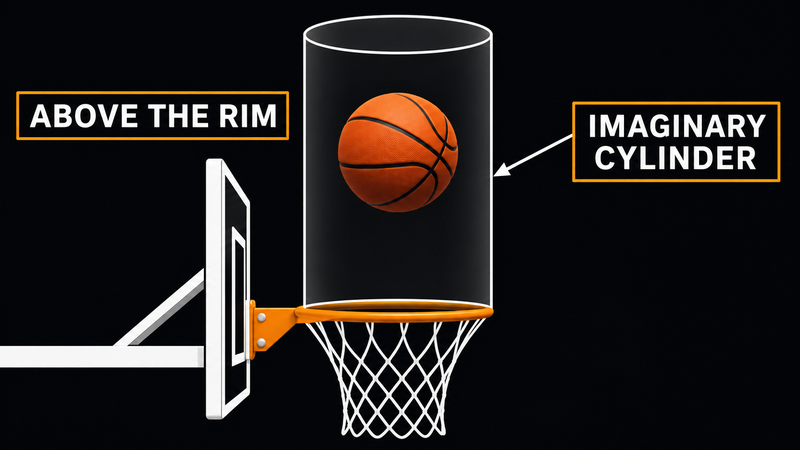
Picture an invisible tube extending upward from the basket ring. Under Rule 11, a player in the playing area may not touch a ball above the ring and within that imaginary cylinder. The position of the ball is the point to watch; a hand reaching over the hoop does not make every nearby touch a violation by itself.
For example, a shot is directly above the basket, inside that cylinder. An attacker tips it towards the hoop. That is basket interference at the attacker’s own basket: no points are scored, and the other team gets possession at the free-throw line extended on either sideline. Change the toucher to a defender, and the violation is at the opponent’s basket; the award is the value of the original attempt.
The cylinder and descending-flight provisions overlap, but they are not identical. A ball can be outside the cylinder and still be protected because it is descending with an opportunity to score. A ball above the ring and inside the cylinder can trigger the separate cylinder provision. To follow a replay, ask where the ball was at the moment of contact, then check its flight and the other conditions as well.
For the wider league structure, the NBA guide for Filipino fans covers the season and league basics. This guide focuses on the on-court ruling.
Can an attacker touch a ball above the rim?
Not when the ball is above the ring and within the imaginary cylinder, subject to the rule’s specified exception. A ball’s height alone does not establish that it is inside the cylinder.
How does the backboard change the decision?
A spectacular block against the glass can be legal, but “hit the ball into the backboard” and “touch the ball after it hits the backboard” are different sequences.
For a field-goal attempt with a chance to score, Rule 11 prohibits touching the ball after it has touched any part of the backboard above ring level, whether the ball is rising or falling. It also prohibits touching such a ball after it has touched the backboard below ring level while the ball is on its upward flight. The rule’s precise conditions matter: do not reduce them to “any contact after the ball touches any part of the board is always goaltending.”
In one hypothetical layup, the ball hits the backboard above ring level and still has a chance to score. A defender then swats it away while it is rising. That is a violation despite the upward flight. In a second play, the defender bats the ball first and the ball then strikes the backboard; the order alone does not establish a violation. Officials still have to consider the rest of Rule 11.
Another separate provision prohibits trapping a released ball against the face of the backboard. The NBA specifies that the hand, ball and board must all be in contact simultaneously for a trap; simply batting a ball against the board is not a trap. Neither description by itself resolves every other possible violation on the play.
Is a block after the ball hits the backboard always illegal?
No. Check where the ball hit, whether it was a field-goal attempt with a chance to score, its flight where relevant, and the other provisions of Rule 11. The above-ring backboard condition applies to both upward and downward flight.
A ball touching the rim: the important exception
A ball resting or rolling on the ring while using it as its lower base is protected: a player may not touch the ball or the ring in that situation. The same rule also covers hanging on the rim while the ball passes through.
But the NBA has documented a narrower legal case. In its 2014 Rule Authority explanation, the league describes a player legally touching a ball that is still in contact with the rim while rolling off its outer edge, ending the attempt. “The ball touched the rim” therefore does not answer every play. Whether it is using the ring as its base, its position, and the precise contact matter.
There is another explicit exception in Rule 11: a player near their own basket who has a hand legally in contact with the ball may continue that contact after the ball enters the cylinder, or touch the basket in that action. This is continued legal contact, not permission to begin a new touch inside the cylinder.
Who gets the points or the ball?
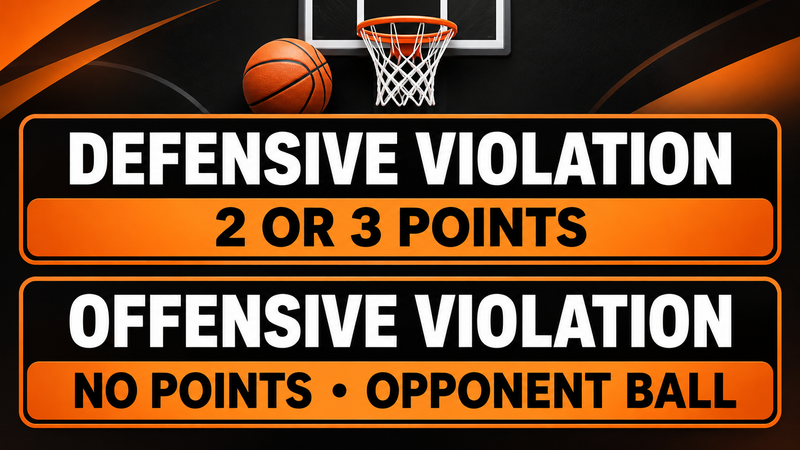
The location of the violation tells you which penalty in Rule 11 applies. In ordinary terms, a defender interfering with a shot at the basket their team is defending commits the violation at the opponent’s basket; an attacker interfering with their own shot commits it at their team’s own basket.
| Situation | Result under Rule 11 |
|---|---|
| Violation at the opponent’s basket on a two-point attempt | Offended team is awarded two points. |
| Violation at the opponent’s basket on a three-point attempt | Offended team is awarded three points. |
| Violation at a team’s own basket | No points; the offended team receives the ball at the free-throw line extended on either sideline. |
| Violation by both teams | No points; a jump ball between opponents at the centre circle resumes play. |
For a defensive violation on a three-point attempt, the award is three, even if the shot was stopped before reaching the hoop. For an offensive violation on that same attempt, the attempt does not become three points merely because the ball was close to going in. The distinction is the location of the violation and which team offended, not how dramatic the touch looked.
The outcomes in the comparison apply only after a Rule 11 violation has been established. A defender contesting a shot or an attacker holding the ball does not by itself establish basket interference; the ball’s position, flight and the other conditions above determine the call.
After an awarded score at the opponent’s basket, Rule 11 says scoring credit and subsequent procedure follow the same pattern as a made basket, except the official hands the ball to a player entitled to the throw-in. Other fouls or special circumstances in an actual game can require separate rulings; the examples here isolate Rule 11.
A practical replay checklist
Watch the sequence rather than just the final frame:
- Identify the attempt and where it was taken: its two- or three-point value matters if points are awarded.
- Locate the ball at the touch: above the ring and inside the cylinder, on the ring as its base, or elsewhere?
- Check whether the ball was descending with an opportunity to score.
- If the backboard was involved, determine whether ball or defender touched first, where the ball hit, and whether the attempt still had a chance to score.
- Identify the touching team and listen for the official ruling before assigning points or possession.
A replay angle can hide depth or the exact moment of contact. If those facts are unclear, the responsible answer is that the clip alone does not settle the play.
Can an offensive player be called for goaltending?
Yes. Rule 11’s prohibited touches apply to players on either team. If the violation is at the offending team’s own basket, no points are awarded and the offended team receives possession as described above.
If both teams interfere, who gets possession?
Rule 11 specifies no points and a jump ball between opponents at the centre circle. It is not automatically possession for the defending or attacking team.
Do these rules apply to all leagues?
This explanation is specific to NBA Rule 11. Other competitions can have different rules, so check the rulebook and season applicable to the game being watched.