
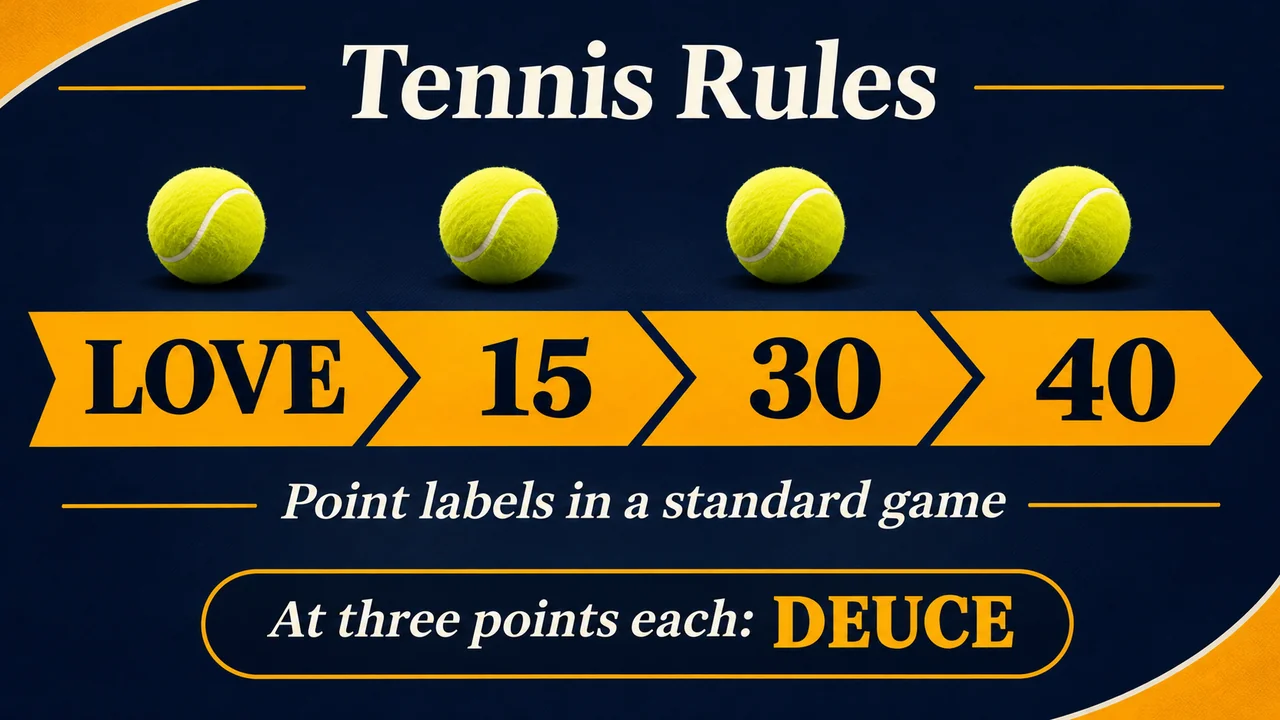
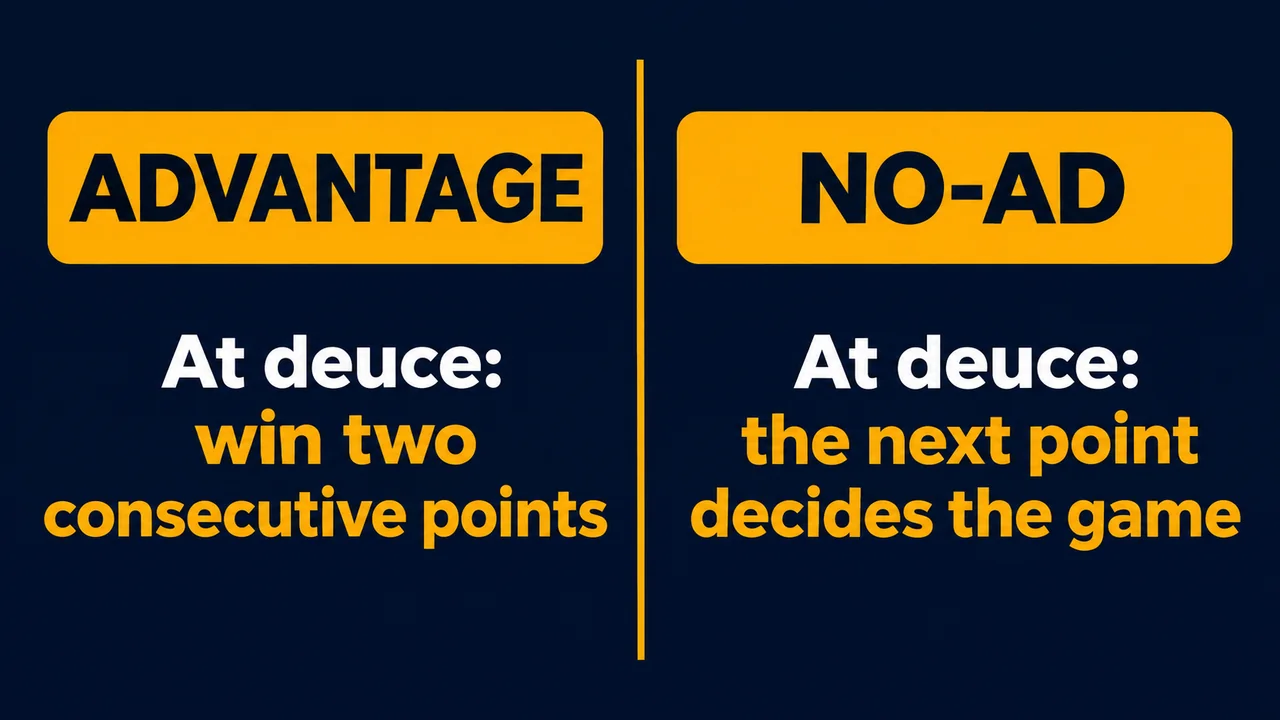
A tennis scoreboard reaches 40–40, but the next point does not necessarily finish the game. Under standard advantage scoring, the players are at deuce: one player must win two consecutive points from there to take the game. Some competitions use a no-ad format instead, where the next point at deuce decides the game. If you do not know which format applies, check the event's rules before treating the next point as a game point.
This guide follows a single invented game using the 2026 ITF Rules of Tennis. It explains points within one game; a set and a match are larger units, and a tie-break uses a different point count.
Love, 15, 30 and 40
In a standard game, a player with no points has love. The first three points won by that player are called 15, 30 and 40. A fourth point wins the game if the player is at least two points ahead. Those numbers are labels: moving from 15 to 30 means winning one more point.
The server's score is called first in an ordinary game. If the server has won two points and the receiver has won one, the call is “30–15”. If both have won one, it is “15-all”. At three points each, the score is called deuce rather than 40-all.
The point labels do not carry into the next game. After an ordinary game, the set's game score changes. The next ordinary game starts at love-all; a tie-break uses its own numerical point count. Who serves next follows the service order; reaching deuce does not change it.
Follow one game through deuce
Imagine Alex serves to Blair in a standard advantage game. The table gives the score from the server's perspective after each point. Both names are fictional; this is a teaching sequence, not a match record.
| Point winner | Score after the point | What it means |
|---|---|---|
| Alex | 15–love | Server has won the first point |
| Blair | 15-all | Each has won one |
| Alex | 30–15 | Server leads by one point |
| Blair | 30-all | Each has won two |
| Alex | 40–30 | Server can win the game on the next point |
| Blair | Deuce | Each has won three |
| Alex | Advantage Alex | Alex is one point from winning the game |
| Blair | Deuce | Blair cancels Alex's advantage |
| Blair | Advantage Blair | Receiver is now one point from winning |
| Blair | Game Blair | Blair wins the second consecutive point from deuce |
At deuce, a player who wins the next point gains advantage. If that player wins the following point too, the game ends. If the opponent wins it, the score returns to deuce. This can repeat more than once; there is no fixed number of returns to deuce in the standard advantage game.
You may hear advantage in when the server has advantage and advantage out when the receiver has it. Broadcast graphics may use “Ad” next to a player's name. Check who is serving rather than assuming the first row of every graphic always represents the server.
What changes in no-ad scoring?
The ITF rules include an alternative no-ad scoring method. In that format, once the game reaches deuce, a deciding point is played; the player or team that wins it takes the game. The receiving side chooses which service court to receive from, subject to the applicable doubles and mixed-doubles provisions.
The same 40–40 display can mean different things for the next point. In a standard game, one point gives a player advantage. In a no-ad game, the next point wins the game. Neither approach should be assumed for an unfamiliar event: consult its competition regulations or the official match information.
No-ad does not change the meaning of love, 15, 30 or 40 before deuce. It changes what happens when both sides reach three points. A broadcast showing only “40–40” may not by itself show whether the next point is decisive.
Points, games and sets are separate
A standard game is one part of a set. The score inside that game might be 30–15 while the set score is 4–3. The first score counts points in this game; the second counts completed games in the set. Winning the current game changes the set score, not the point score of a previous game.
Set formats vary. A tie-break game also uses numerical points such as 1, 2 and 3 rather than love, 15 and 30. Match tie-breaks and deciding-set formats can differ by event. Before applying a rule to a particular match, check the event's published format rather than assuming every tournament uses the same deciding set.
For readers checking a sports market, a point score on a broadcast may lag the official record, and a market's settlement rules can differ by operator. If the score or market terms are unclear, pause and consult the official match record and accepted rules rather than making a decision from a delayed graphic.
Read the score in five steps
- Identify the server and check whether the display is showing points, games or sets.
- In an ordinary game, read the server's announced point score first.
- At deuce, find out whether the event uses standard advantage or no-ad scoring.
- In an advantage game, follow who has advantage and whether the score returns to deuce.
- When a game ends, update the set score and identify whether the next game is ordinary or a tie-break.
Common questions
Is 40–40 the same as deuce?
In standard game scoring, three points each is called deuce. What happens next depends on whether the event uses the standard advantage method or an authorised alternative such as no-ad.
Does the player who reaches 40 first win?
No. Reaching 40 means that player has won three points in the game. They still need to win the game under the applicable scoring method, including the two-point margin in a standard advantage game.
What happens after advantage?
In a standard game, if the player with advantage wins the next point, that player wins the game. If the opponent wins it, the score returns to deuce.
Are tie-break points called 15, 30 and 40?
No. A tie-break game uses numerical point scores. Its target and the format of the deciding set can depend on the competition.
For more coverage, visit the tennis section. The ITF Rules of Tennis, including Rule 5 and Appendix VI, set out standard game scoring and authorised alternatives; check the event's regulations for the format in use.
By IPL Betting. Source and review: The game sequence is invented to illustrate ITF 2026 scoring. It is not an account of a real match, and it does not assume that every competition uses the same format.
Promotional link. Gambling involves financial risk and may be restricted where you live. Participation is for eligible adults.