
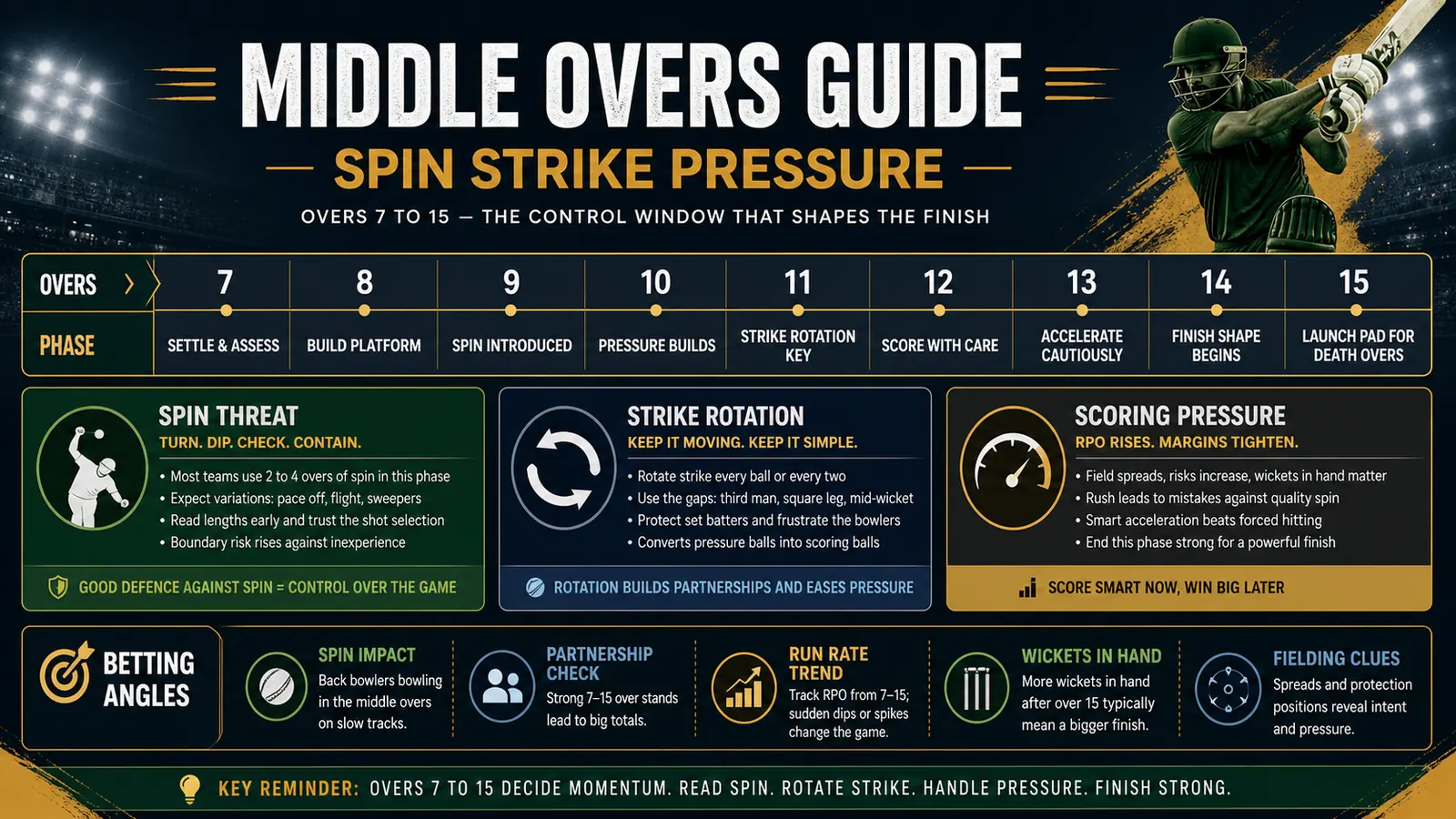
The middle overs are often where a T20 innings becomes legible. The field spreads, spinners enter, batters choose between rotation and attack, and the next wicket can change the plan.
A middle-overs guide should not reduce the phase to a single run-rate number. Look at the batter pair, the bowling options, the surface, and the number of wickets available to absorb risk.
Editorial note: Reviewed by IPL Betting Editorial Team. Last updated: August 2026. Evidence method: compare published competition rules, current match information, and the exact market terms shown by your chosen platform. Match information, team news, weather, prices, and market terms can change, so keep every decision within a planned limit.
What the Phase Is Trying to Do
Batting teams usually want to keep the scoreboard moving while preserving enough wickets for the finish. Bowling teams try to deny easy singles, force a low-risk error, or bring a favorable matchup into play.
That tactical tension makes the phase useful to watch. It also means a slow over does not automatically show failure and a quick over does not automatically show control.
| Phase check | Question | Useful context |
|---|---|---|
| Strike rotation | Are batters finding singles? | Field and surface can restrict options |
| Spin | Which type of spin is being used? | Angle and matchup matter |
| Wickets | How many remain? | Risk capacity changes |
| Tempo | Is the rate rising or falling? | Read it with wickets and phase left |
Spin Matchups Need Detail
A spinner’s effect depends on grip, pace, angle, boundary size, and the batter’s preferred scoring areas. “Spin versus batter” is too broad to be a complete note.
Check whether the same bowler has a role in the middle overs and whether the batter pair can rotate strike when boundaries are not available.
| Matchup detail | What to note | Why it matters |
|---|---|---|
| Type | Finger spin, wrist spin, or variation | Movement and release differ |
| Angle | Around or over the wicket | Changes shot options |
| Surface | Grip and pace | Affects timing |
| Pair | Left and right combination | Can change field and bowling plans |
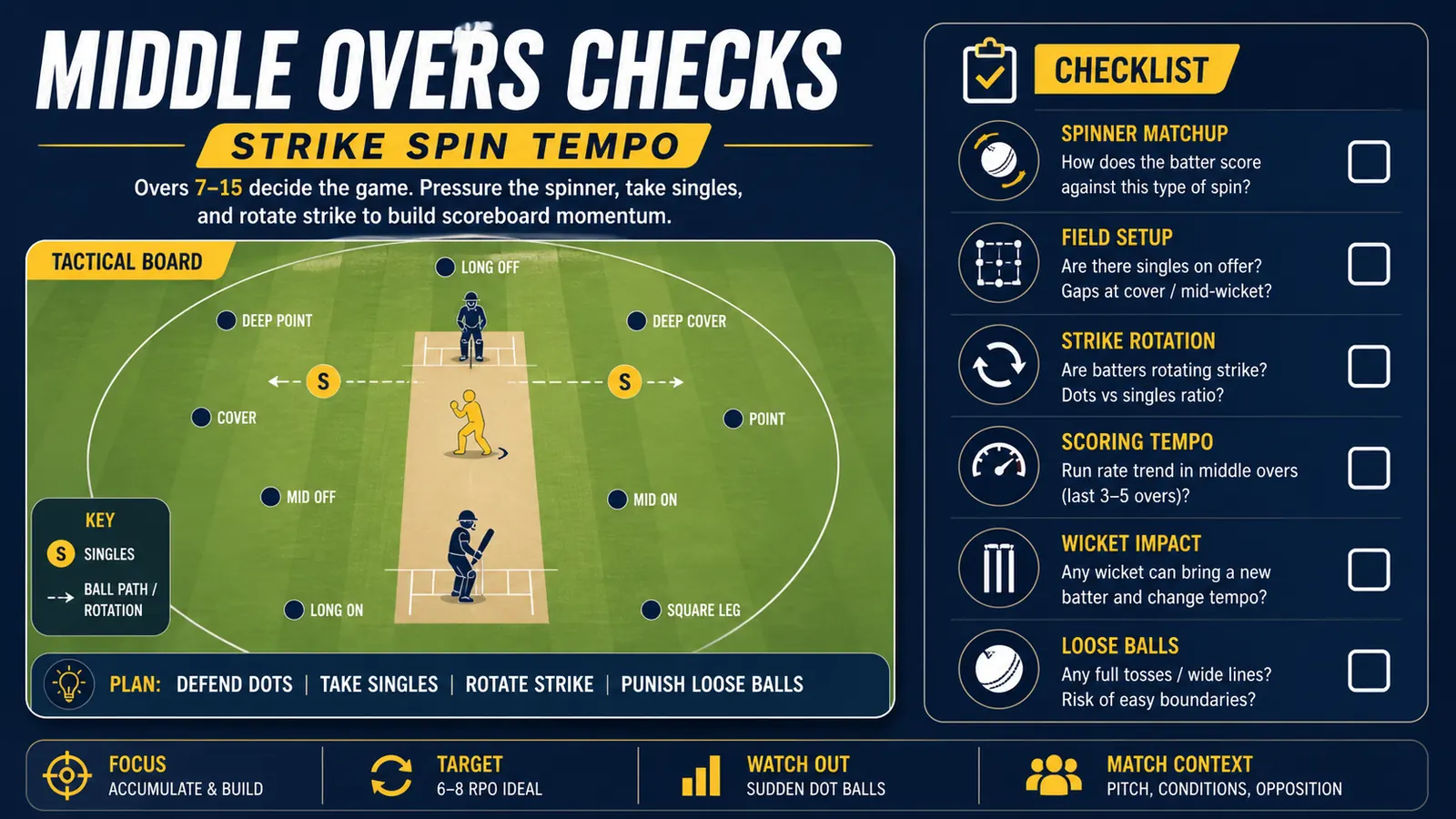
Use Wickets to Read Pressure
A team that is scoring steadily with wickets in hand can choose when to attack. A team that loses two wickets in the phase may need to rebuild even if the required rate has not moved much.
Write down the current pair and the next two batting options. That small detail often explains more than a broad statement about momentum.
Avoid a Flat Middle-Overs Label
Middle overs are not identical across venues, innings, or lineups. The seventh over can have different pressure from the fifteenth, and a rain-shortened match may compress the phase entirely.
Use the phase as a framework, then return to the current ball, role, and market terms. A framework is useful only while it still fits the match.
FAQ
What are the middle overs in an IPL innings?
They generally refer to the phase after the powerplay and before the death overs, with the exact number depending on the innings length.
Why is strike rotation important?
Singles can keep the innings moving when boundaries are limited and can preserve options for the finish.
Does spin automatically control the middle overs?
No. Spinner role, angle, surface, batter pair, and field placement all matter.
What should be recorded during this phase?
Note the current pair, wickets, bowling roles, surface, tempo, and the market scope before comparing a price.
Source and update note: This evergreen guide should be checked against current official match information, published competition rules, and the exact market terms shown by your chosen platform before you act.
Related Reading
- IPL Powerplay Betting Guide ↗
- IPL Death Overs Betting Guide ↗
- IPL Pace vs Spin Matchup Guide ↗
- IPL Partnership Markets Guide ↗
Take a pause when a material input is unconfirmed or a market rule is unclear. Clear information and a planned limit are more important than forcing a decision.