
Published by IPL Betting. Sources checked on 11 September 2026; examples are illustrative.
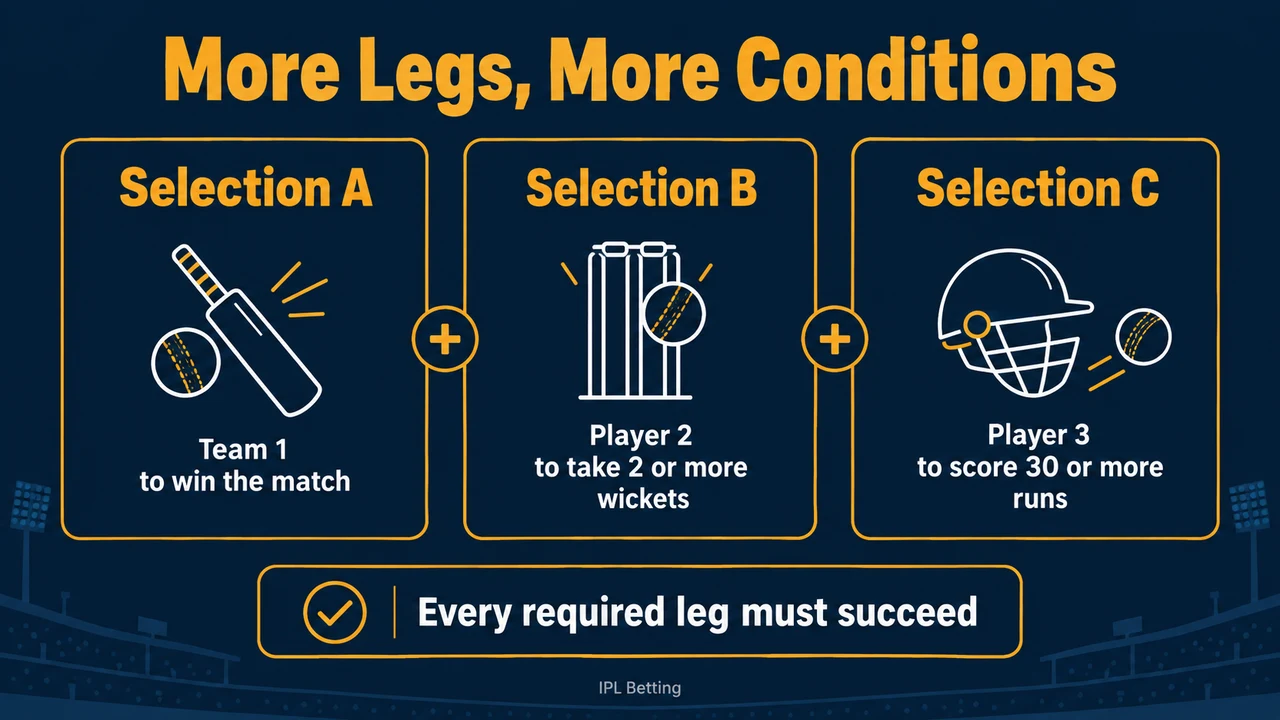
Three selections on one ticket do not give you three separate chances to receive the displayed return. In a standard all-to-win accumulator, all three have to succeed, subject to the settlement rules. The larger potential return depends on every required outcome happening.
A same-game bet adds another complication: its selections may describe connected parts of one match. Multiplying their standalone odds can be misleading because one outcome may change the chance of another. Start by identifying what kind of ticket you are reading before doing any arithmetic.
A simple accumulator calculation
Assume an ordinary cash-funded treble with decimal odds of 2.00, 1.50, and 1.80. If the ticket combines these by multiplication, the combined odds are 5.40. A stake of 10 would return 54 if every leg wins, including the 10 stake. The net gain would be 44. If an ordinary losing leg defeats the accumulator, the return is zero.
All numbers in this article are hypothetical. The displayed combined odds and confirmed stake on the actual receipt take precedence over an estimate assembled from prices you saw earlier. Odds may change before acceptance, and special products may have their own pricing.
| Illustrative result | Calculation | Total return |
|---|---|---|
| All three win | 10 × 2.00 × 1.50 × 1.80 | 54 |
| Middle leg void, other two win; reduced-multiple rule applies | 10 × 2.00 × 1.80 | 36 |
| One ordinary losing leg | All-to-win condition fails | 0 |
Combined odds do not tell you the true chance
For a separate probability example, suppose three genuinely independent events each have a 60% chance of success. The chance all three occur is 0.60 × 0.60 × 0.60 = 21.6%. Each event is more likely to happen than not, but the combined outcome is less likely than any single one.
The 60% values are assumptions, not estimates for real teams. They illustrate why adding legs can make the required sequence less likely. They do not establish fair odds for a live ticket, and a bookmaker’s quoted price is not direct evidence that its implied probability is the true probability.
Correlation changes the calculation
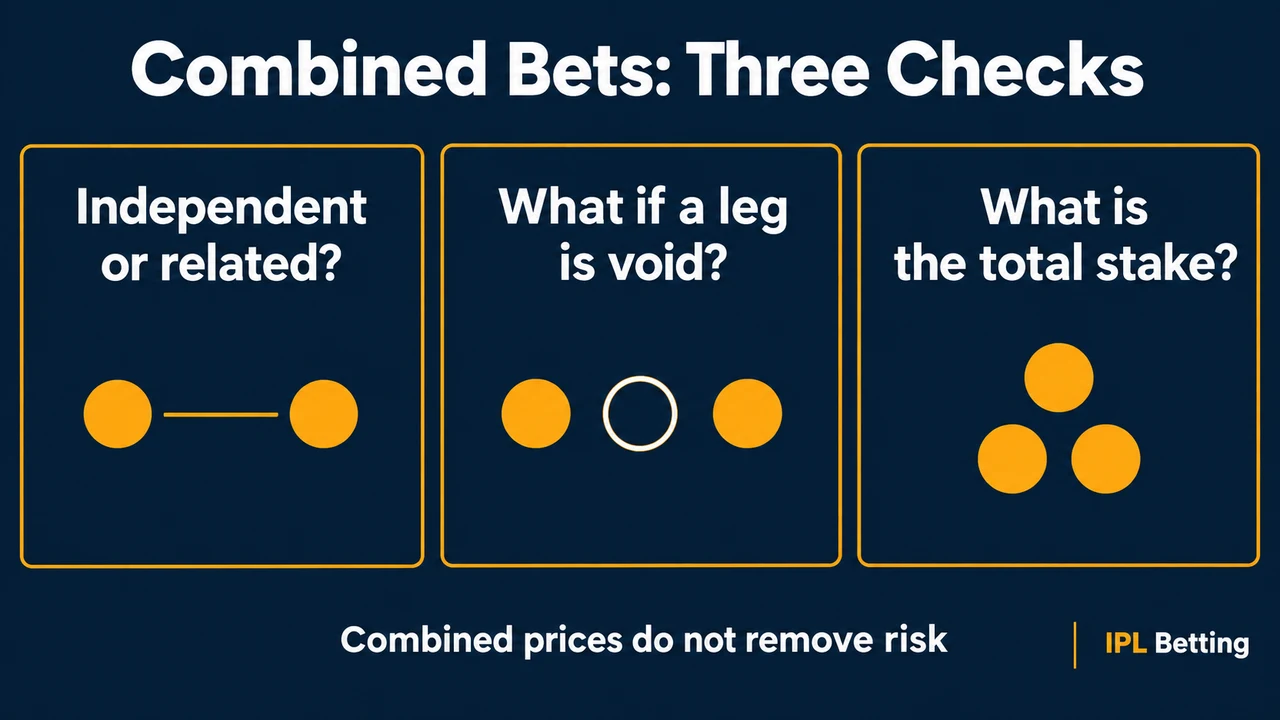
Imagine event A is a team winning and event B is that team exceeding a particular total. Invented probabilities are P(A) = 50% and P(B) = 50%. Multiplying them gives 25% only if they are independent. If the assumed chance of B given A is 70%, their joint chance is 50% × 70% = 35% instead.
The formula is P(A and B) = P(A) × P(B given A). The second term is conditional: it asks about B in the cases where A happened. Positive or negative relationships can change that term. You cannot replace it with the standalone chance of B without justification.
Some combinations are more directly connected. If one selection mathematically guarantees another, the second does not create an independent hurdle. Other selections cannot both succeed. A bet-builder price therefore needs its own treatment; a collection of familiar standalone numbers is not enough to reconstruct it.
A void leg does not have one universal treatment
Under Betfair’s fixed-odds multiple rules, a void leg can reduce a treble to a double. Those rules explicitly distinguish fixed-odds multiples from same-game multiples and restrict related selections outside the latter product. This is one provider’s rule example, not a statement of availability or a recommendation. Read the specific same-game terms rather than assuming the reduced-treble example applies.
The second row in the table assumes that the 1.50 leg is removed and both remaining legs win. It does not mean that every ticket containing a non-playing person pays 36. Participation rules, already-determined markets, and the bet type can change the treatment. A losing selection does not become void because the result felt unlucky.
Count the money across tickets
Five separate 10-unit accumulators cost 50, even if each screen presents 10 as a small stake. If several share the same team, one result can defeat several tickets together. Counting only the largest single stake hides that concentration.
A system bet may create several combinations from the chosen selections. Check whether the amount entered is per combination or the total stake. For example, six combinations at 2 each require 12 in total. Do not infer the total cost from the number beside one combination.
Read the receipt in a fixed order
Identify the product name, list every required outcome, check the accepted combined odds, and confirm the total stake. Then locate void and participation provisions. If any one of those fields is unclear, there is no need to finish the purchase while a countdown is running.
A near miss is still a losing all-to-win ticket. Repeating a larger accumulator because only one leg failed changes the amount at risk without changing what happened. Keep the original spending limit separate from the excitement of a large possible return, and leave room to decide against placing a bet at all.
Questions readers ask
What happens to the treble if one leg is void?
Under the reduced-multiple rule used in the example, it becomes a double and the remaining odds are multiplied. That is not a universal rule for same-game bets; read the product-specific terms.
Why can’t I multiply same-game probabilities directly?
You can multiply the standalone probabilities only when independence is justified. If one selection changes the chance of the other, use the conditional probability instead. The article’s 35% example is hypothetical, not an estimate for a match.
Is a 2-unit system bet always a total cost of 2?
No. If 2 is the stake per combination and there are six combinations, the total is 12. Check the total debit on the confirmation rather than assuming the amount beside one line covers the whole ticket.
Related reading
Best IPL Betting Markets Explained: Which Options Fit the Match, the Reader, and the Moment; How Bookmakers Calculate IPL Odds: Margin, Price Moves, and Match Context; IPL Betting Bankroll Management: Match Limits, Live Caps, and Season Discipline.