
Published by IPL Betting. Sources checked on 11 September 2026; examples are illustrative.
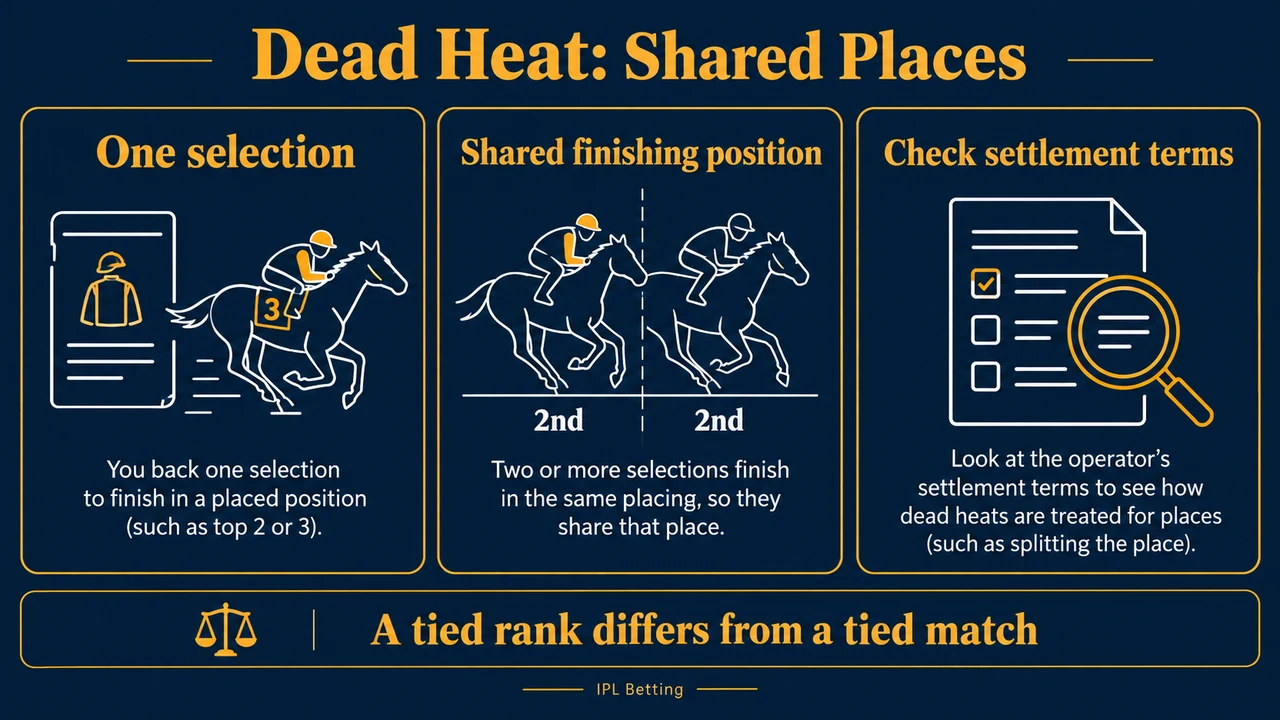
Your selected player finishes joint top scorer, the ticket is marked as a winner, and the credited amount is lower than expected. That can happen under a dead-heat rule. A share of the original stake is settled at the winning odds, while the rest loses. “Joint winner” does not always mean the full winning return.
Once you know which rule applies, you can check the credited amount against the ticket. The harder part is identifying whether the market actually uses dead-heat settlement. A tied match, two players with the same runs, and a void bet are different events for settlement purposes.
Divide the stake before calculating the return
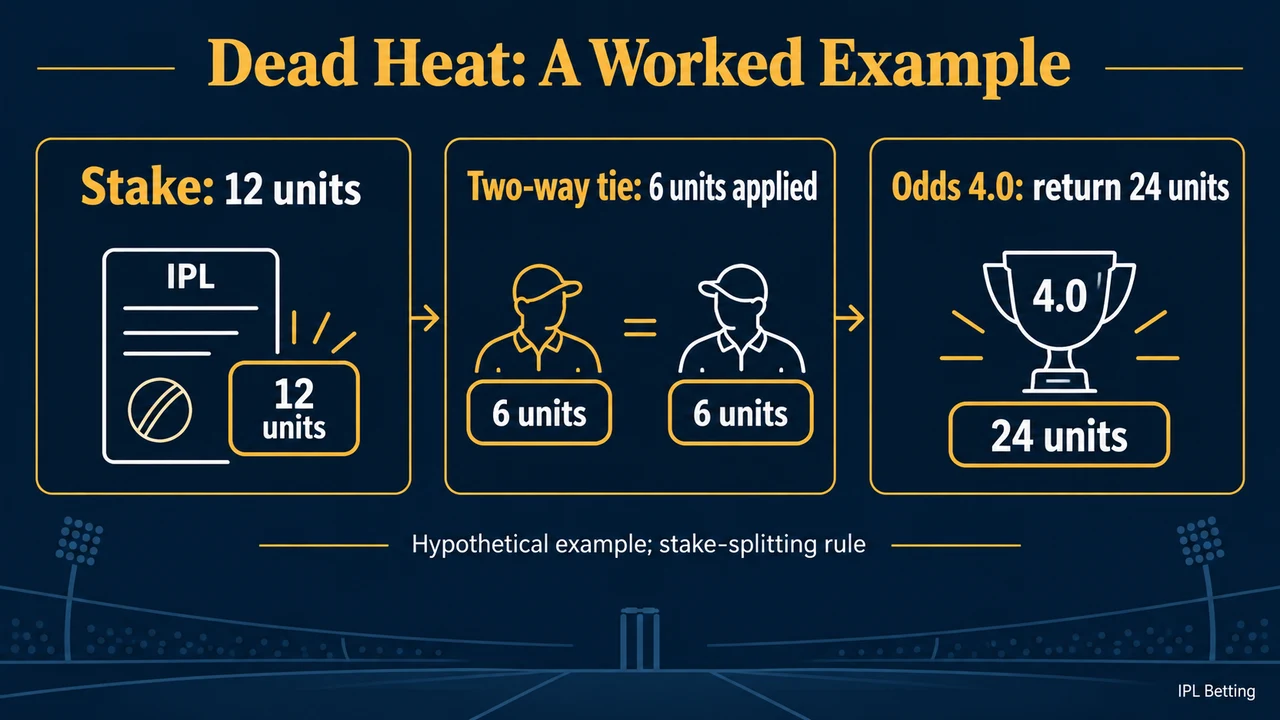
The Betfair dead-heat explanation uses proportional stake division. For a single winning position shared equally by two selections, half the stake wins at the full odds and half loses. With three equal winners, one third wins and two thirds lose. Market-specific rules may override the general treatment, so first confirm that this is the method on your ticket.
Using decimal odds, the illustrative formula is: total return = original stake ÷ number of joint winners × decimal odds. Net result = total return − original stake. This simple version assumes one winning position, equal shares, an ordinary cash stake, and no separate deductions or commission.
| Hypothetical ticket | Winning stake portion | Total return / net |
|---|---|---|
| 30 at 4.00; sole winner | 30 | 120 / +90 |
| 30 at 4.00; two equal winners | 15 | 60 / +30 |
| 30 at 4.00; three equal winners | 10 | 40 / +10 |
For the two-way case, the 15 winning portion returns 60 at 4.00. That 60 already includes the 15. The other 15 does not come back. Adding the original 30 again would count money twice and inflate the result.
A joint winner can still mean a net loss
Now change the hypothetical odds to 1.50 and keep the 30 stake. With two equal winners, the return is 15 × 1.50 = 22.50. Compared with the original 30, the net result is −7.50. The player shared first place, but the payout did not cover the full stake.
This is not the same as halving a normal profit and then returning all of the stake. That alternative would produce 37.50 here: half of the normal 15 profit, plus 30. Under the stake-division assumption, that is the wrong calculation. That shortcut incorrectly gives back the 15 that lost.
Top scorer and match winner are separate questions
Suppose two batters from the same team both finish with 48 runs. A hypothetical team top-scorer market may have two joint leaders even though the match itself has a clear winner. Conversely, a match can finish level while one batter is the sole top scorer. One type of tie does not settle the other.
Read whether the market names a team, one innings, the whole match, or a tournament. Then read any tie-break clause. A provider might define a separate ranking test; another product may use dead-heat settlement. Do not use the award shown during the presentation ceremony as a substitute for the ticket’s definition.
The Sportsbook rules distinguish general rules from specific sports rules. In practice, your evidence needs both the market wording and the applicable exception. A search result for “dead heat” is not enough if the ticket has a more specific provision.
When the simple divisor is insufficient
The examples above cover one position. A place market can involve several available places and a tie across the final qualifying position. Before using the number of tied participants as the divisor, identify how many paid places remain for that tied group. The operator’s worked rule is needed for that situation.
Free-bet stakes can also produce different credits because the promotional stake may not be returned. Exchange statements may show profit and loss rather than a retail-style total return, and commission can introduce another adjustment. Keep those cases out of a simple cash-single calculation unless their terms are included.
Check a smaller-than-expected return
Write one short line for each input: stake 30; odds 4.00; one paid position; three equal winners; cash-funded single. The provisional return is 40. Next compare that number with the actual credited transaction, rather than the headline label on the bet history page.
If the amount differs, ask which input changed. Was there a different number of joint winners? Did a specific rule break the tie? Was the stake promotional? Was a deduction applied? A precise question is easier to answer than “my winning bet paid too little,” and it makes a genuine arithmetic error easier to locate.
Keep the original receipt and the rule version available. If the page has since changed, ask support to identify the terms used for your bet. Do not place another ticket to recover a surprise shortfall. Resolving the calculation and deciding whether to gamble again are separate decisions.
Questions readers ask
Why was my joint winner paid less than the quoted return?
A dead-heat rule may settle only part of the stake as winning. For one winning position shared by two selections, the illustrated method halves the stake and settles that half at full odds. Confirm the specific market rule first.
Do I add the original stake back after the calculation?
No. Under the cash-stake examples here, the decimal-odds return already includes the winning stake portion. The other portion loses; adding the whole original stake again would overstate the credit.
Does a tied cricket match automatically mean a dead heat?
No. Match-result terms, tie-breaker treatment, and a player-ranking market answer different questions. Check the ticket’s definition rather than applying the player dead-heat example to every tied score.
Related reading
IPL Player Prop Betting Guide: Roles, Usage, and Market Discipline; IPL Super Over Betting Guide: Tie-Breaker Rules, Market Settlement, and Key Checks; IPL Abandoned Match vs Void Bet: Terms Readers Should Check.