
Published by IPL Betting. Sources checked on 11 September 2026; examples are illustrative.
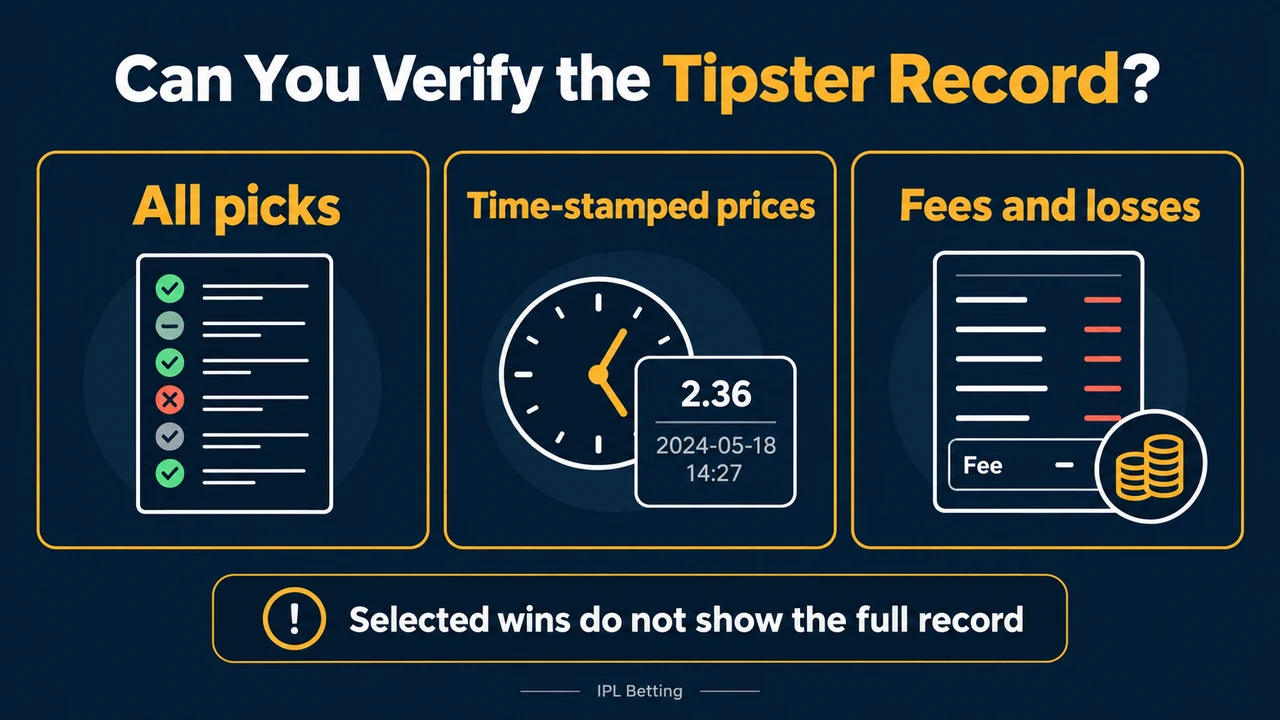
“Eight winners this week” sounds impressive until you ask how many selections were sent, what prices were available, and what the subscription cost. A winning screenshot answers none of those questions. Ask for the complete record, then check whether its prices, stakes, and fees produce the advertised result.
This is a check on advertising evidence, not a method for finding guaranteed selections. Even a properly documented past result does not establish what will happen next. The first useful decision may be to leave the subscription unpurchased.
Ask for the denominator
Eight winners from ten selections and eight winners from forty selections describe very different records. Ask for every selection in the stated period, including losses, voids, cancelled advice, and any revisions. A feed that shows only successes cannot establish an overall result.
The period needs a clear start and end. If the headline uses a successful weekend but the subscription was sold for a month, inspect the full month. If the service claims several different records, identify which one corresponds to the product being sold to you.
The UK’s ASA guidance on tipster advertising covers selective winning periods, independent proofing, and whether subscribers could obtain the quoted odds. It is useful evidence of the questions such claims raise, although it is UK advertising guidance rather than a statement of every country’s rules.
Check that the advice existed before the event
A result posted after the match is not evidence of a pre-match recommendation. Look for a record showing the selection, market, line, odds, stake, and publication time before the relevant event. The record should also show edits instead of silently replacing the original entry.
Independent proofing can strengthen evidence that advice existed at a particular time, but it does not make the selection reliable or suitable for you. Ask what the verification actually covers. A badge might concern the identity of an account rather than the completeness of its performance record.
For live advice, timestamps matter even more. A price captured before the message reached subscribers may not have been obtainable by them. Keep the distinction between the author’s screenshot and the reader’s opportunity to act.
Recalculate one complete period
Consider a fictional service that posts ten selections, each at decimal odds of 2.00 with a ten-unit stake. Six win and four lose. The six winning tickets return 120 units including their stakes, while the total amount staked is 100. The betting result is a 20-unit gain before fees.
If the subscription for that period costs 30 units, the subscriber’s combined result is a ten-unit loss. The claim “six winners” remains numerically true, but it does not describe the cost of following the service. These figures are invented solely to show the accounting.
Now suppose the six winning selections were only available to the reader at 1.80. Their return would total 108 units on the same stakes. After the 100 units staked and 30-unit subscription, the combined result would be a 22-unit loss. A modest-looking difference in available price changes the account substantially.
Watch for changing stake definitions
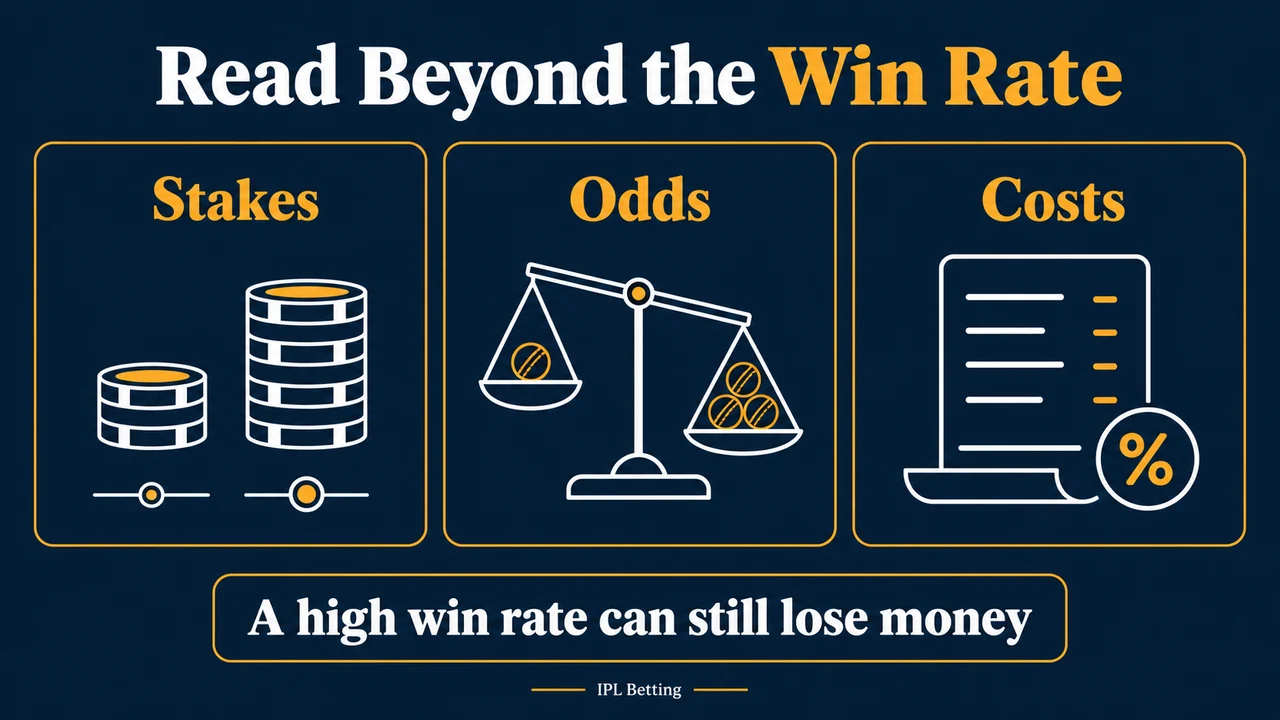
A record expressed in “units” needs a stable definition. If losing bets are counted at one unit but successful bets are later presented as larger stakes, the total cannot be evaluated fairly. Ask whether stake sizes were stated before each event and whether the summary uses those same sizes.
Do not treat a hypothetical maximum return as the amount a normal subscriber received. Likewise, a total return includes returned stakes; net profit subtracts the amount staked. Fees and other applicable costs should be identified separately rather than disappearing into a footnote.
You do not need a complex spreadsheet to test a claim. A row for each selection with stake, accepted odds, settlement, and net result is enough to expose many inconsistencies. Without the selections, stakes, prices, and results, you cannot check the total.
Separate evidence from persuasion
Testimonials, follower counts, and photographs of expensive purchases do not reconstruct a betting record. Neither does a claim that losing selections were “unlucky.” The record should use the same settlement treatment for wins and losses without deciding afterward which selections counted.
Pay attention to how the service handles questions. A clear explanation of a void or correction is useful. Pressure to buy before you can inspect the terms is not a substitute for information. Read renewal, cancellation, and refund conditions before paying, especially where a trial converts to an ongoing charge.
Keep your own limit separate from the seller’s suggested stake. A subscription fee does not create an obligation to place every selection to “get value” from it. If following advice is increasing pressure to spend, you can stop using it regardless of the advertised record.
Questions readers ask
Is a high win rate enough to assess a tipster?
No. You also need prices, stakes, the complete set of selections, and costs. A high proportion of winners can still produce a loss when returns are small or fees are substantial.
Does an independently recorded history predict future results?
No. It can support a claim about what was recorded in the past. It does not remove uncertainty from future matches or show that a subscription fits your circumstances.
What if the seller only provides screenshots?
Ask for the complete, time-stamped record behind them. If that is unavailable, describe the claim as unverified and avoid building a spending decision around it.
Sources checked on 11 September 2026: ASA CAP tipster advertising guidance.
Related reading: IPL Betting Prediction Checklist: How to Verify Inputs Before a Match; IPL Betting Record-Keeping Guide: Track Prices, Stakes, Results, and Decision Reasons; IPL Betting Trend vs Noise Guide: How Many Matches Make a Statistic Useful?.