
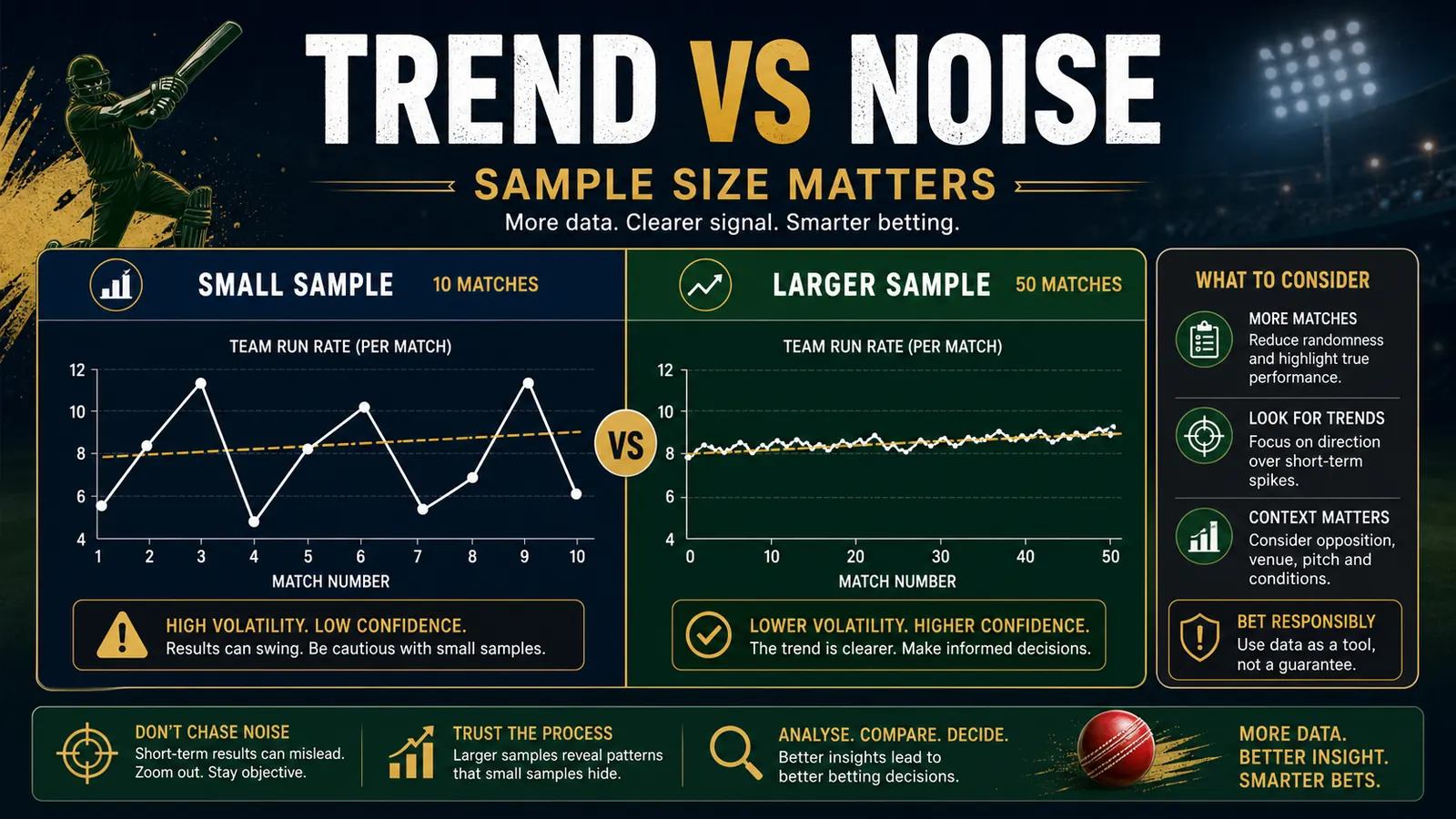
A statistic can look persuasive after two or three matches, especially when the results are memorable. The more useful question is whether the pattern survives changes in venue, role, opponent, and match situation.
This guide is about evidence discipline. It does not set a magic number of matches, because sample quality matters as much as sample size.
Editorial note: Reviewed by IPL Betting Editorial Team. Last updated: August 2026. Evidence method: compare published competition rules, current match information, and the exact market terms shown by your chosen platform. Match information, team news, weather, prices, and market terms can change, so keep every decision within a planned limit.
Count the Observations
Write down how many innings, overs, balls, or matches support the statistic. A percentage without its denominator can make a small sample look established.
Also note whether every observation belongs to the same player role and match phase. Ten powerplay overs are not the same evidence as ten full-match appearances.
| Evidence field | Question | Why it matters |
|---|---|---|
| Sample size | How many observations? | Small samples swing easily |
| Unit | Matches, innings, balls, or overs? | Units are not interchangeable |
| Role | Was the usage similar? | Opportunity may have changed |
| Context | Same venue or conditions? | Environment affects comparison |
Look for Context Changes
A team can change its batting order, bowling plan, or substitute usage. A player can move from opener to middle order, or from a full spell to a short role. Those changes can break an old trend.
Venue and opponent quality also matter. A run of results against different conditions should not be summarized as one unchanged environment.
| Change | What to recheck | Do not assume |
|---|---|---|
| Role change | Opportunity and phase | Old rate still applies |
| Venue change | Surface and boundary context | Ground history transfers exactly |
| Opponent change | Bowling or batting matchup | Past difficulty is equal |
| Rule change | Market and format conditions | Old settlement wording remains |
Separate Signal From Selection Bias
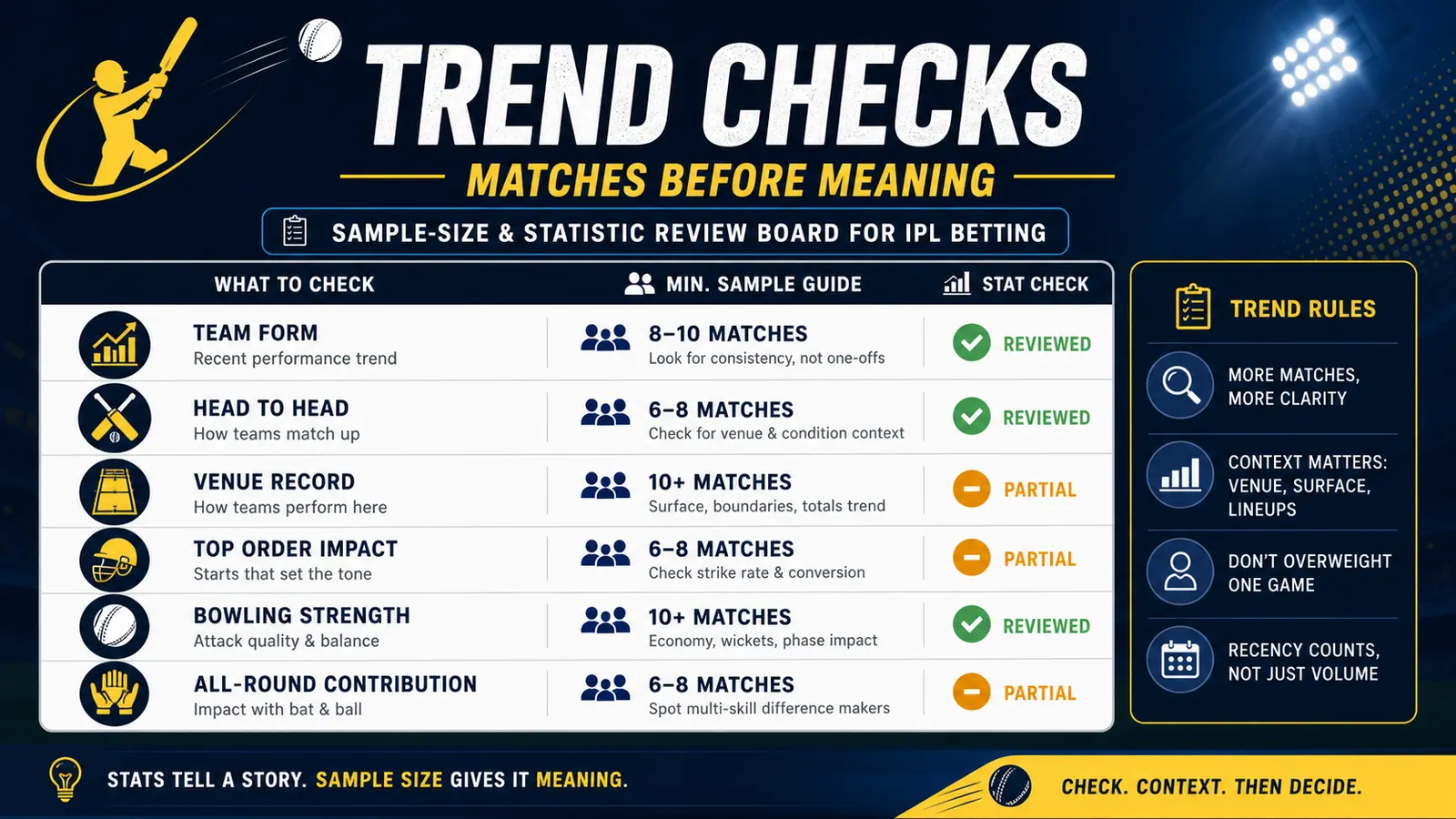
A trend may be noticed because it is interesting, while ordinary matches are ignored. Review the full set of relevant observations when possible, including the events that do not support the story.
Be careful with labels such as “always,” “never,” or “every time.” Cricket has too many changing inputs for a short highlight sequence to carry that certainty.
Use a Recheck Rule
Before using a trend, state what would make you stop using it: a role change, a new venue, a different phase, a material injury update, or a sample that is too small.
A trend is more useful when it produces a question you can verify today. If it only produces confidence from yesterday’s results, treat it as noise until the context is checked.
FAQ
How many matches make an IPL trend useful?
There is no universal number. Check the sample size, unit, role, conditions, and whether the observations are comparable.
Why can a short trend be misleading?
A small sample can be shaped by one unusual innings, opponent, venue, or match situation.
Should all past matches be treated equally?
Not necessarily. Similar roles and conditions make comparisons more useful than a mixed set with no context.
What is a good trend check?
Record the observations, explain the context, state the limits, and identify what new information would change the view.
Source and update note: This evergreen guide should be checked against current official match information, published competition rules, and the exact market terms shown by your chosen platform before you act.
Related Reading
- IPL Stats for Betting Guide ↗
- IPL Betting Record-Keeping Guide ↗
- IPL Pace vs Spin Matchup Guide ↗
- IPL Betting Prediction Checklist ↗
Take a pause when a material input is unconfirmed or a market rule is unclear. Clear information and a planned limit are more important than forcing a decision.