
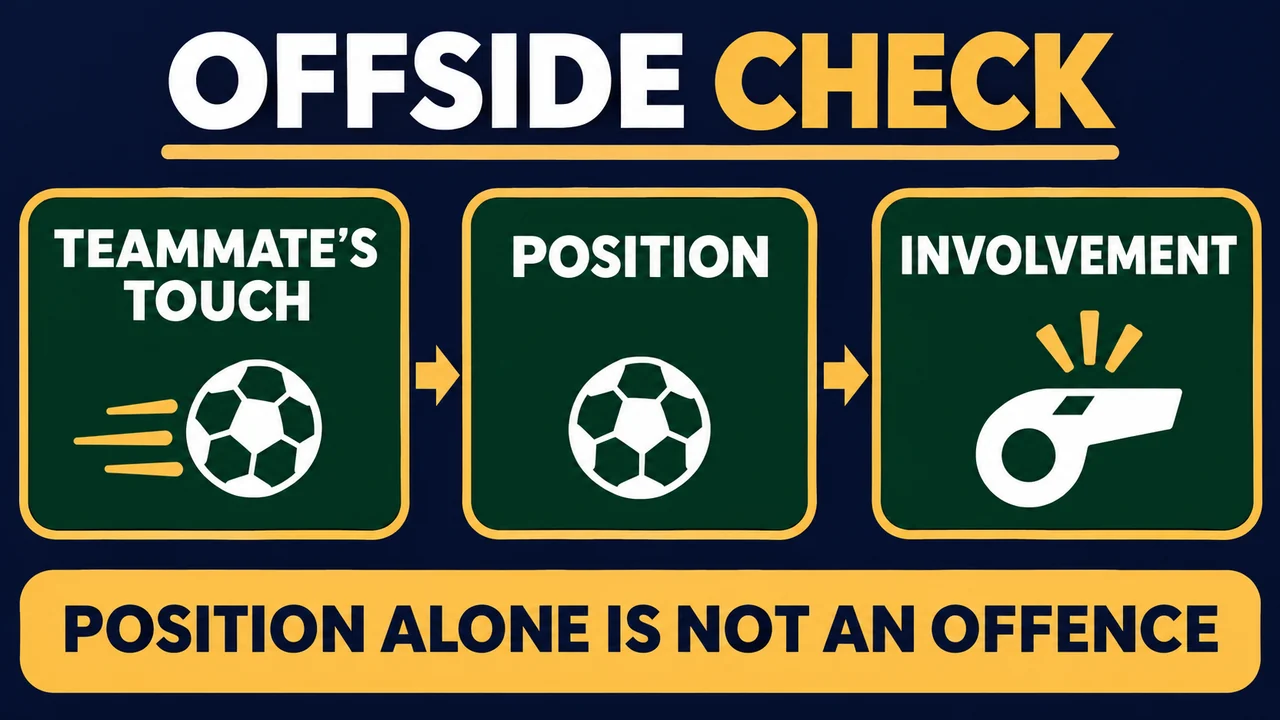
An attacker is standing beyond the defensive line when a teammate plays the ball. That position alone is not an offside offence. If the broadcast does not show the full sequence, wait for the officials’ ruling before drawing a conclusion. The officials also need to consider the attacker's position relative to the ball and the second-last opponent at the relevant moment, and whether the attacker becomes involved in active play under the law.
Start with the moment the teammate plays or touches the ball, not the moment the attacker receives it. Then ask what the attacker did. If the broadcast does not show the relevant touch, all players' positions or the subsequent involvement, a single freeze-frame may not settle the decision. The examples here are invented and use the IFAB Laws of the Game as the reference, not a particular match.
Position is the starting point, not the whole decision
Under Law 11, a player is in an offside position when a relevant part of the head, body or feet is in the opponents' half, excluding the halfway line, and is nearer to the opponents' goal line than both the ball and the second-last opponent. Hands and arms are not considered for this position test. A player level with the second-last opponent or the last two opponents is not in an offside position.
The goalkeeper counts as an opponent, but is not necessarily the player closest to the goal line. Imagine the goalkeeper has moved forward and two defenders remain nearer their own goal line. Count the opposing players' actual positions rather than treating “the last defender” as a fixed person. Likewise, an attacker level with or behind the ball does not satisfy the test of being nearer to the goal line than the ball.
Those checks describe position. Law 11 separates that position from an offence; when an offside offence is penalised, play restarts with an indirect free kick at the place of the offence, which can be in the player's own half. An official must consider the player's involvement and the other conditions in the law.
Why the teammate's touch matters
Imagine a teammate plays a forward pass. At the relevant touch, Attacker A is in an offside position. A then runs back toward midfield and plays the ball. Moving back before receiving it does not, by itself, erase the position at the earlier teammate touch. The official still examines whether A became involved in active play.
Reverse the order. If A was not in an offside position at the teammate's touch, A can run beyond the defenders to receive that same pass without becoming offside merely because of the later running position. A new touch by a teammate may create a new moment to assess, so identify which action the official is judging.
For an ordinary play or touch, Law 11 uses the first point of contact. When a goalkeeper throws the ball, it uses the final contact—the release. Close sequences can involve several touches, rebounds or a defender's action. If the camera does not show the decisive touch clearly, keep the decision provisional rather than choosing a convenient frame.
Involvement can occur without touching the ball
Suppose Attacker A is in an offside position when a teammate shoots, but A stays away from the ball and does not affect an opponent. Being there is not automatically an offence. If A plays or touches the teammate's ball, that is one form of interfering with play under Law 11.
The law also describes interfering with an opponent. Examples include clearly obstructing an opponent's line of vision, challenging an opponent for the ball, or making an action that clearly affects an opponent's ability to play it. Those are judgments about the complete play. A player need not touch the ball for every form of involvement, and a television angle may not show what the goalkeeper or defender could see.
In a different hypothetical sequence, A stands in an offside position in front of the goalkeeper as a shot comes through. Whether A clearly obstructed the goalkeeper's line of vision is an officiating judgment, not a conclusion the position alone supplies. Wait for the decision and its explanation when available.
| Invented situation at a teammate's touch | What to check next | Why one detail is not enough |
|---|---|---|
| Attacker is beyond the second-last opponent but behind the ball | Compare the attacker with both the ball and the opponent | Being beyond one reference does not satisfy both parts of the position test |
| Attacker is level with the second-last opponent | Check the relevant body parts and timing | Law 11 says level is not an offside position |
| Attacker is in an offside position and does not touch the ball | Check whether the player interfered with an opponent or otherwise became involved | No touch does not settle every possible offence |
| Attacker receives directly from a corner kick | Identify the restart and whether the reception was direct | Law 11 lists a direct-corner exception |
Restarts, rebounds and deliberate play
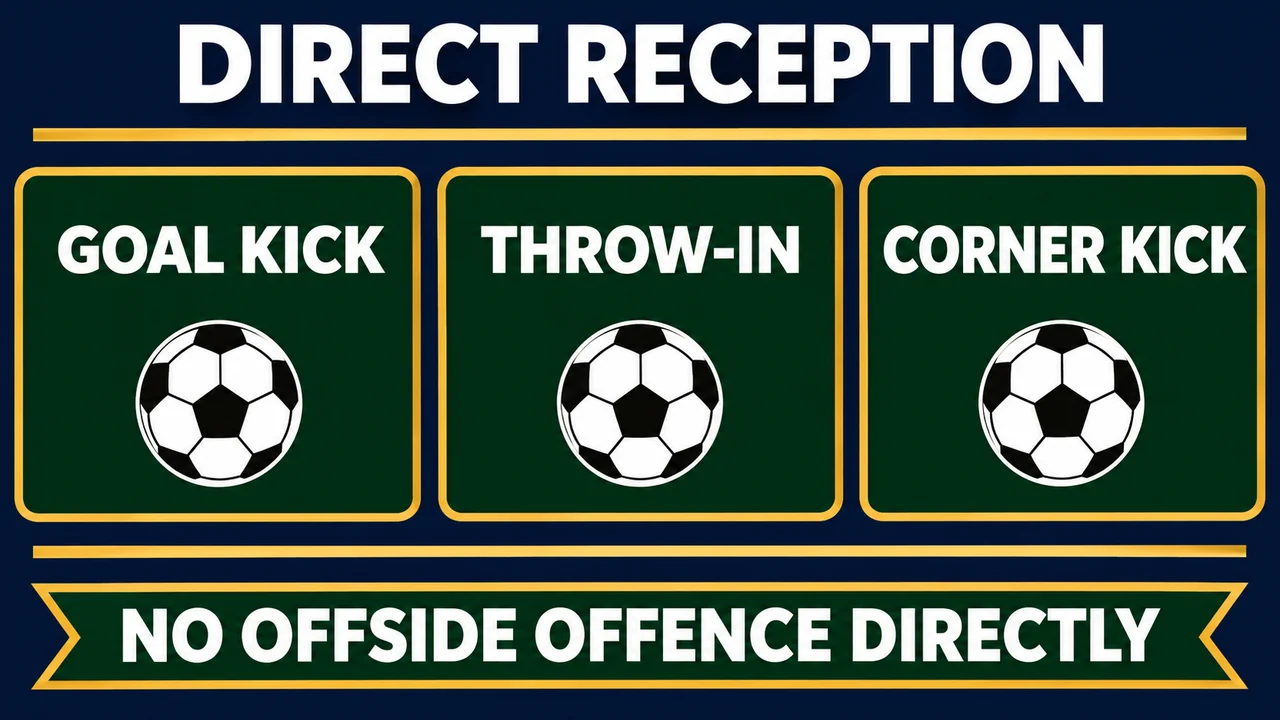
Law 11 says there is no offside offence if a player receives the ball directly from a goal kick, a throw-in or a corner kick. “Directly” matters. If the ball is subsequently played or touched by another teammate, the later action can create a different situation for officials to assess.
If an attacker in an offside position receives the ball from an opponent's deliberate play, that reception is not treated as gaining an advantage, unless the opponent's action was a deliberate save. A rebound or deflection does not, by itself, remove the earlier offside-position concern: the officials still assess whether the attacker gains an advantage or otherwise becomes involved. If the attacker already interfered with an opponent before the defender played the ball, the timing of that earlier action matters too. Law 11 defines deliberate play; a defender reaching for the ball does not automatically prove the legal test has been met.
A line on a still image can show relative position; it cannot establish every touch or whether an attacker interfered with an opponent. Nor can it by itself determine whether a defender's action was deliberate play.
Follow a disputed play in five steps
- Identify the team attacking and the goal line relevant to the decision.
- Find the teammate's relevant play or touch of the ball, rather than starting when the pass is received.
- At that moment, compare the attacker's relevant body parts with the ball, the halfway line and the second-last opponent.
- Follow what the attacker does next: touching the ball and interfering with an opponent are different forms of possible involvement.
- Check the nature of any restart, rebound or opponent's play, then wait for the officials' decision if the evidence is incomplete.
Some competitions use video review or specialised technology, while others do not. Availability and procedures depend on the competition; do not assume a review has occurred simply because a broadcast repeats the incident.
Common questions
Is a player automatically penalised for being in an offside position?
No. Position alone is not an offence. The player's involvement and the other conditions in Law 11 matter.
Does the goalkeeper have to be the last opponent?
No. The position test refers to the second-last opponent; the goalkeeper's actual position is part of the count, not a fixed assumption.
Is a player level with the second-last opponent offside?
Law 11 says a player level with the second-last opponent is not in an offside position. In a close decision, officials assess the relevant body parts and moment of the teammate's touch.
Can a player be offside directly from a corner kick?
Law 11 provides that there is no offside offence when the player receives the ball directly from a corner kick. A later touch by a teammate can create a new situation to assess.
For more football coverage, visit the football section. For the complete definitions and exceptions, read IFAB Law 11 and check the competition's applicable rules.
By IPL Betting. Source and review: This guide uses IFAB Law 11, checked against the 2026–27 law information. The scenarios are invented teaching examples; they are not reconstructions of actual decisions.
Promotional link. Gambling involves financial risk and may be restricted where you live. Participation is for eligible adults.