
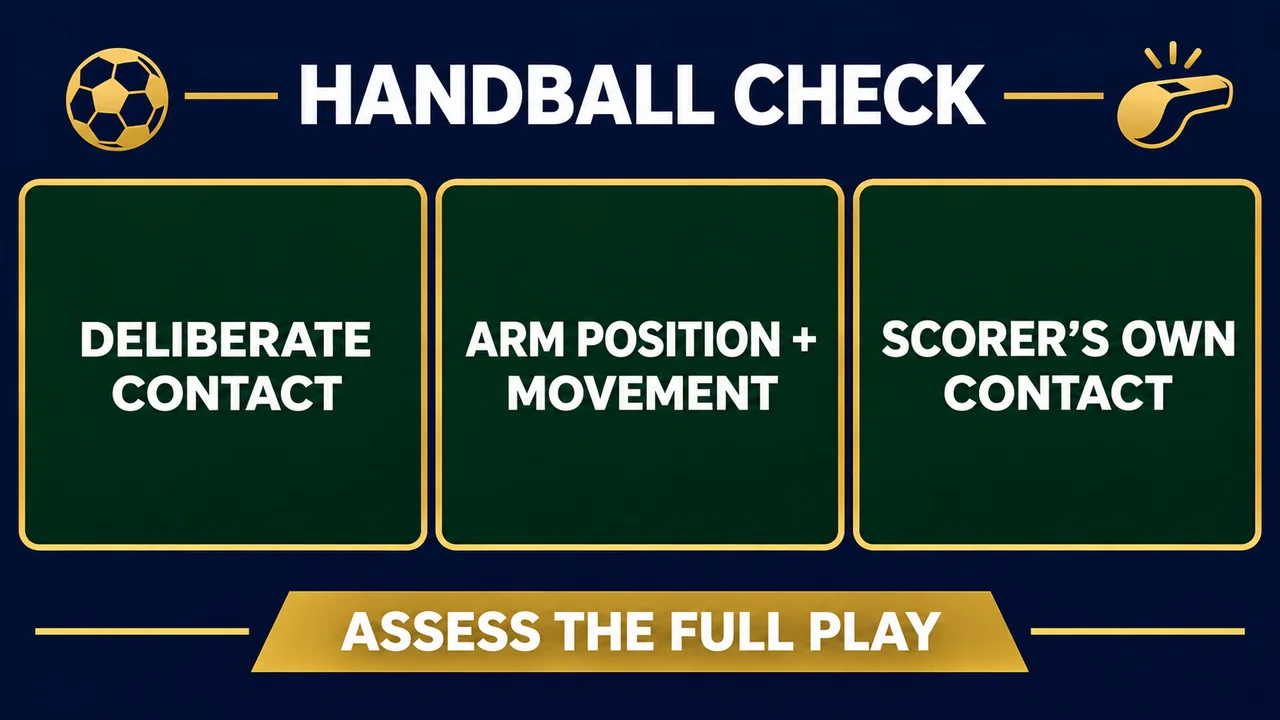
A shot hits a defender's arm inside the penalty area. A penalty kick is not automatic just because the ball and arm made contact. If the broadcast does not show the full sequence, wait for the officials’ ruling before drawing a conclusion. The referee first has to judge whether a handball offence occurred under the applicable law, including the player's action and arm position.
The IFAB Laws of the Game distinguish deliberate contact, an arm position that makes the body unnaturally bigger, and a separate rule about a scorer's own hand or arm. A freeze-frame can show contact while hiding the movement that preceded it. The examples below are invented and explain the 2026–27 law, not a decision in an actual match.
Not every touch is a handball offence
Law 12 makes it an offence to touch the ball deliberately with the hand or arm, including a movement of the hand or arm towards the ball. It also addresses contact when the hand or arm makes the player's body unnaturally bigger. The law asks whether that position is a consequence of, or can be justified by, the player's body movement in the specific situation.
Those are related but different questions. Imagine one defender deliberately moves an arm toward a pass. In another situation, a defender is moving and the ball strikes an arm held away from the body. The referee must assess the relevant facts under the law; the two cases do not become identical merely because both involve contact.
For the boundary between shoulder and arm, Law 12 identifies the upper limit of the arm in line with the bottom of the armpit. Contact above that boundary is not hand or arm contact for this handball test. A tightly cropped television picture may make the exact contact point difficult to establish.
Arm position needs the movement around it
“The arm was away from the body” is a useful observation, not the complete decision. The law connects the position to the player's body movement in that situation. A referee considers what the player was doing, where the arm was, and how the contact occurred rather than applying a single arm-height slogan to every incident.
Imagine a player falling while trying to block a shot. A still image captures the arm away from the torso, but it does not show the beginning of the fall or whether the position is a consequence of the movement. The image alone cannot tell a viewer how the referee should resolve that judgment.
A short distance or a deflection does not automatically excuse contact either; the referee still assesses the relevant movement and arm position. Those details may matter to the assessment, but the official must consider the circumstances and the law as a whole.
A scorer's own hand contact is a separate question
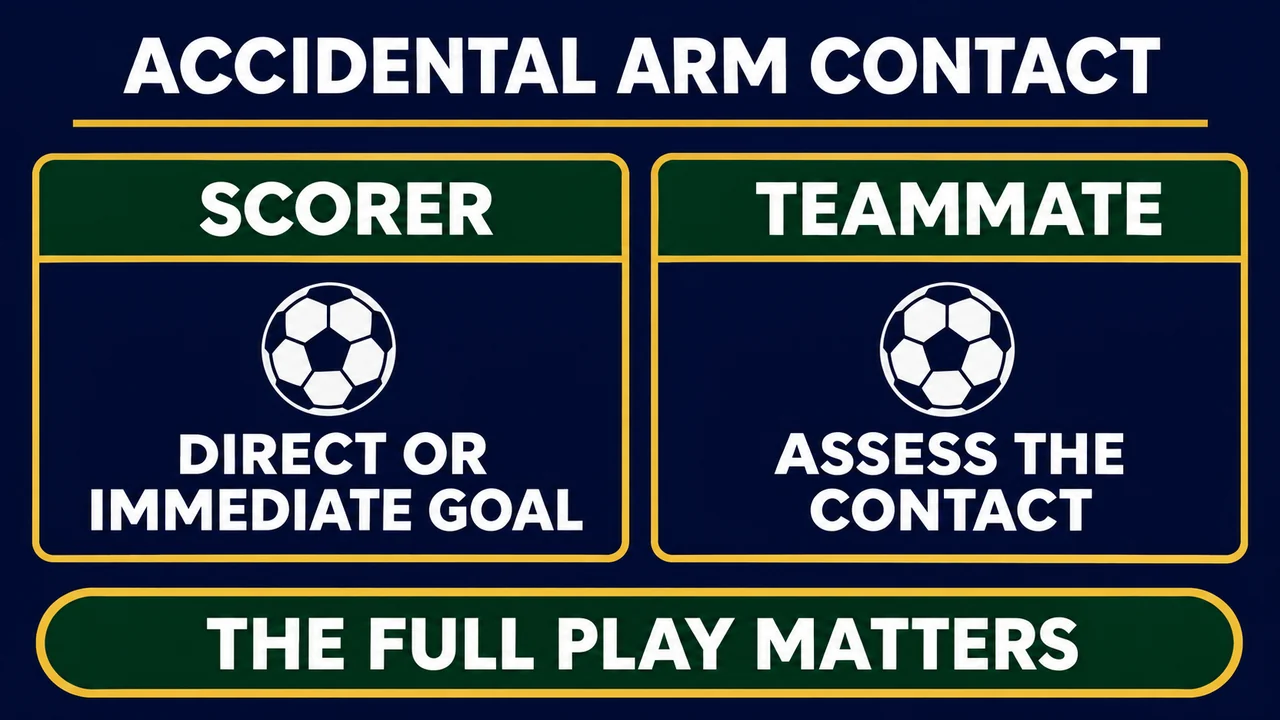
Law 12 contains a specific scoring provision. It is an offence when a player scores in the opponents' goal directly from their hand or arm, even accidentally, or scores immediately after the ball touches their own hand or arm, even accidentally. “Own” and “immediately” are important parts of that description.
Compare two invented sequences. In the first, Attacker A accidentally touches the ball with an arm and immediately scores. The scorer's own contact falls within the specific scoring provision. In the second, teammate B accidentally touches the ball with an arm and A subsequently scores. B's accidental contact is not automatically an offence merely because A scored; officials still consider whether B's contact was deliberate or B's arm position made the body unnaturally bigger, among the relevant facts. The IFAB's Law 12 explanations include examples addressing this distinction.
Do not turn that comparison into a promise that every goal after a teammate's arm contact will stand. Another offence may have occurred, and the referee must assess the complete play.
| Invented incident | Main question under the law | What the picture alone may not reveal |
|---|---|---|
| Defender's arm meets a shot | Was contact deliberate, or did the arm make the body unnaturally bigger? | The player's full movement and the exact contact point |
| Player falls and the arm is away from the torso | Is the arm position a consequence of, or justifiable by, the movement? | The action before the still frame |
| Scorer's own arm is touched before an immediate goal | Was the goal scored directly from, or immediately after, that player's hand or arm contact? | Timing and identity of the scorer |
| Teammate's arm is touched before another player scores | Was that teammate's contact an offence under the relevant tests? | Whether the movement or position is properly visible |
Use the table to identify the question, not to decide the incident. A real ruling may depend on details the image does not show.
When can the restart be a penalty kick?
If the ball is in play and a defending player commits a direct-free-kick handball offence inside their own penalty area, the referee can award a penalty kick, subject to the Laws. The important order is: identify the offence, establish where it occurred and apply the relevant restart. A ball touching an arm inside the area does not skip the first step.
If a handball offence occurs outside the defender's penalty area, the restart may instead be a direct free kick, depending on the circumstances and location. Disciplinary action is a separate question. Do not infer a yellow or red card solely from the fact that a handball offence has been called; the reason and context matter under Law 12.
Outside their own penalty area, the goalkeeper has the same handball restrictions as any other player. Inside it, some prohibited handling—such as handling a ball deliberately kicked to the goalkeeper by a teammate—leads to an indirect free kick, subject to the law's exception when the goalkeeper clearly kicks or attempts to kick the ball to release it into play. Those goalkeeper-specific questions need their own facts and should not be treated as an automatic exemption from every rule.
How to follow a disputed incident
- Identify the player who touched the ball and the part of the body involved.
- Watch the movement before contact, not just the final frame.
- Ask which question applies: deliberate contact, arm position and body movement, or the scorer's own immediate hand contact.
- If a goal follows, distinguish the scorer's contact from a teammate's and identify the timing.
- Once an offence has been established, check where it occurred and how the referee restarts play. If key angles are missing, wait for the official ruling.
Some competitions use video review, but not every match has the same technology or procedures. A broadcast replay is not necessarily an official review, and a replay shown to viewers may not include every available angle.
Common questions
Is every ball-to-arm contact a handball offence?
No. Law 12 distinguishes deliberate contact and an arm position that makes the body unnaturally bigger, among its provisions. The referee assesses the specific situation.
Is the shoulder always treated as the arm?
No. For the handball boundary, Law 12 places the upper limit of the arm in line with the bottom of the armpit. Officials must still decide where contact occurred.
Can a scorer's accidental hand contact matter?
Yes. The law includes a specific offence for a player scoring directly from their own hand or arm, or immediately after it touches their own hand or arm, even if accidental.
Does a handball offence in the penalty area always mean a red card?
No. The restart and disciplinary decision are separate questions. The reason, effect and circumstances of the offence matter.
For more football coverage, visit the football section. For the complete wording and examples, read IFAB Law 12 and the competition's applicable rules.
By IPL Betting. Source and review: This guide uses the linked IFAB Law 12, checked against the 2026–27 law information. Its scenarios are invented for explanation and are not descriptions of real matches.
Promotional link. Gambling involves financial risk and may be restricted where you live. Participation is for eligible adults.