
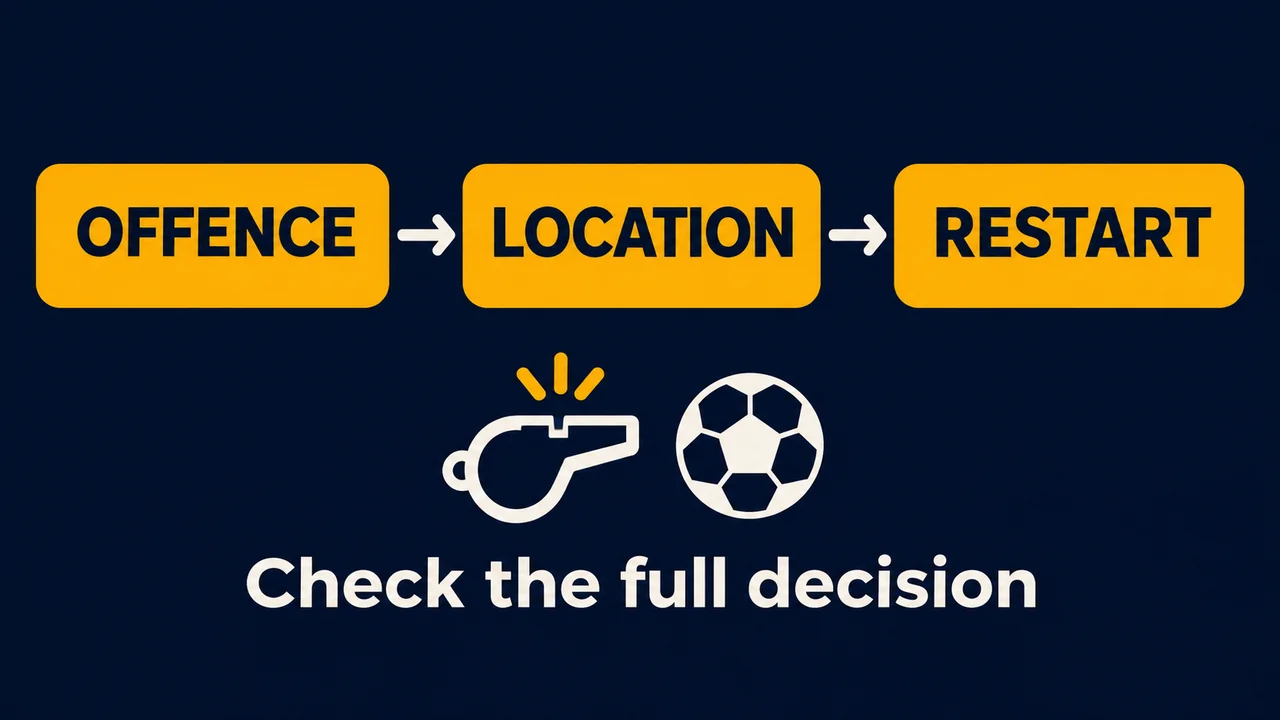
A defender trips an attacker near the edge of the penalty area. The referee points to the spot, but a replay makes the contact look close to the line. If the ball is in play, a direct-free-kick offence by a defender inside their own penalty area can result in a penalty. The offence and its location both matter. The line is part of the area. If the camera does not establish the relevant contact or location, wait for the officials' ruling.
Not every whistle inside the area leads to a penalty. Some offences lead to an indirect free kick instead. The examples below are invented, and use the 2026–27 IFAB Laws as their reference; the referee applies the law to the actual incident.
Start with the offence, then the location
Imagine two challenges while the ball is in play. In each, the referee judges that a defender has carelessly tripped an opponent, a direct-free-kick offence. In the first, the offence occurs outside the defender's penalty area; in the second, it occurs inside. The first normally results in a direct free kick; the second results in a penalty kick. The point at which the offence is committed matters, not simply where the attacker falls.
The boundary belongs to the area it marks, so a direct-free-kick offence on the penalty-area line is treated as inside it. A television freeze-frame may not reveal the first contact, whether a foul was committed or the full sequence. For example, if a defender holds an opponent while the ball is in play and the holding offence starts outside but continues into the defender's area, the referee awards a penalty. Do not use a single frame to override the announced decision.
Law 12 describes direct and indirect free-kick offences. The specific restart can depend on who committed the offence, where it occurred, whether the ball was in play and other provisions in the Laws. The simple pair above is a teaching example, not every possible case.
What direct and indirect free kicks allow
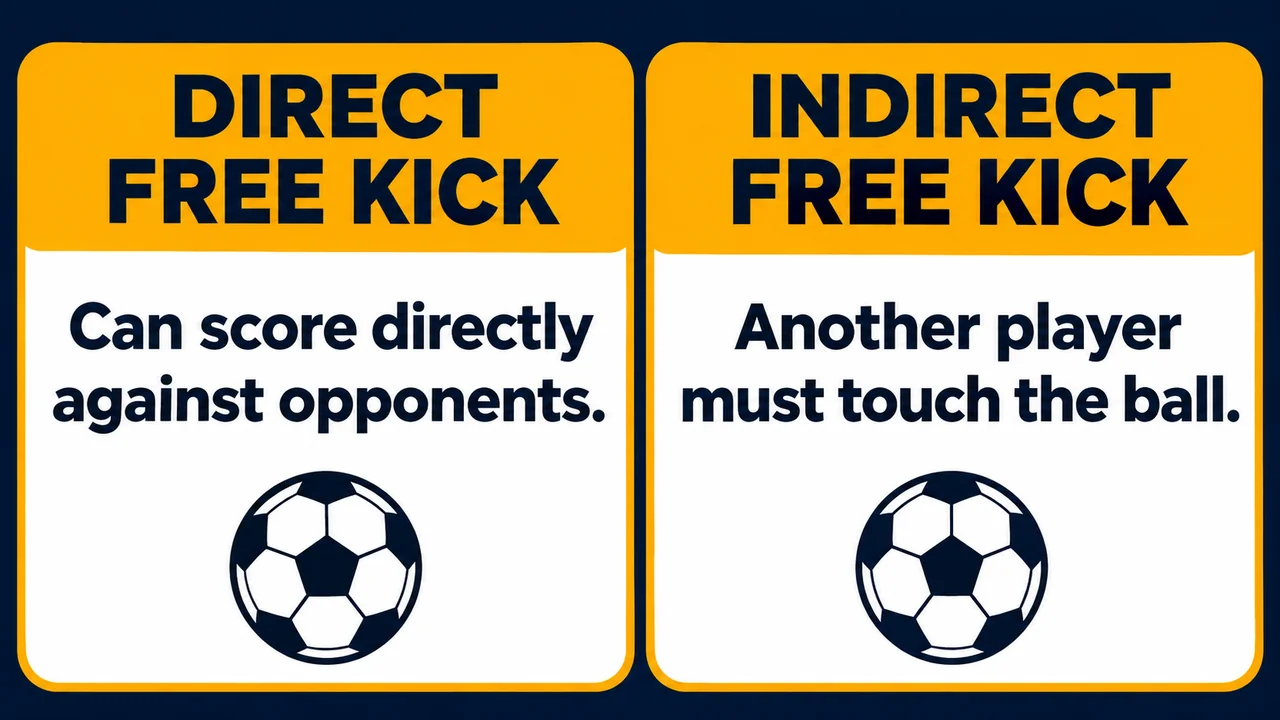
The name of the free kick tells you whether the kicking team can score directly against the opponents from that kick. It does not tell you the distance from goal, the seriousness of an incident or whether a particular player deserves a card.
For a direct free kick, the kicking team can score if the ball enters the opponents' goal directly, provided the kick was taken correctly and no other offence prevents the goal. For an indirect free kick, another player must touch the ball before a goal can be scored against the opponents. The referee signals an indirect free kick by raising an arm as described in Law 13.
| Correctly taken kick | Ball enters the opponents' goal without another touch | Ball enters the kicking team's own goal without another touch |
|---|---|---|
| Direct free kick | Goal | Corner kick to the opponents |
| Indirect free kick | Goal kick to the opponents | Corner kick to the opponents |
There is an important signalling exception: if the referee fails to signal an indirect free kick and the ball is kicked directly into the goal, Law 13 requires the kick to be retaken. The table assumes the kick is correctly taken and signalled; it is not a substitute for checking the officials' decision and the full law.
Can an indirect free kick happen inside the area?
Yes. As one example, the Laws specify an indirect free kick for certain goalkeeper handling offences inside the goalkeeper's own penalty area. That does not become a penalty kick merely because it happened inside the area. The exact goalkeeper handling provision and its exceptions matter; Law 12 sets them out.
If an attacking team is awarded an indirect free kick for an offence inside the opponents' goal area, Law 13 places the kick at the nearest point on the goal-area line parallel to the goal line. Other free-kick location exceptions exist. A viewer should therefore avoid assuming that every restart occurs exactly where a player was standing in a cropped replay.
What changes at a penalty kick?
A penalty kick is a particular restart governed by Law 14. The ball is placed at the penalty mark, the kicker is identified and players take the positions required by the law. The referee signals for the kick; the ball is in play when it is kicked and clearly moves. A goal can be scored directly from a penalty kick.
The goalkeeper and other players have positioning rules too. If someone infringes them, the outcome depends on the infringement and what happens next. Do not assume every early movement requires a retake: the current law distinguishes different incidents, including when a player encroaches and becomes involved. The officials' decision and the applicable wording matter.
A penalty kick during a match is also different from a penalty shoot-out used to decide a winner after the match. Whether a competition uses extra time or a shoot-out depends on its rules. For historical tournament context, see the site's 2026 World Cup knockout guide.
A viewing checklist
- Confirm that the referee has identified an offence; contact alone is not necessarily a foul.
- Identify the type of offence and which team committed it.
- For a possible penalty, check the offence's location relative to the defending team's penalty area and line.
- Watch the referee's signal and the restart: direct free kick, indirect free kick or penalty kick.
- If the clip omits the decision, location or another relevant touch, wait for the official ruling.
Common questions
Does a foul on the penalty-area line count as inside?
The line forms part of the penalty area. A direct-free-kick offence by a defender on that line can therefore result in a penalty, subject to the full circumstances and the Laws.
Is every offence inside the penalty area a penalty kick?
No. For example, a goalkeeper handling offence that carries an indirect free kick can remain an indirect free kick inside the area. The law's conditions and exceptions determine the restart.
Can a player score directly from an indirect free kick?
Not against the opponents without the ball touching another player. If a correctly signalled indirect kick goes directly into the opponents' goal, the restart is a goal kick; Law 13 provides a retake if the referee failed to signal the indirect kick.
Is a penalty shoot-out the same as a penalty kick awarded during play?
No. They serve different purposes and have different procedures. Check the competition's rules for how a tied match is decided.
For more coverage, visit the football section. This guide uses IFAB Law 12, Law 13 and Law 14; follow the competition's current regulations and the referee's final decision for an actual game.
By IPL Betting. Source and review: The restarts and examples above are based on IFAB's 2026–27 Laws. The scenarios are invented teaching examples, not reports of real incidents.
Promotional link. Gambling involves financial risk and may be restricted where you live. Participation is for eligible adults.