
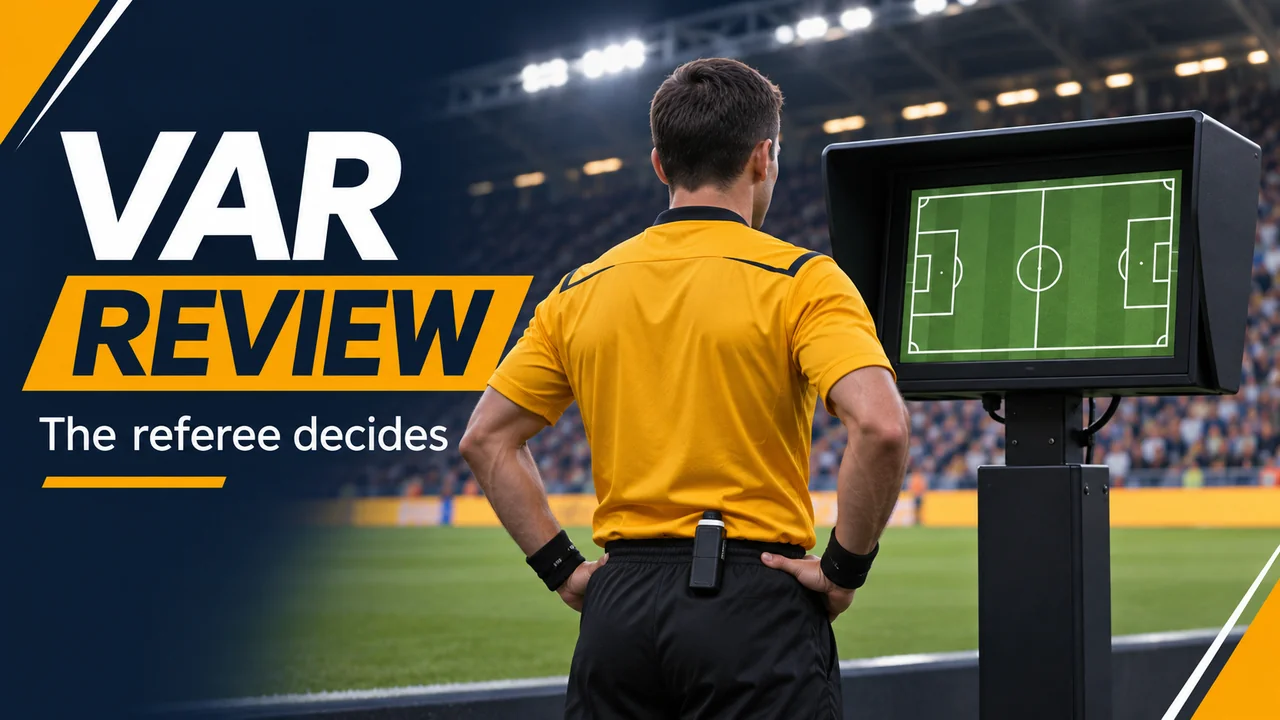
A defender challenges an attacker in the penalty area. The referee waves play on, and a television replay appears to show contact. That replay alone does not mean a penalty must follow: the officials must assess the incident against the Laws, and a video review is limited by the applicable protocol. The referee makes the final decision.
In a match using VAR, the video assistant can check a relevant incident and, when the protocol allows, recommend a review. A check is not the same as the referee watching a monitor, and a review does not guarantee that the original decision will change. If the footage does not show the whole challenge, wait for the officials' decision rather than treating a single frame as a verdict.
This guide uses the IFAB 2026–27 Laws of the Game and its VAR protocol. The examples are invented, not descriptions of actual matches. Not every competition uses VAR; organisers need the required implementation approval, and some options depend on the competition rules.
The first decision still matters
Match officials normally make an initial decision on the field, including a decision to let play continue; a serious incident they did not see is an exception. VAR is not there to replace that initial decision with a fresh vote on every challenge. For the principal review categories, the protocol refers to a clear and obvious error or a serious missed incident.
Imagine the referee sees a challenge and decides there is no foul. The VAR checks the available footage and considers whether it reveals a potential clear and obvious error. If a review is recommended, the referee decides whether to initiate it. The referee may then confirm the original decision or change it after considering the information.
The referee may decide using information from the VAR or after viewing footage at the pitch-side monitor. The exact route depends on the incident: the protocol says a VAR-only review is usually appropriate for factual matters such as the location of an offence or an offside position. An on-field review can still be used when appropriate. Neither route means the VAR makes the final decision.
Which incidents can VAR review?
The protocol covers goals, penalty decisions, red cards and mistaken identity, plus a limited incorrect-corner option when a competition adopts it. The permitted scope inside each category matters. A foul can become relevant to a review in the build-up to a goal or penalty, but that does not turn every ordinary foul elsewhere on the pitch into a reviewable event.
| Incident | What the protocol can cover | What a viewer should avoid assuming |
|---|---|---|
| Goal or no goal | A goal decision or a relevant attacking offence in the build-up | That every earlier incident in the match can be reopened |
| Penalty or no penalty | Whether a penalty was wrongly awarded or a penalty offence missed, including the location of an offence | That contact inside the area automatically means a penalty |
| Red card | Direct red-card incidents and a clearly incorrect second caution that results in a sending-off | That VAR can intervene for every missed yellow-card offence |
| Mistaken identity | The referee clearly identifies the wrong player for a yellow or red card; the offence may have been committed by a player of either team | That identity review automatically reopens the underlying offence |
| Incorrect corner | A clearly incorrect award, when the competition adopts this option and the decision can be changed immediately without delaying the restart | That every corner or every possible missed corner is reviewable |
The current rules on a clearly incorrect second caution differ from older explanations that exclude all second yellow cards. IFAB's FAQ distinguishes an incorrect second caution actually shown from a potential second-caution offence that the referee missed: the latter is not a reason for VAR to intervene under that provision. A competition may also adopt the limited corner-kick option shown in the table. Check the competition's current regulations before assuming it applies.
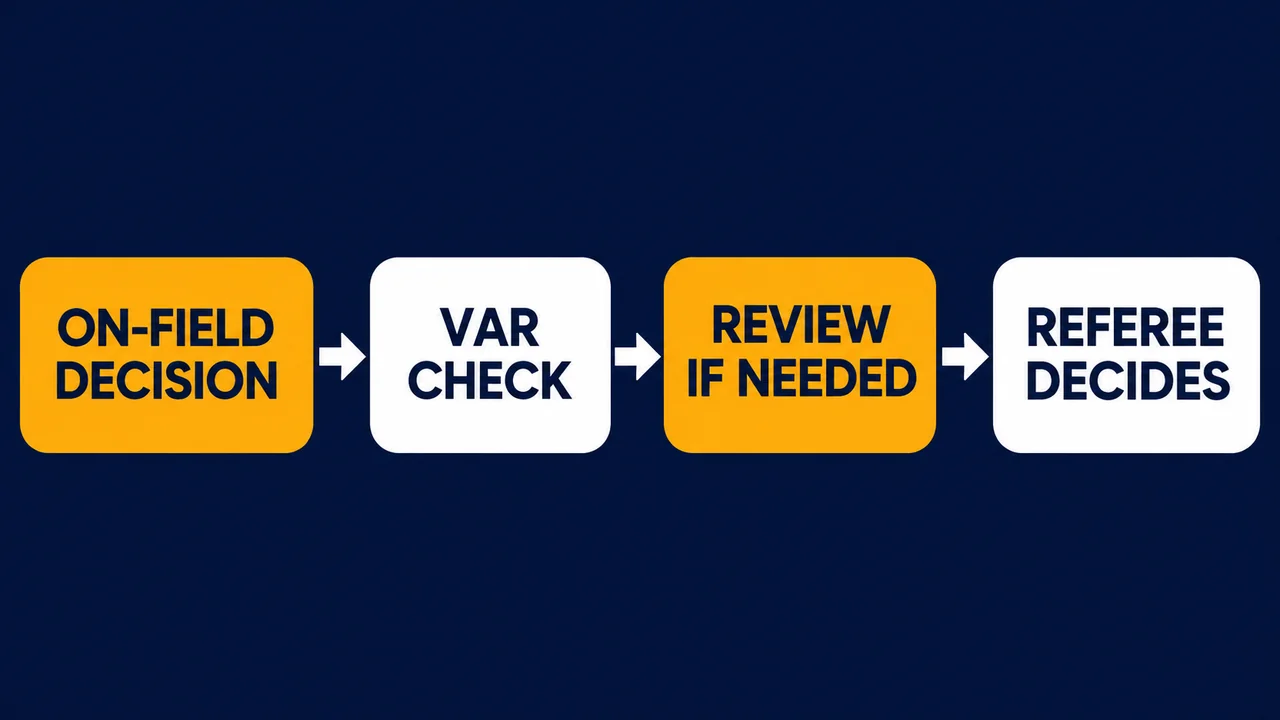
A check, a review and the final signal
In a match using VAR, relevant decisions and incidents are checked; a check can be silent and does not necessarily mean a monitor review. If the check identifies a potential clear and obvious error or serious missed incident, the VAR communicates with the referee and can recommend a review; only the referee can initiate one.
Return to the invented penalty example. Suppose the available angles suggest the defender's contact may have caused the attacker to fall. The VAR can provide information and recommend a review if the relevant threshold appears to be met. The referee might watch the replay, consider the context and make a final decision. If the referee does not change the original call, that is not evidence by itself that no check took place.
The referee uses the TV signal before communicating the final decision after a review. Some competitions also use public explanations under the applicable guidelines, but viewers should not expect the same announcement system at every match. Accuracy takes priority over speed; the protocol sets no fixed maximum time for a review.
Why a single replay may be misleading
One camera can hide the point of contact; slow motion can make a challenge look different from the same incident at normal speed. The officials may also need to consider where an offence occurred, whether the ball was in play and the sequence leading to the decision. A still image does not necessarily answer those questions.
If play has stopped and restarted, the scope for a review is restricted. The protocol sets exceptions, including mistaken identity and specified serious sending-off offences. Do not infer that a decision can always be reopened simply because a new clip appears online.
For viewers following a live market, a scoreboard, stream and operator's settlement rules may update at different times. The VAR protocol explains the match decision; it does not establish the terms of a particular bet. If the market's accepted rules or the official ruling are unclear, stop and check them before acting.
A quick viewing checklist
- Establish whether the competition uses VAR and whether any competition-specific option applies.
- Identify the on-field decision, including a decision to let play continue.
- Ask which permitted review category is involved; do not assume every foul or yellow card qualifies.
- Separate the VAR's check or recommendation from the referee's final decision.
- If the available footage or decision is incomplete, wait for the official ruling.
Common questions
Does the referee have to use the monitor?
No. The referee can decide based on information from the VAR or after an on-field review. The appropriate procedure depends on the incident and the protocol.
Can VAR reverse a second yellow card?
The 2026–27 protocol permits assistance for a clearly incorrect second caution that was shown and resulted in a red card. Its FAQ says VAR cannot intervene merely because a possible second-caution offence was missed.
Can VAR award a corner?
The protocol provides a competition option for a clearly incorrectly awarded corner when the decision can be changed immediately without delaying the restart. It should not be read as a general power to review every corner or missed corner.
Does a review always change the decision?
No. The referee can confirm the original call or change it where the protocol's conditions are met. The final decision remains with the referee.
For broader coverage, visit the football section. The 2026 World Cup knockout guide provides historical tournament context; it is not a live match guide.
By IPL Betting. Source and review: This guide summarises the IFAB 2026–27 VAR protocol and its published questions. The penalty scenario is hypothetical. The complete protocol and the relevant competition regulations govern the actual match.
Promotional link. Gambling involves financial risk and may be restricted where you live. Participation is for eligible adults.