
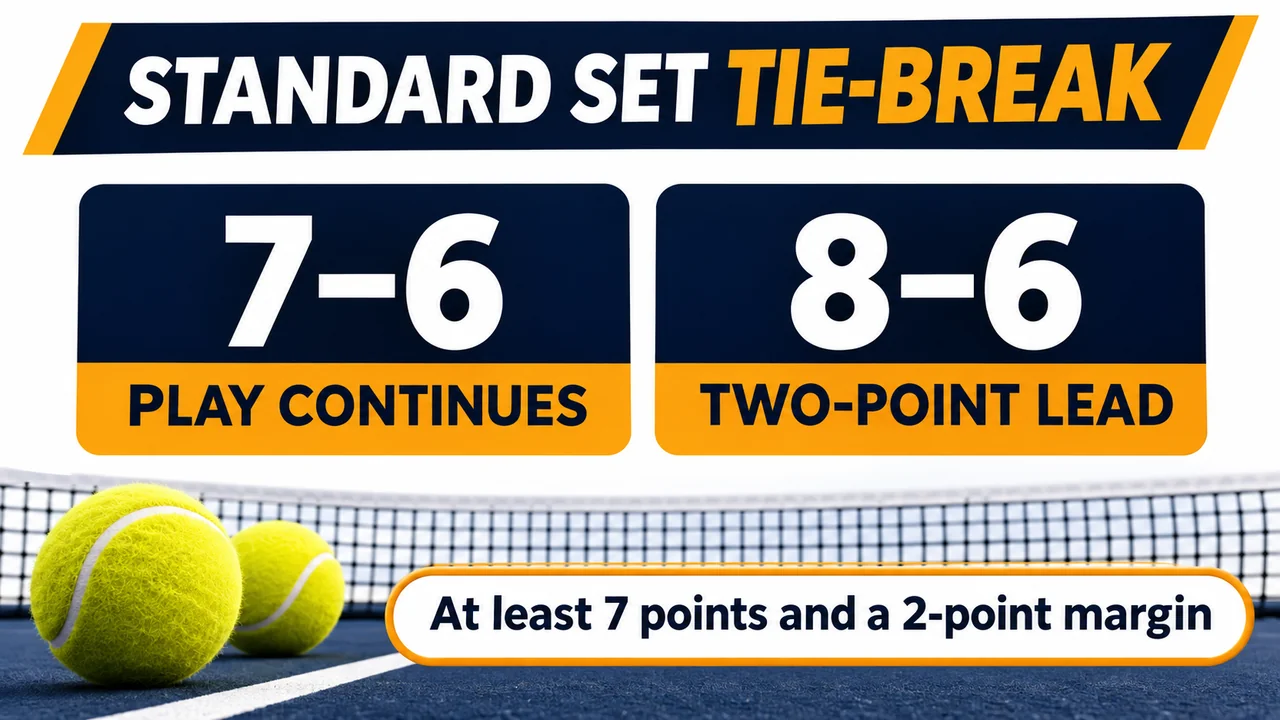
A tennis tie-break reaches 6–6 and continues. That is expected in the standard seven-point tie-break: a player or team must reach at least seven points and lead by two. A 7–6 lead is not enough; 8–6 is. If the scoreboard does not identify the event's tie-break format, check the competition rules before assuming the target or predicting the end.
This guide uses the standard tie-break game in the 2026 ITF Rules of Tennis. The point sequence is invented. Events can use authorised alternatives, including a match tie-break that replaces a deciding set.
The score counts points, not 15 and 30
In an ordinary tennis game the point calls are love, 15, 30 and 40. In a tie-break game, points are counted numerically: zero, one, two and so on. Under the standard method, the first player or team to win at least seven points with a two-point margin wins the game and the set.
At 6–5, the leader has a chance to finish on the next point. If the other player wins it, the score becomes 6–6. At 7–6 the leader is still only one point ahead; the score could become 8–6 and end, or 7–7 and continue. The two-point condition matters as much as the target of seven.
A tie-break game is commonly played at six games all in a tie-break set, but the applicable set format matters. Some events use different deciding-set procedures. Read the event regulations and official score before treating a displayed 6–6 as proof of a particular format.
One serve, then blocks of two
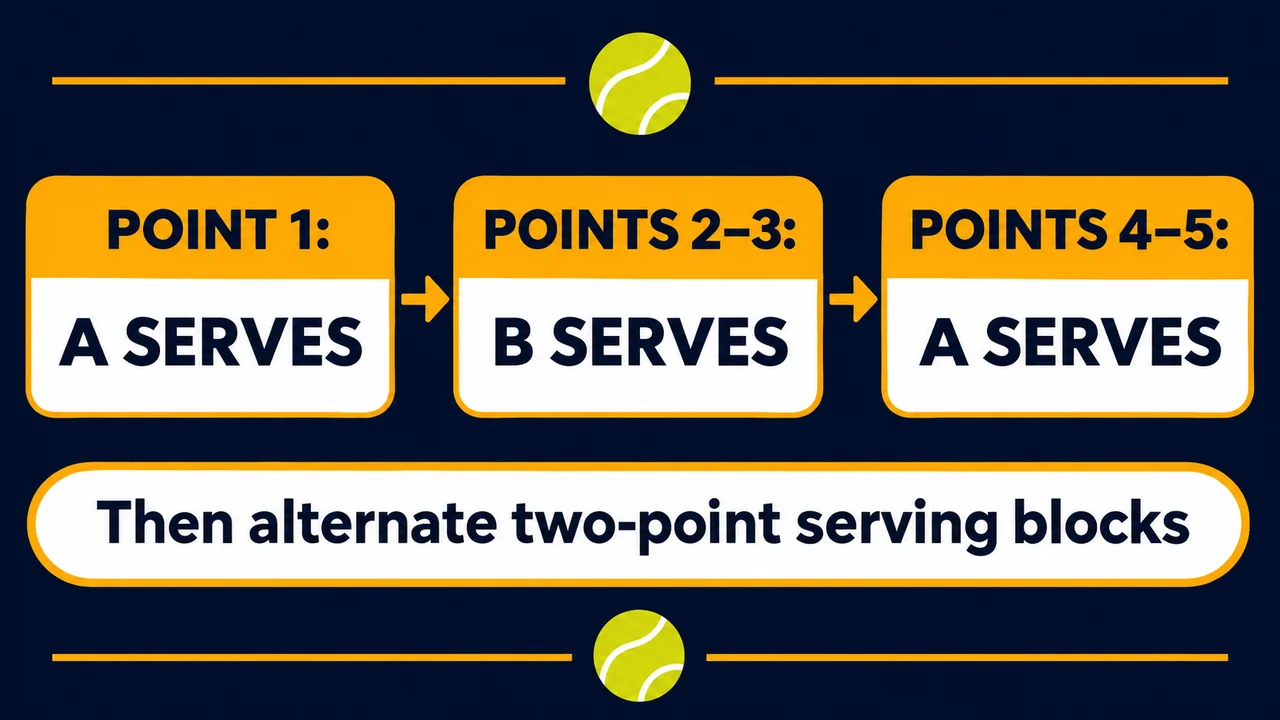
In a singles tie-break, the player whose turn it is to serve starts with the first point. The opponent serves the next two points; the players then alternate serving two points each until the tie-break ends. The first server serves point 1, the opponent serves points 2 and 3, the first server serves points 4 and 5, and so on.
Service courts also alternate point by point. The first point starts from the right service court; the next is served from the left, then the right, continuing in that alternating pattern. A change of server does not reset the right–left sequence. In a tie-break within a doubles set, the next player due to serve takes each two-point block, with each team's service rotation continuing in the same order as during that set.
Under the standard rule, the player or team that served first in the tie-break receives in the first game of the next set. A match tie-break that replaces a deciding set has no next set, and competition rules may specify other authorised formats.
A twelve-point example
Imagine Alex starts serving against Blair. The score shown after each point is Alex's points first, so it is easy to follow even when Blair serves. This is a hypothetical teaching example, not a real match.
| Point | Server | Point winner | Score after point (Alex–Blair) |
|---|---|---|---|
| 1 | Alex | Alex | 1–0 |
| 2 | Blair | Blair | 1–1 |
| 3 | Blair | Alex | 2–1 |
| 4 | Alex | Blair | 2–2 |
| 5 | Alex | Alex | 3–2 |
| 6 | Blair | Blair | 3–3 |
| 7 | Blair | Alex | 4–3 |
| 8 | Alex | Blair | 4–4 |
| 9 | Alex | Alex | 5–4 |
| 10 | Blair | Blair | 5–5 |
| 11 | Blair | Alex | 6–5 |
| 12 | Alex | Alex | 7–5 |
Alex wins 7–5: the score reaches seven and the margin is two. Notice that Blair serves points 10 and 11 even though Alex wins point 11; the point winner does not decide the next server in this sequence.
In a standard tie-break, players change ends after every six points without a rest. They change ends after point 6. Point 12 ends the tie-break and the set; if another set follows, they also change ends at the end of this 13-game set. A change of ends does not itself alter the two-point serving blocks. Some competitions may adopt an authorised alternative for changing ends, so check the event's current rules.
Set tie-break or match tie-break?
A set tie-break settles the set once the games reach the score specified by that format. A match tie-break can instead be used as an authorised alternative to a deciding final set. Depending on the rules chosen for the event, a match tie-break may have a seven- or ten-point target, with a two-point margin under the ITF alternatives. A ten-point tie-break played at 6–6 in a final set is not the same as replacing that set with a match tie-break.
Do not assume a 10-point match tie-break and a set tie-break are interchangeable. First find out whether the event is playing a full deciding set or replacing it with a match tie-break, then check the target. In doubles, the original team service order continues, but teams may alter the serving and receiving order within each team before the match tie-break. Tournament rules and the official match information are the right sources for a specific event.
For a betting market, the way a match tie-break is recorded or settled can depend on the operator's accepted terms. A broadcast score is not a substitute for those terms. If the market's treatment or official result is unclear, pause and check both before acting.
Five things to check on a broadcast
- Confirm whether the current segment is a set tie-break or a match tie-break.
- Identify the event's target and required margin.
- Find the first server, then track the one-point opening serve and the following two-point blocks.
- Keep the service court and end changes separate from the service order.
- Wait for the official score if the graphic or stream is delayed.
Common questions
Does the first player to seven always win?
Not in the standard tie-break unless that player also leads by two points. At 7–6 play continues; at 8–6 it ends.
Who serves after the first point?
In the standard singles order, the opponent serves points 2 and 3. The players then alternate two-point serving blocks. In a set tie-break, doubles teams follow the service rotation established during that set. A match tie-break replacing the final set has a separate option to alter the order within each team.
Does the player who wins a point serve the next one?
Not because of winning the point. The service order follows the prescribed sequence regardless of who wins a particular point.
Is a 10-point match tie-break always played in a deciding set?
No. A match tie-break is an alternative format used where the competition has adopted it. Check the specific event's rules.
Visit the tennis section for more coverage. The ITF 2026 Rules of Tennis, especially Rules 5, 6, 10, 17 and 29 and Appendix VI, describe the standard sequence and authorised alternatives; a tournament's regulations determine the format in use.
By IPL Betting. Source and review: The point-by-point example is invented from the 2026 ITF rules. It is not a record of an actual match or a claim that every event uses the same deciding format.
Promotional link. Gambling involves financial risk and may be restricted where you live. Participation is for eligible adults.