
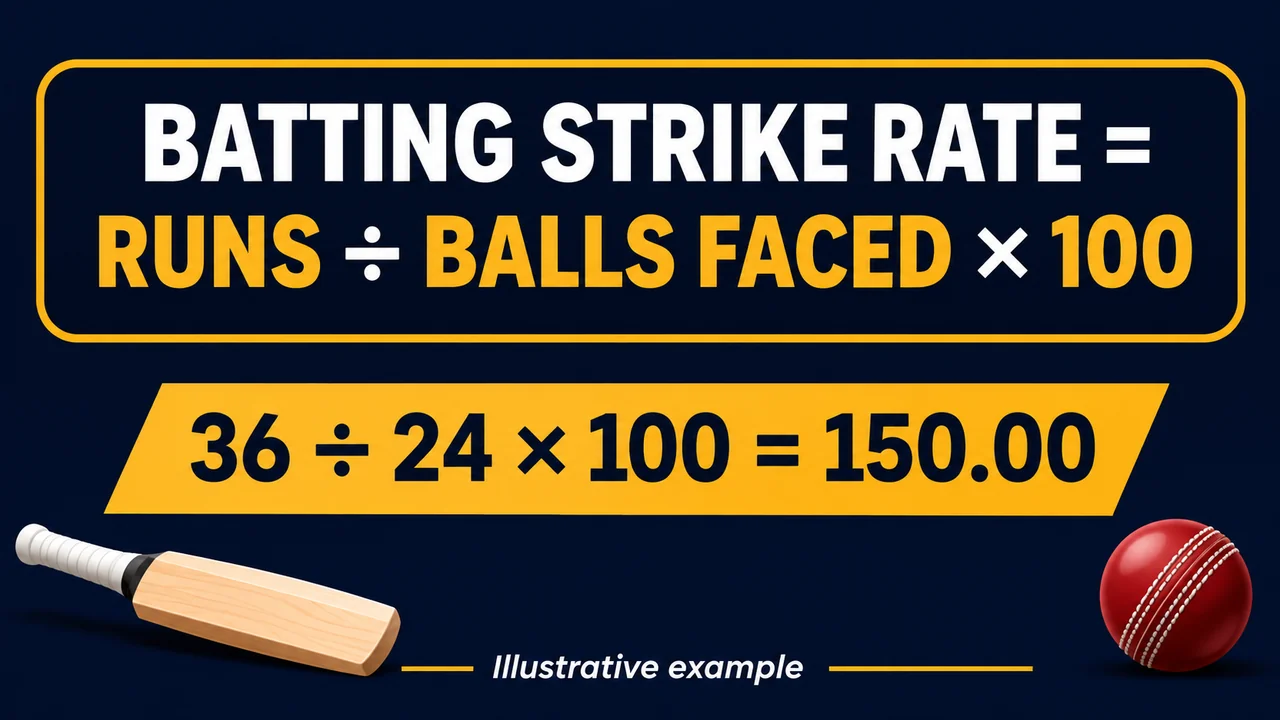
A batter has 36 runs from 24 balls, and the scorecard shows a strike rate of 150.00. That means the batter scored at a rate of 150 runs per 100 balls: 36 divided by 24, then multiplied by 100. It does not predict what the batter will score next. If the runs or balls-faced figure is missing or still changing, wait for the official scorecard before calculating.
This guide concerns batting strike rate. Its examples are invented and use the formula in New Zealand Cricket's scorer's companion. Bowling strike rate is a different statistic.
Start with the batter's two numbers
The calculation is:
Batting strike rate = batter's runs ÷ balls faced × 100
For 36 runs from 24 balls, divide 36 by 24 to get 1.5 runs per ball. Multiply by 100 and the strike rate is 150.00. It is a rate expressed per 100 balls, not a claim that the batter actually faced 100 balls.
Use the runs and balls faced recorded for the same batter on the scorecard. The team's total can include runs credited elsewhere, including extras; it is not the numerator for an individual batter's strike rate. If you are using a live feed, its figures can be corrected, so record the scorecard and time you checked.
Three examples with different samples
| Invented innings | Calculation | Strike rate |
|---|---|---|
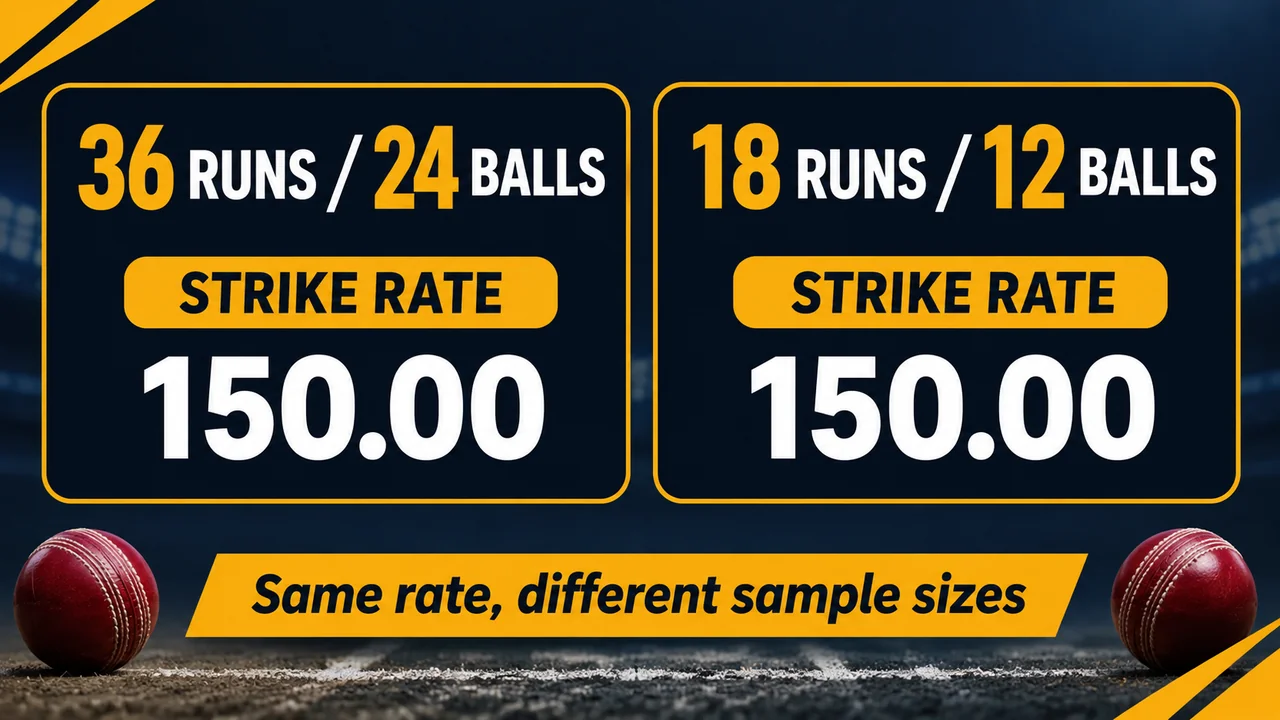
| 36 runs from 24 balls | 36 ÷ 24 × 100 | 150.00 |
| 18 runs from 12 balls | 18 ÷ 12 × 100 | 150.00 |
| 42 runs from 35 balls | 42 ÷ 35 × 100 | 120.00 |
The first two innings have the same rate even though one contains twice as many runs and balls. The rate makes their scoring pace comparable on that arithmetic measure; it does not make the innings equally valuable in every match context. The target, match phase, wickets available and conditions can differ.
At the start of an innings, a single delivery can move the rate sharply. For example, four runs from the first recorded ball gives a strike rate of 400.00, but one ball is too small a sample to support a reliable prediction about the rest of the innings. When no balls faced are recorded, do not divide by zero: the calculation is undefined until a denominator exists.
Is 150 a percentage?
It is better read as 150 runs per 100 balls at that observed pace. Because it is scaled to 100 balls, a strike rate can be above 100; it is not a probability and does not mean a batter will score a run on 150% of deliveries.
You can compare the rates, but keep the ball counts alongside them: 150 from 12 balls rests on a smaller sample than 150 from 24. Neither proves what would happen over another 100 deliveries.
Strike rate is not batting average or team run rate
Batting strike rate uses runs and balls faced. Batting average is commonly total runs divided by dismissals: a not-out innings contributes runs without adding a dismissal, as illustrated by the Association of Cricket Statisticians. Being not out does not change the strike-rate formula for an innings: use that batter's runs and balls faced.
Team run rate concerns the team's scoring per over, not one batter's runs per 100 balls. The two numbers have different numerators and denominators. A scorecard's extras and the contributions of the other batter can make the team total move differently from one player's figures.
For an overview of the other fields, see the site's cricket scorecard guide. Check the source's recorded figures rather than reconstructing balls faced from a short clip; scoring conventions and corrections can affect the published data.
A practical check before comparing batters
- Confirm that the statistic is batting strike rate, not bowling strike rate or team run rate.
- Write down the same batter's credited runs and recorded balls faced.
- Calculate runs divided by balls, then multiply by 100; do not divide if balls faced is zero.
- Keep the ball count, innings phase and match context beside the rate.
- If a live score or a market is unclear, pause and check the official record and the market's accepted terms rather than treating the rate as a forecast.
Common questions
Can two different scores have the same strike rate?
Yes. In the examples above, 36 from 24 balls and 18 from 12 both equal 150.00 because the runs-to-balls ratio is the same.
Does being not out change a batter's strike rate?
The innings strike-rate formula still uses that batter's runs and balls faced. Not-out status matters differently when calculating a batting average based on dismissals.
Is a strike rate above 100 an error?
No. It means the observed pace is more than one run per recorded ball faced, expressed on a per-100-ball scale. It is not a probability.
Can strike rate be calculated before a batter has faced a ball?
Not with a zero denominator. Wait for a recorded ball faced and the associated runs figure; a display may use a placeholder until then.
The New Zealand Cricket scorer's companion sets out the calculation. For a specific competition, use its official scorecard and published scoring conventions.
By IPL Betting. Source and review: The figures are invented arithmetic examples based on the cited scoring formula. They are not player statistics, a performance ranking or a prediction.
Promotional link. Gambling involves financial risk and may be restricted where you live. Participation is for eligible adults.