
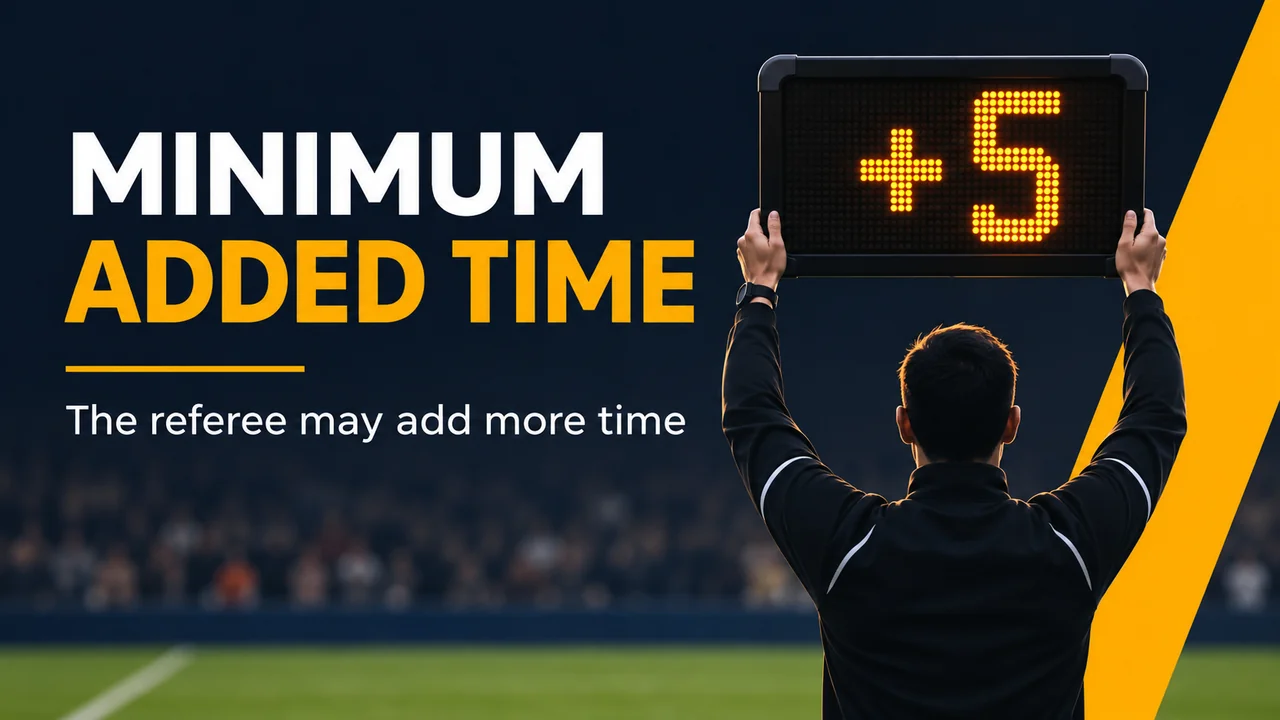
The fourth official shows five minutes at the end of the second half, but play continues after the television clock reaches 95:00. That is not automatically a timing error. If the broadcast does not show the full sequence, wait for the officials’ ruling before drawing a conclusion. Under IFAB Law 7, the displayed figure is the minimum additional time decided by the referee, who may increase it if more time is lost.
The referee keeps the match time and decides when the half ends. A television clock, a board and a short clip do not necessarily show every stoppage the referee has considered. The examples in this guide are invented and use the 2026–27 Laws of the Game as their reference; individual competition rules can supply additional details.
What additional time is for
Law 7 requires the referee to allow for playing time lost in each half, including through substitutions, injuries, time-wasting, disciplinary sanctions, permitted medical breaks, video-review delays and goal celebrations. It also allows for other significant delays in restarting play, including delays caused by an outside agent.
“Injury time” is a familiar name, but injuries are not the only possible reason for the allowance. A long substitution sequence or a delayed restart may also be relevant. Conversely, a viewer counting every pause on a television timer should not assume that the sum will exactly match the referee's allowance. The referee assesses playing time lost rather than mechanically adding the full length of every interruption. IFAB describes an injury stoppage beginning seconds before normal time ends and lasting longer than the remaining playing time: in that example, the original three minutes decided by the referee are indicated when play restarts and are played, rather than adding the full five-minute stoppage.
This is not a promise that each substitution, celebration or review produces a fixed number of added seconds in every competition. Some competitions issue more detailed instructions. Check the competition's current guidance before treating a suggested calculation as a universal law.
Five minutes means at least five
Imagine the second half approaches 90 minutes and the fourth official indicates a minimum of five additional minutes. During those five minutes, play stops again for an injury. The referee may increase the allowance to account for further time lost, so the half can continue beyond the five-minute minimum. The board is an indication, not a final whistle. The referee decides when the half ends.
The injury delay alone does not tell a viewer the exact time of the final whistle. The broadcast clock may not be the referee's official timepiece, and the referee assesses the stoppage and the relevant circumstances. Treat “at least five” as the usable information, not as a prediction that play must stop at precisely 95:00 or at a specified later second.
Law 7 says the indicated additional time may be increased but not reduced. The timing indication is made at the end of the final minute of the half by the fourth official where one is appointed. Not every level of football has the same match-official arrangements or a televised board.
| Hypothetical event | What a viewer knows | What remains with the referee |
|---|---|---|
| Five additional minutes are indicated | Five minutes is the stated minimum | The precise timekeeping and final whistle |
| A later injury causes another delay | More time may be allowed | How much allowance is appropriate |
| The television clock reaches 95:00 | The broadcast has reached a displayed time | Whether the official time and all allowances have been completed |
These examples are not the record of a real match. They do not establish a fixed formula for measuring stoppages.
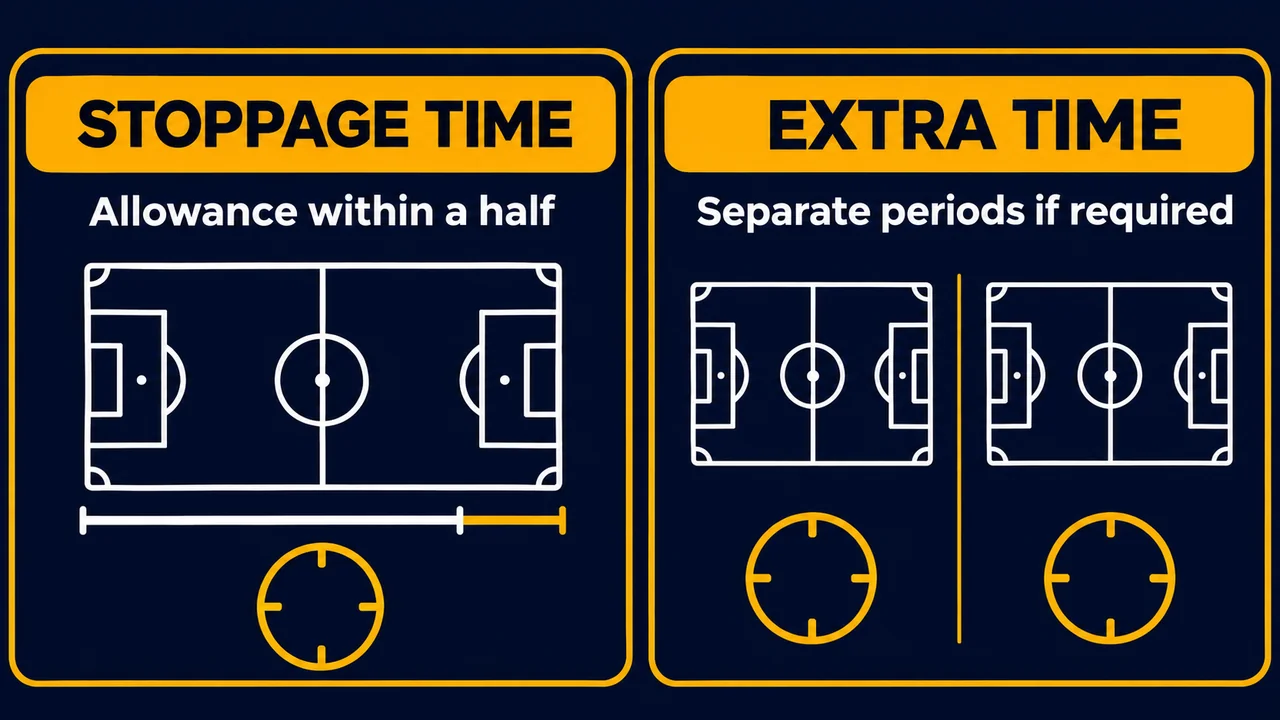
Stoppage time is not the same as extra time
Additional or stoppage time is added to a half to allow for time lost. Extra time is a separate period or set of periods used in some competitions when the rules require a winner after the initial match period. The competition rules determine whether extra time is played and its format.
An invented knockout match can therefore reach the end of the second half after its additional time and still be level. The competition may then require extra time. Extra time is separate from the five minutes shown on the board at the end of regulation. Additional time may also be relevant within periods of extra time under the applicable rules.
The phrases also matter in football markets, where “regular time,” “extra time” and “to qualify” can be treated differently. Do not infer a particular settlement from the name alone: if a ticket or market rule is unclear, stop and check its accepted terms. For historical tournament context, the site's 2026 World Cup knockout guide discusses those distinctions; it is not a current fixture or price guide.
A penalty kick at the end of a half
Law 7 also provides that, if a penalty kick has to be taken or retaken, the half is extended until the kick is completed. That rule concerns the completion of the kick under the Laws; it should not be replaced with a general claim that every attacking move must be allowed to finish after time expires.
In a close end-of-half incident, first establish whether the referee awarded a penalty and whether it has to be taken or retaken. A broadcast that begins with the player placing the ball may omit the original decision. If the governing decision is unclear, wait for the official ruling rather than inferring it from the scoreboard.
A practical viewing checklist
- Identify the half or extra-time period being played and the competition.
- Look for the minimum additional time indicated by the fourth official, if there is one.
- Note any further significant stoppage after the indication without assuming a fixed number of seconds is added for it.
- Keep the broadcast clock separate from the referee's final signal.
- If a penalty kick must be taken or retaken at the end of the half, follow the official decision and the applicable rule.
Common questions
Is the number on the board the exact time left?
No. Under Law 7 it indicates the minimum additional time decided by the referee. The referee may increase that time but not reduce it.
Is stoppage time added only for injuries?
No. Law 7 lists several possible causes of lost time, including substitutions, disciplinary sanctions, goal celebrations and video-review delays.
Does every match that is level after stoppage time go to extra time?
No. Whether extra time is played depends on the competition and stage. Many matches can finish as a draw under their competition rules.
Can a referee end a half after a penalty is awarded but before it is taken?
Law 7 says the half is extended until a penalty kick that must be taken or retaken is completed. The actual situation and officials' ruling still matter.
For more football coverage, visit the football section. The complete rule is available in IFAB Law 7; check the competition's current regulations for the match you are watching.
By IPL Betting. Source and review: This guide uses IFAB Law 7 and its 2026–27 presentation. The five-minute board scenario is invented. The separate three-minute and five-minute stoppage example paraphrases an IFAB FAQ; neither is presented as a record of an actual game.
Promotional link. Gambling involves financial risk and may be restricted where you live. Participation is for eligible adults.