
There are 70 seconds left in a quarter. A defender commits a common foul away from a shot, and the other team goes to the free-throw line even though the defense has only three team fouls in the period. The timing matters as well as the team's total: if two qualifying fouls came in the final two minutes, the second can put the team in the penalty. If the call is unclear, wait for the officials’ ruling before drawing a conclusion.
To understand the decision, check the period, the defending team's foul count, what happened in the final two minutes, and the type of foul. The examples below are invented and assume ordinary defensive common fouls charged as team fouls. Shooting fouls and other special situations have their own provisions; a scoreboard badge alone cannot explain every whistle.
The ordinary regulation-quarter count
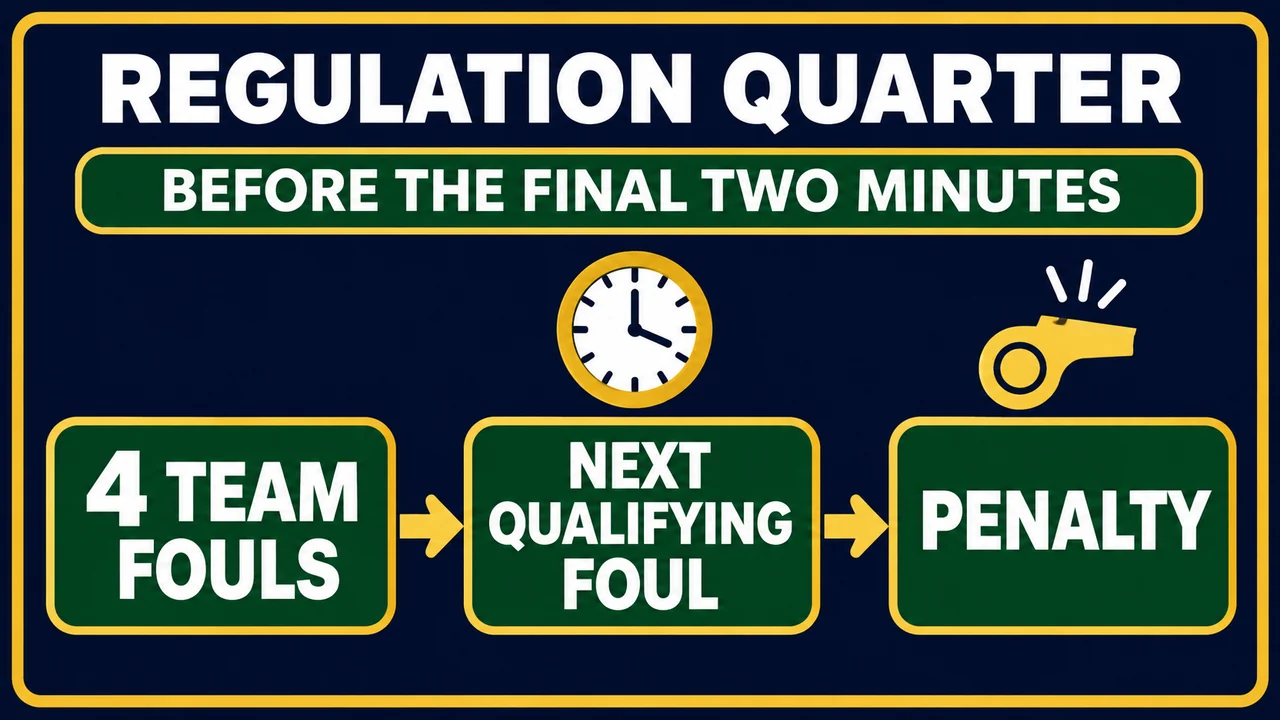
Under NBA Rule 12, each team is allowed four team fouls in a regulation period without the additional team-foul penalty. Common fouls charged as team fouls beyond that allowance bring a free-throw attempt plus a penalty free-throw attempt. The rule includes important exceptions, including how certain offensive fouls and successful shooting plays are administered.
Imagine Team A has committed four qualifying defensive common fouls in the first seven minutes of a quarter. Later, with more than two minutes remaining, an official calls a fifth qualifying defensive common foul away from a shot. In this simplified sequence, Team B is awarded two free-throw attempts under the team-foul penalty. The useful number is Team A's count for that period, not the individual defender's personal-foul total.
If the same foul occurs while the defender's team has not yet reached the relevant penalty situation, the ordinary restart can be a throw-in instead. Check the whole sequence and the call: a shooting foul or a special foul can lead to different free throws or possession.
The final two minutes can change the timing
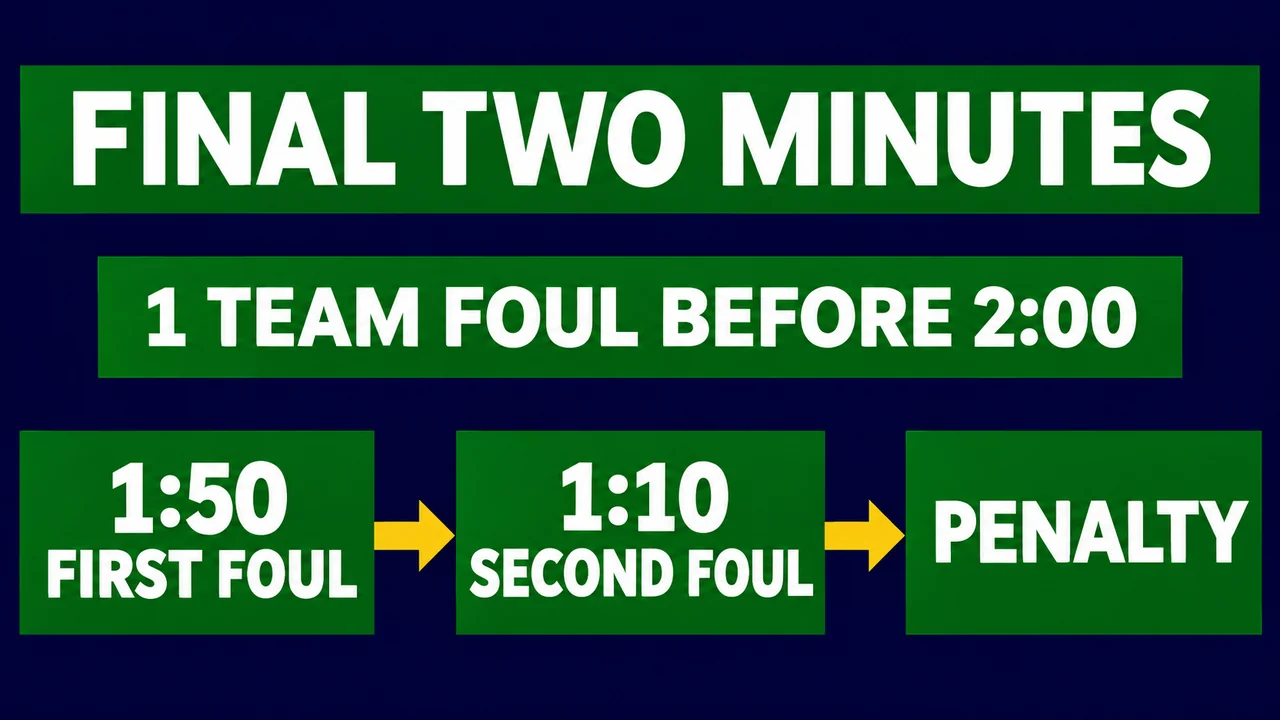
Now imagine Team A has committed only one team foul before the clock reaches 2:00 in the quarter. At 1:50 it commits one qualifying defensive common foul; at 1:10 it commits another. The second foul in that final two-minute span can trigger the penalty even though the team's period total has reached only three.
The rule is not “the first foul after 2:00 is always free.” If the team already reached its ordinary allowance earlier in the period, the penalty situation can already be in effect. If the team has not reached its allowance before the last two minutes, it may incur one team foul in that span before the additional team-foul penalty applies; the next qualifying foul in that span is treated under the penalty. Check the official scorer's count when the display or timeline is unclear.
| Invented regulation-quarter sequence | Defending team's context | General result for the specified foul |
|---|---|---|
| Fifth qualifying common foul with 3:00 left | Four qualifying team fouls already charged in that quarter | Team-foul penalty applies |
| Second qualifying foul inside the last two minutes | Only one team foul had occurred before 2:00 | Team-foul penalty applies despite a total of three |
| A foul after the quota was already reached | Penalty was already in effect | Do not assume a new free foul starts at 2:00 |
These examples deliberately leave out competing calls and special foul types. They are not complete ruling instructions for every contact near the end of a game.
Overtime has its own allowance
An NBA overtime period is five minutes, rather than a 12-minute regulation quarter. Rule 12 provides an allowance of three team fouls in an overtime period without the additional penalty; qualifying common fouls beyond three are subject to the stated penalty. The last-two-minute protection is also expressed in the rule for overtime, with the first three minutes as the earlier portion.
For example, suppose a team commits four qualifying defensive common fouls in the first three minutes of an overtime period. The fourth is beyond the overtime allowance and is subject to the team-foul penalty. If a team has not reached its allowance in those first three minutes, follow the separate last-two-minute provision rather than carrying over the regulation-quarter example unchanged.
Player fouls and team fouls answer different questions
A player can have several personal fouls while the team-foul display for the current period shows a different number. A player's game total does not tell you how many team fouls have been charged in this quarter. The team-foul penalty concerns the team count under the relevant rule; the individual total has its own implications for the player.
Do not try to reconcile them by simply adding the personal-foul numbers on a box score and assuming that every foul occurred in the present quarter or is administered identically. Start with the official period record, then identify the foul just called. A flagrant, technical, offensive or shooting situation needs its own rule rather than a shortcut based on the word “bonus.”
Why a made basket can still mean one free throw
Suppose a shooter scores while being fouled and the officials award one free throw for the successful field-goal attempt. The NBA rule says that a personal foul in that successful scoring situation does not gain an additional penalty free-throw attempt merely because the team-foul penalty is in effect. The scoreboard's penalty indicator does not turn this example into two extra attempts.
That is different from an ordinary qualifying non-shooting defensive common foul in the penalty situation. Keep the two events separate: first identify whether the basket counted and how the foul was classified, then follow the officials' administration. Other rule provisions can apply to unusual plays.
A five-step viewing check
- Identify the period and whether the game is in regulation or overtime.
- Find the defending team's team-foul count for that period, not just one player's total.
- If the clock shows 2:00 or less, consider when the relevant fouls occurred and whether the penalty was already in effect.
- Listen for the classification: shooting, ordinary common, offensive and special fouls do not all have the same treatment.
- If the scoreboard and official scorer differ or the sequence is incomplete, wait for an official correction or explanation.
Common questions
Does the fifth team foul in an NBA quarter always mean two free throws?
Not for every kind of foul. The general team-foul penalty applies to qualifying common fouls charged as team fouls beyond the allowance, but Rule 12 provides exceptions and separate treatment for certain situations.
Why can a team be in the penalty with fewer than five fouls?
The final-two-minute provision can make the penalty apply to a second qualifying team foul in that span when the team had not reached its earlier allowance. Check the period and timing, not just the displayed total.
Does a player's personal-foul count reset every quarter?
No. A player's personal fouls accumulate through the game; the team-foul allowance is assessed for each period. Check the official scorecard for both totals.
Is the overtime allowance the same as a regulation quarter's?
No. The NBA rule describes an allowance of three team fouls per overtime period, rather than four in a regulation period, with a separate last-two-minute provision.
For a wider introduction to the league, see our NBA guide for Filipino fans. The NBA fouls and penalties rule provides the full provisions and exceptions.
By IPL Betting. Source and review: This guide uses the linked NBA rules. Every foul sequence is an invented teaching example, not a match record. Rules may change, and the officials' ruling governs the actual play.
Promotional link. Gambling involves financial risk and may be restricted where you live. Participation is for eligible adults.