
Updated for July 2026: Prepared for readers in the Philippines by IPL Betting Editorial Team. Match-day lineups, injuries, venue conditions, prices, wallet rules, and platform limits can change quickly, so confirm current details before you act.
This article is written as a decision guide, not a promise of results. If the reason for the bet becomes weak after lineups, price checks, or account limits are reviewed, skipping the market is still a valid choice.
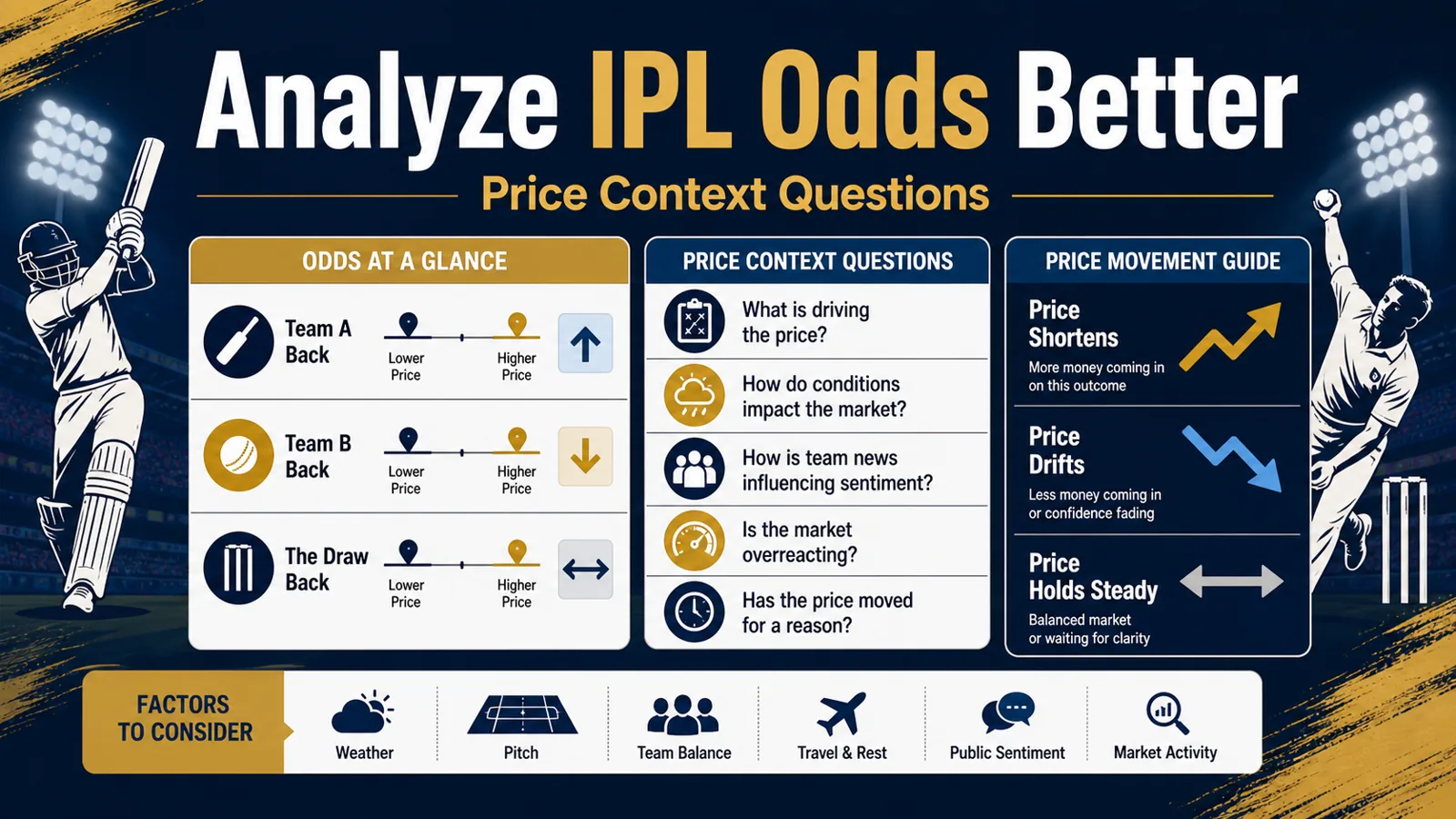
A price on the board is useful, but it only becomes meaningful when the reader knows what question it is answering. In IPL coverage, odds are easiest to misread when they are separated from lineup clarity, venue shape, and the timing of the move itself.
This handbook keeps the workflow simple enough for repeated use. Instead of turning every number into a verdict, it shows how to read price together with context and how to leave a market alone when the explanation still feels incomplete.
Quick Answer
To analyze IPL odds well, start with the market price, then ask what it is reacting to. Team balance, lineup confirmation, venue conditions, and the direction of line movement all belong in the same note.
A good odds routine never asks only whether the price looks high or low. It asks whether the match information around that number is strong enough to support any view at all.
The Four Questions Behind Every IPL Price
A reader who sees the number first should immediately shift into questions. What changed, who benefits, what context is still missing, and is the move based on real information or broad market noise?
That four-question frame keeps the board readable. It also stops the common habit of calling a number attractive before the team or venue picture is stable enough to justify that language.
| Core Question | Why It Matters | Useful Follow-Up |
|---|---|---|
| What is this price reacting to? | It reveals whether the move belongs to lineups, conditions, or sentiment. | Look for a real trigger, not just a number change. |
| What part of the match does it assume? | Some prices quietly depend on pace, dew, or batting depth. | Match the number to the phase story. |
| What is still missing? | Unconfirmed lineups or unclear roles weaken any early conclusion. | Write the missing piece before acting. |
| Would I explain this price the same way in one sentence? | If the answer is no, the read may still be muddy. | Keep refining the note until it sounds coherent. |
How Context Changes the Meaning of the Same Number
The same price can mean different things on different nights. A short favorite at one venue might look sensible because of role certainty and reliable late bowling. The same-looking number elsewhere might feel fragile if the batting order is unsettled or dew could flatten the edge later.
That is why context matters more than memorized thresholds. Odds do not become easier because the reader recognizes the number. They become easier because the reason behind the number is clear enough to test.
A Practical IPL Odds Worksheet
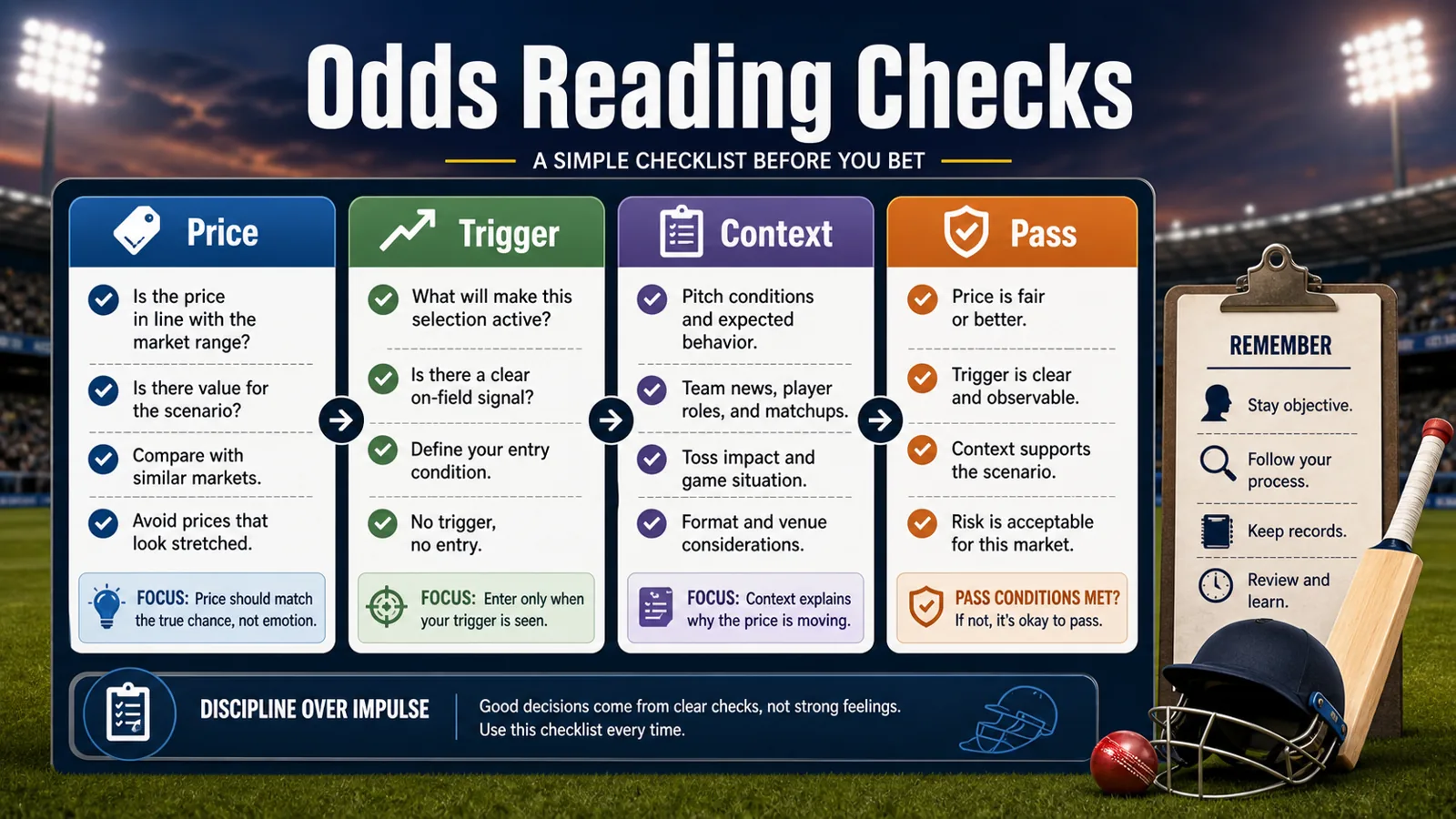
A one-page worksheet is usually enough. Write the opening price, the current price, the likely trigger, the best context note, and the reason to pass if confidence still feels borrowed from the market rather than earned through reading.
This method helps because it allows uncertainty to stay visible. If the match note still depends on a guess, that guess should remain on the page instead of quietly hiding behind the price.
| Worksheet Line | What To Write | Why It Helps |
|---|---|---|
| Opening vs current price | Record both, not just the latest number. | Movement matters only when direction and timing are visible. |
| Likely trigger | Lineup update, venue expectation, or public sentiment. | The market story becomes easier to test. |
| Strongest context note | Role balance, venue shape, or phase control. | This keeps the number tied to cricket logic. |
| Missing evidence | List what is still not confirmed. | Prevents false certainty. |
| Pass condition | Define when no action makes more sense. | A disciplined exit is part of the system. |
Why Movement Deserves Respect but Not Worship
Line movement is useful because it tells you the market has noticed something. It becomes dangerous when the reader treats that attention itself as proof. Some moves are grounded in real team information. Others reflect momentum, copying, or incomplete interpretation.
The right response is to read movement as a clue, then test whether the clue survives lineup, role, and venue review. If it does, the note gets stronger. If it does not, the move may have been louder than it was useful.
When the Best Read Is Still to Pass
Sometimes the worksheet ends with a clearer reason not to act. The price moved, but the lineup is still uncertain. The venue note exists, but the batting order question is unresolved. Those are not failures of analysis. They are exactly the kind of limits a good routine is supposed to expose.
A complete odds handbook should teach the pass decision as clearly as the action decision. That is what keeps price reading honest across a long season.
Source and Update Note
This July 2026 refresh keeps the article focused on how to analyze IPL odds in 2026, practical match-day process, and risk-aware decision making for IPL readers.
Readers should still verify current team news, venue updates, line movement, wallet limits, and platform rules before placing any bet or transfer request.
FAQ
What is the first thing I should check when reading IPL odds?
Check what the price is reacting to before deciding whether it looks attractive.
Why is context more important than the number alone?
Because the same price can imply very different things depending on lineup certainty, venue shape, and phase control.
How should I track line movement?
Write the opening and current price together, then note the likely trigger and what still remains unconfirmed.
What belongs in a simple odds worksheet?
Opening price, current price, likely trigger, strongest context note, missing evidence, and a pass condition.
When should I pass on the market?
Pass when the price story still depends on missing lineup, role, or venue evidence.