
“Full, straight and fast” describes three separate features of a delivery. Full is a length, straight describes a line, and fast describes pace. A yorker can be outside off stump, while a short ball can be directed at the body. Keeping these dimensions separate helps you follow bowling commentary.
First identify where the ball went; then consider the outcome. A wicket does not prove the ball was a yorker, and a boundary does not prove it was a full toss. Watch whether the ball landed, where it landed and where it reached the batter.
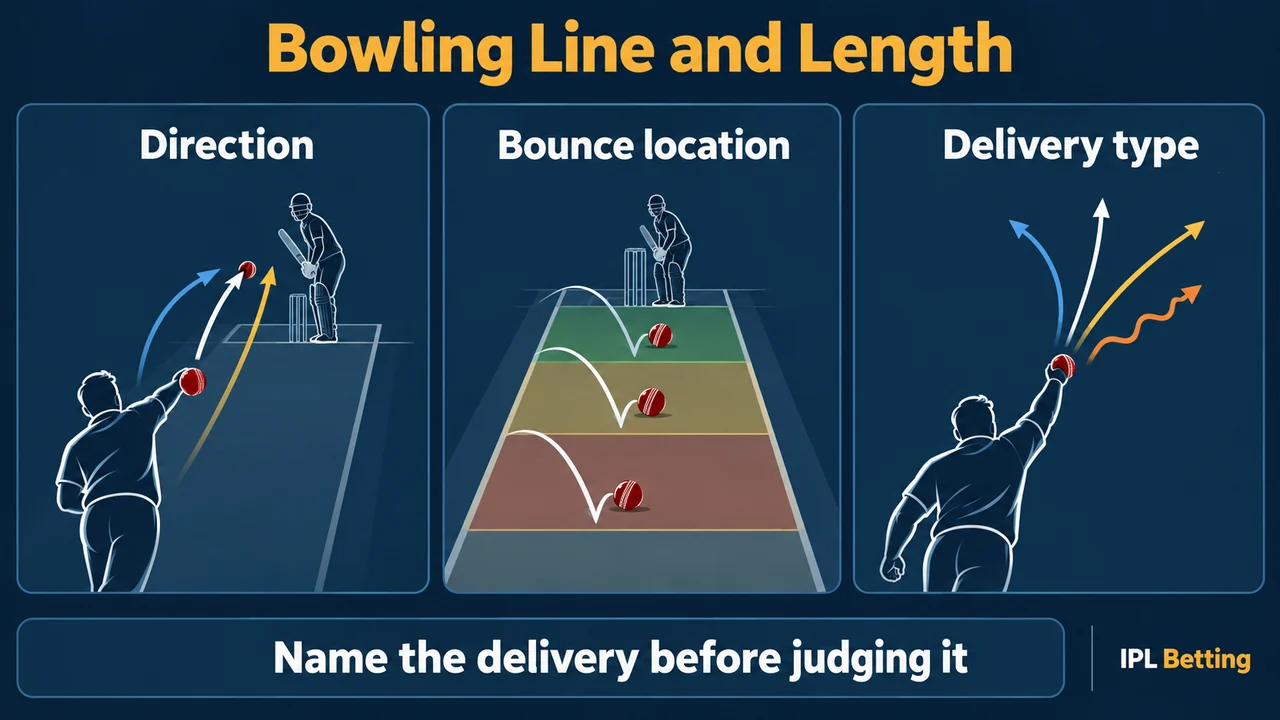
Line runs across; length runs along
Line describes the sideways route relative to the batter and stumps: outside off stump, at the stumps or down the leg side, for example. Length describes how far down the pitch the ball lands. These are commentary descriptions rather than a single set of painted landing zones.
A left-handed stance changes off and leg. The television camera changing ends can also reverse what your screen shows. Identify the current batter’s stance first. “Wide on the screen” is too vague to establish an off-side line, especially from an angled camera.
A length ladder for the viewer
| Description | First visible clue | Avoid assuming |
|---|---|---|
| Yorker | Very full delivery arriving near the feet or base of the bat | It must be on the stumps. |
| Full pitched ball | It lands relatively close to the batter | Every full ball is a yorker. |
| Good length | It creates a choice between coming forward and going back | One distance suits every bowler and surface. |
| Short ball | It lands farther from the batter and can rise after bouncing | It is automatically a no-ball. |
| Full toss | It reaches the batter without pitching first | Every full toss is illegal. |
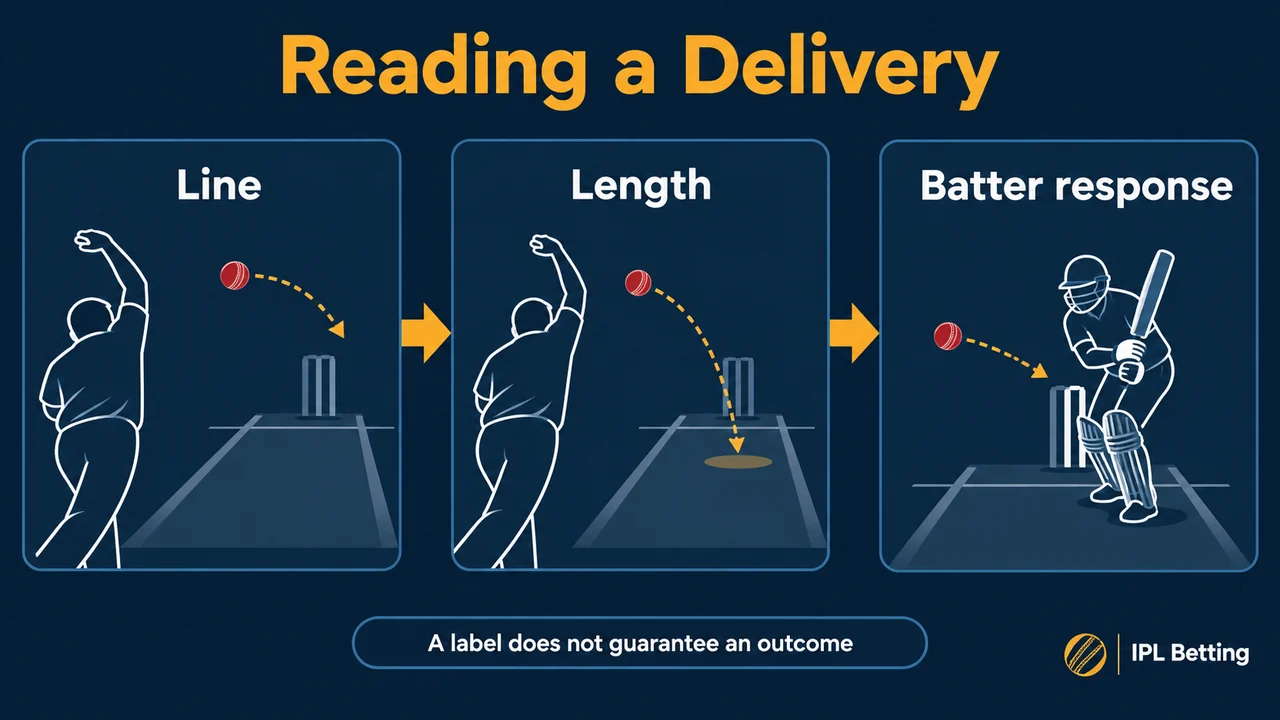
The categories help organise a replay. They are not exact metre measurements or promises of what shot follows. Batter height, pace and bounce can alter how a landing point is experienced. Use “appears full” when the bounce is unclear rather than claiming precision from an overhead illustration.
A yorker and a full toss are different
Cricket Australia’s historical yorker clip description places the delivery near the batter’s toes and stumps. That is a useful orientation example, not a guarantee that every yorker takes a wicket. A full toss has not bounced before reaching the batter. A bowler attempting a yorker can miss the intended landing point, but the attempt is not the delivered length.
Imagine two fictional balls. Ball A lands close to the batter’s feet outside off stump and is dug out. Ball B travels at shin height to the bat without bouncing and is blocked. Ball A can be described as a wide yorker; Ball B is a low full toss. Neither description depends on whether the shot produces runs.
Now imagine a third delivery pitched shorter, which climbs towards the chest. It is not a full toss simply because it arrives high: it bounced first. Check the bounce before using a height label to decide the delivery type.
Height matters for the legal question
MCC Law 41.7 treats a non-landing delivery passing, or that would pass, above waist height of the striker standing upright at the popping crease as unfair and requires a no-ball. Law 41.6 separately addresses dangerous and unfair short deliveries. The different provisions are why “high ball” is not enough detail.
These are general-law references. Competition conditions may add or modify restrictions, including permitted short-pitched deliveries. This page does not supply a current IPL quota. Check the relevant season’s conditions and the umpire’s decision rather than importing a number from another format.
In a replay, the batter may crouch, jump or step down the pitch. Their actual body position in that frame is not necessarily the reference specified in the law. A television waist line can help the officials’ assessment, but a viewer should not invent the missing upright-at-the-crease measurement from one photograph.
Follow a plan across three deliveries
Use an invented sequence: a full ball at off stump, a short ball outside off, then a full delivery well outside off. The bowler has changed length and line. Calling all three “pace bowling” is true at a broad level but misses the visible variation.
Write two columns: line and length. Add pace only if the speed is supplied reliably or the variation is otherwise identified. Leave the intended tactic conditional. A field can suggest what the captain is protecting, but a missed length or an improvised shot can send the ball elsewhere.
Questions to ask on the replay
Did it bounce? Where was the landing point? Where did it pass relative to the batter? Was a no-ball actually signalled? Those questions move from description to decision in a useful order. “A perfect yorker” is commentary praise; “no-ball” is an official ruling. Do not let the praise determine the ruling or the ruling replace the descriptive vocabulary.
Related reading: Cricket rules introduction; Cricket Extras and Free Hits: Where the Runs and Deliveries Go; IPL Pace vs Spin Matchup Guide: Pitch, Roles, and Sample-Size Checks.
Prepared by IPL Betting Editorial Team. Updated 4 October 2026. The linked official materials support the rules identified in this guide. Match examples are invented exercises, and a competition’s published conditions can differ from the general Laws.