How to Use IPL Stats for Betting: 8 Key Statistics Filipino Players Need to Know (2026)

Written by a cricket analytics contributor covering data-driven betting for Southeast Asian audiences. Last updated: April 2026.

Raw cricket statistics are everywhere — but knowing which numbers matter for betting is a completely different skill. Most publicly available IPL stats are designed for fans who want to know who’s performing well. Betting-relevant stats answer a different question: which numbers predict future performance better than the odds reflect?

This guide identifies the specific statistics that consistently provide betting edge in IPL 2026, explains why they work, and shows you where to find them for free.

Why Most IPL Stats Don’t Help Bettors

Season averages, total runs scored, and overall wicket tallies are the most commonly cited IPL statistics. They’re also the least useful for betting, because bookmakers use them too — they’re already priced in. The stats that provide betting edge are the ones that are contextual, condition-specific, and not prominent in mainstream cricket coverage.

The 8 Statistics That Actually Predict IPL Match Outcomes

1. Venue-Specific Strike Rate (Batter)

A batter’s overall season strike rate means less than their strike rate at a specific venue. Some batters thrive at flat, fast pitches (Chinnaswamy, Wankhede) but struggle at slower surfaces (Chepauk, Ranchi). Look up each top-order batter’s venue-specific numbers on ESPN Cricinfo Statsguru before betting player props or total runs markets.

Where to find it: Cricinfo Statsguru → Batting → Filter by player → Add ground filter

2. Economy Rate in Death Overs (Bowler)

Overall bowling economy is a poor predictor of death-over performance. A bowler with a 7.8 season economy might concede 12 runs per over in overs 17–20. Death-over economy specifically (overs 16–20) predicts how many runs a team will concede in the final phase — which determines whether a total is defendable. Teams with bowlers whose death-over economy is above 9.5 consistently leak too many late runs.

Where to find it: Cricinfo Statsguru → Bowling → Filter by over range (16–20)

3. Powerplay Wicket Percentage (Bowling)

How often does a bowling attack take at least one wicket in the powerplay? Teams with bowlers who generate early breakthroughs (top-order wickets in overs 1–6) have higher defensive capability. A team that takes powerplay wickets in 70%+ of matches disrupts opposition scoring more reliably than a team taking wickets later in the innings.

4. Chase Success Rate at This Venue

This is more predictive than overall chase success rate. Some venues strongly favour chasing (Wankhede ~58% chase success), others favour defending (Chepauk ~52% batting first). Use this to inform your post-toss match winner bet after you know who’s batting first or chasing.

5. Middle-Over Run Rate (Overs 7–15)

The middle overs determine whether a team builds a platform or gets strangled. A team with a middle-over run rate below 7.0 is typically falling behind the required rate or building slowly — which either produces a lower final total (when setting) or creates late-over pressure (when chasing). This stat predicts match tempo more accurately than powerplay or death statistics alone.

6. Dot Ball Percentage (Bowling)

The percentage of deliveries that result in no run. A bowling attack with 40%+ dot balls creates pressure, forces mistakes, and takes wickets. Under 35% means the bowling is being dominated. Before betting on a team’s bowling to restrict the opposition, check their recent dot ball rate — it’s a more reliable pressure indicator than wickets alone.

7. Boundary Percentage (Batting)

The percentage of runs coming from fours and sixes versus singles and twos. High boundary percentage batters (above 55%) are aggressive but risky on difficult surfaces. Low boundary percentage batters (below 40%) are patient but won’t accelerate on flat pitches. When the pitch is slow, a team full of high-boundary-percentage batters often underperforms expectations — their attacking shots don’t clear the boundary as easily.

8. Recent Form Index (Last 5 Matches)

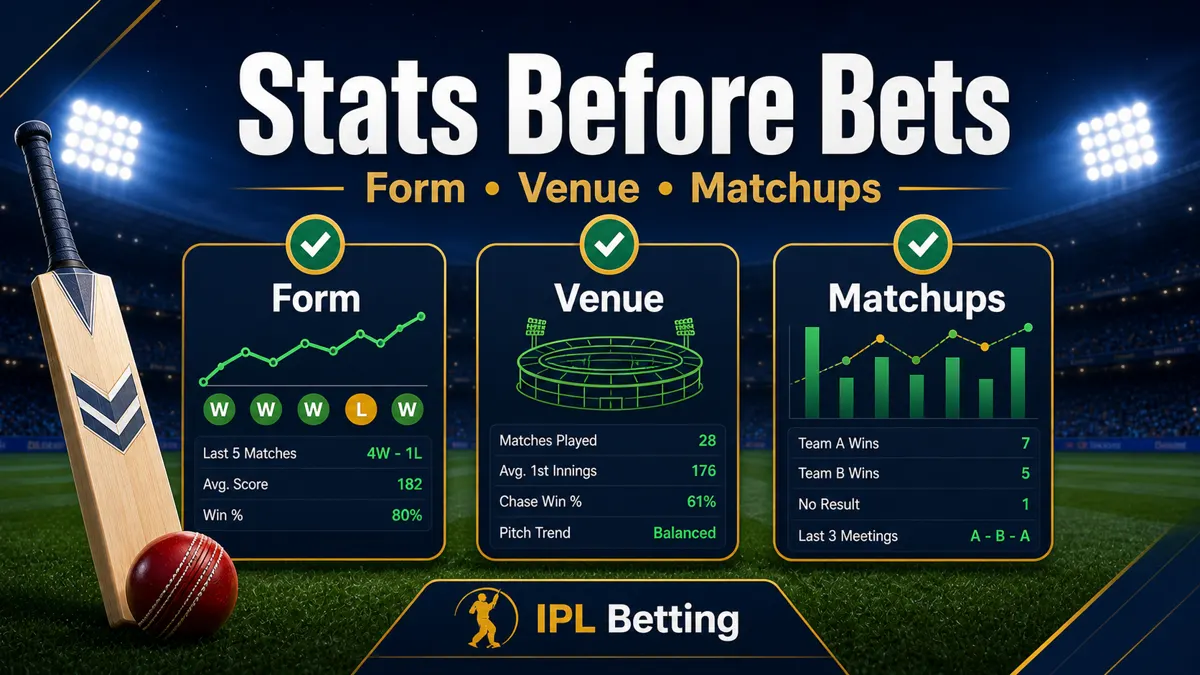
Weight each of the last 5 matches: most recent = 5 points, then 4, 3, 2, 1. A team that won their last 4 but lost 5 matches ago has a form index of (5+4+3+2+0) = 14. A team with random wins has a lower weighted index. This weighted form index predicts current form better than a simple win/loss ratio over the last 5 games.

Free Tools for IPL Betting Stats

ToolBest ForCost
ESPN Cricinfo StatsguruVenue-specific, phase-specific, head-to-head statsFree
Cricbuzz Match CentreLive ball-by-ball data, pre-match formFree
IPL Official AppPlayer profiles, head-to-head, current season statsFree
CricSheetRaw ball-by-ball data (advanced users)Free
HowStatQuick batter/bowler career and recent form summariesFree

A Pre-Match Stats Checklist for Filipino Bettors

Before every IPL match you plan to bet on, run through this 10-minute stats review:

  1. ✅ Both teams’ recent form (last 5 weighted)
  2. ✅ Venue average score for first and second innings
  3. ✅ Top-3 batters’ venue-specific strike rates
  4. ✅ Opposition’s death-over bowling economy
  5. ✅ Powerplay wicket percentage for both bowling attacks
  6. ✅ Chase success rate at this specific venue
  7. ✅ Weather forecast (cloud cover, wind, humidity)
  8. ✅ Confirmed playing XIs (wait until official announcement)

Running this checklist consistently means you’ll enter every bet with more information than the average bettor — and more importantly, you’ll spot the situations where your assessment diverges from the bookmaker’s odds, revealing genuine value opportunities.

Stats Betting FAQ

How far back should I look at statistics?

For team-level stats: last 2–3 IPL seasons at the specific venue. For player-level stats: last 30 T20 innings across all competitions (not just IPL) gives enough sample size. Anything beyond 3 seasons risks including data from significantly different squad compositions.

Do IPL stats from other T20 leagues transfer?

Partially. Player stats from similar-format T20 leagues (BBL, SA20, PSL) can supplement small IPL sample sizes for newer players. However, IPL-specific stats are more directly relevant because of the specific pitch conditions, altitudes, and crowd factors unique to Indian venues. Use other T20 stats to fill gaps, but weight IPL data more heavily.

Good statistics are the foundation of good betting decisions. But always combine numbers with match-day context — stats tell you probabilities, not certainties. PAGCOR helpline: 1-800-1-888-0098.


Further Reading