
Updated for July 2026: Prepared for readers in the Philippines by IPL Betting Editorial Team. Match-day lineups, injuries, venue conditions, prices, and platform rules can change quickly, so confirm current details before you act.
This article is written as a decision guide, not a promise of results. If the reason for the bet is unclear after lineups and price checks, skipping the market is still a valid choice.
A long list of stats does not automatically improve a match read. In IPL coverage, the real skill is knowing which numbers answer the current question and which ones only create the feeling of being prepared.
This page keeps the list narrow on purpose. The goal is not to collect every number. It is to find the numbers that change what you do next.
Quick Answer
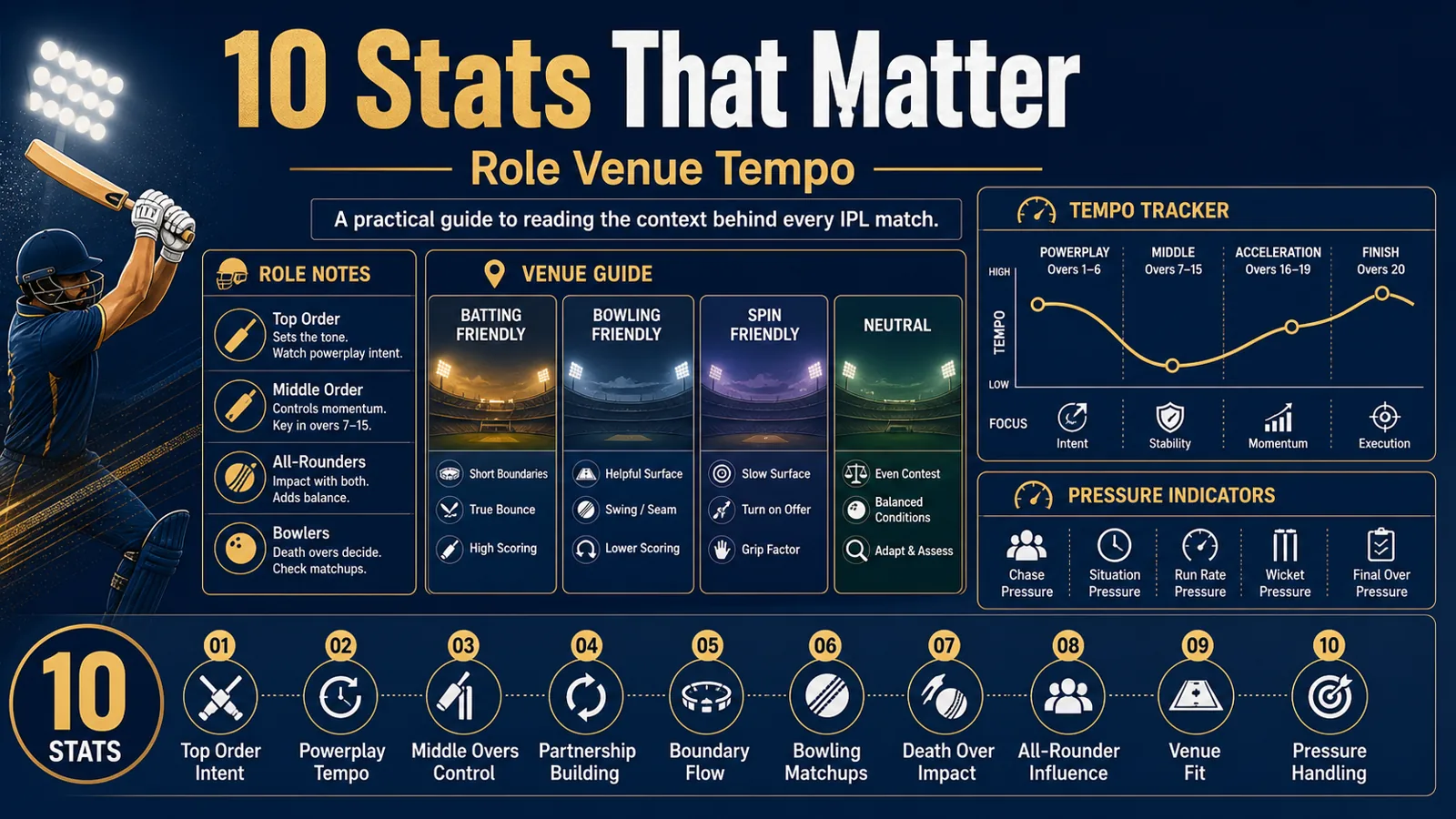
The most useful IPL stats are the ones that explain role, venue, tempo, and pressure. If a number does not help you answer one of those four questions, it probably belongs in the notes later, not in the core pre-match read.
That is why a smaller stat sheet usually produces better match decisions than a crowded one.
Ten Stats Worth Reading First
These numbers help most when they are tied to a real match question rather than admired on their own.
| Stat | What It Helps Explain | Why It Matters Before the Match |
|---|---|---|
| Recent powerplay scoring pace | How quickly a side starts its innings. | Useful for early-overs reading and totals context. |
| Wickets lost in the first phase | Whether a fast start is stable or fragile. | Run rate means less if the innings burns too many wickets early. |
| Middle-overs control | Which side can hold or change tempo after the opening burst. | Often the quiet separator between a good total and a flat one. |
| Death-overs scoring rate | How strongly a team finishes. | Late scoring can reshape totals and chase pressure quickly. |
| Death-overs wickets taken | How a bowling unit closes innings under pressure. | Useful for both totals and live reading. |
| Venue first-innings average | Baseline scoring environment on that ground. | A strong venue context stops readers from judging totals blindly. |
| Chasing record by venue shape | Whether the ground tends to stay calm or tighten late. | Useful when toss and dew become part of the story. |
| Player role usage | Whether a batter or bowler is being used the same way recently. | Role consistency matters more than one standout match. |
| Boundary dependence | How much a team relies on fours and sixes to keep pace. | Helpful when surface conditions may slow the scoring pattern. |
| Dot-ball pressure | Whether an innings absorbs too many empty balls in key phases. | Often the hidden reason a chase starts to squeeze. |
How to Group Stats by Match Question
A better way to use numbers is to sort them by the question on your page, not by the column heading in a spreadsheet.
| Match Question | Best Stat Group | What to Avoid |
|---|---|---|
| Can this team start fast enough? | Powerplay pace, early wickets, and boundary dependence. | Do not lean on full-match averages only. |
| Is the total still reachable? | Venue scoring profile, wickets in hand, and death-overs output. | Do not ignore match phase context just because the target looks familiar. |
| Does the toss matter here? | Venue chase shape and second-innings control trends. | Do not assume every ground behaves the same late. |
| Is this player market grounded in a real role? | Recent role usage and likely involvement. | Do not rely on highlight-driven form alone. |
| Is the price reacting to real pressure? | Phase scoring, wickets, and tempo changes. | Do not confuse market noise with information-rich movement. |
Numbers That Look Smart but Often Waste Time
The most common trap is reading large raw totals without phase context. Another is copying old averages that do not reflect the current role or venue.
A number becomes misleading the moment it answers a different question than the one in front of you.
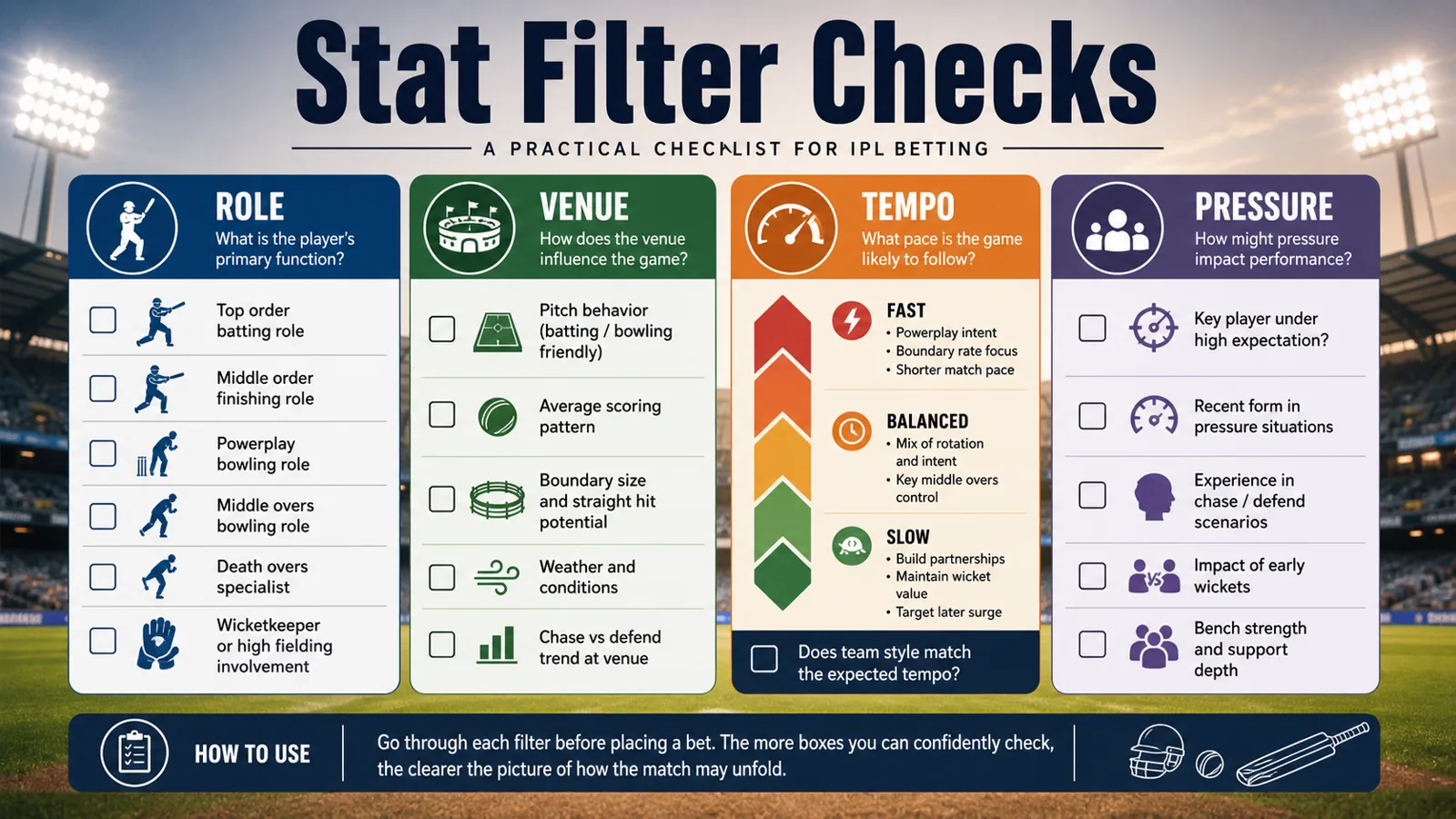
A Better One-Page Stat Note
Keep the sheet short: one venue note, one pace note, one wickets note, one role note, and one pressure note. That is usually enough to decide whether the match still needs deeper reading.
If the note becomes too long, the problem is usually not missing data. It is missing focus.
What to Review After the Match
After the game, write which numbers actually helped and which ones only looked useful before the first ball. That review sharpens the next pre-match sheet faster than adding more columns ever will.
The best stat routine gets smaller and more exact over time.
Source and Update Note
This July 2026 refresh keeps the article focused on IPL statistics that matter for betting, match-day process, and risk-aware decision making for IPL readers.
Readers should still verify current team news, line movement, match conditions, and the house rules shown on their chosen platform before placing any bet.
FAQ
What is the first stat I should check before an IPL match?
Start with a stat that answers the main match question, usually venue scoring shape or phase pace rather than a broad season average.
Why are phase stats better than full-match averages?
Because they explain where pressure or control appears inside the innings instead of flattening the entire match into one number.
Do player markets need separate stats?
Yes. Role usage and likely involvement usually matter more than one big recent score.
How many stats should I carry into one match note?
A small set is better. One venue note, one pace note, one wickets note, one role note, and one pressure note is often enough.
How do I know a stat is misleading me?
If it sounds impressive but does not answer the current match question, it is probably noise rather than guidance.