
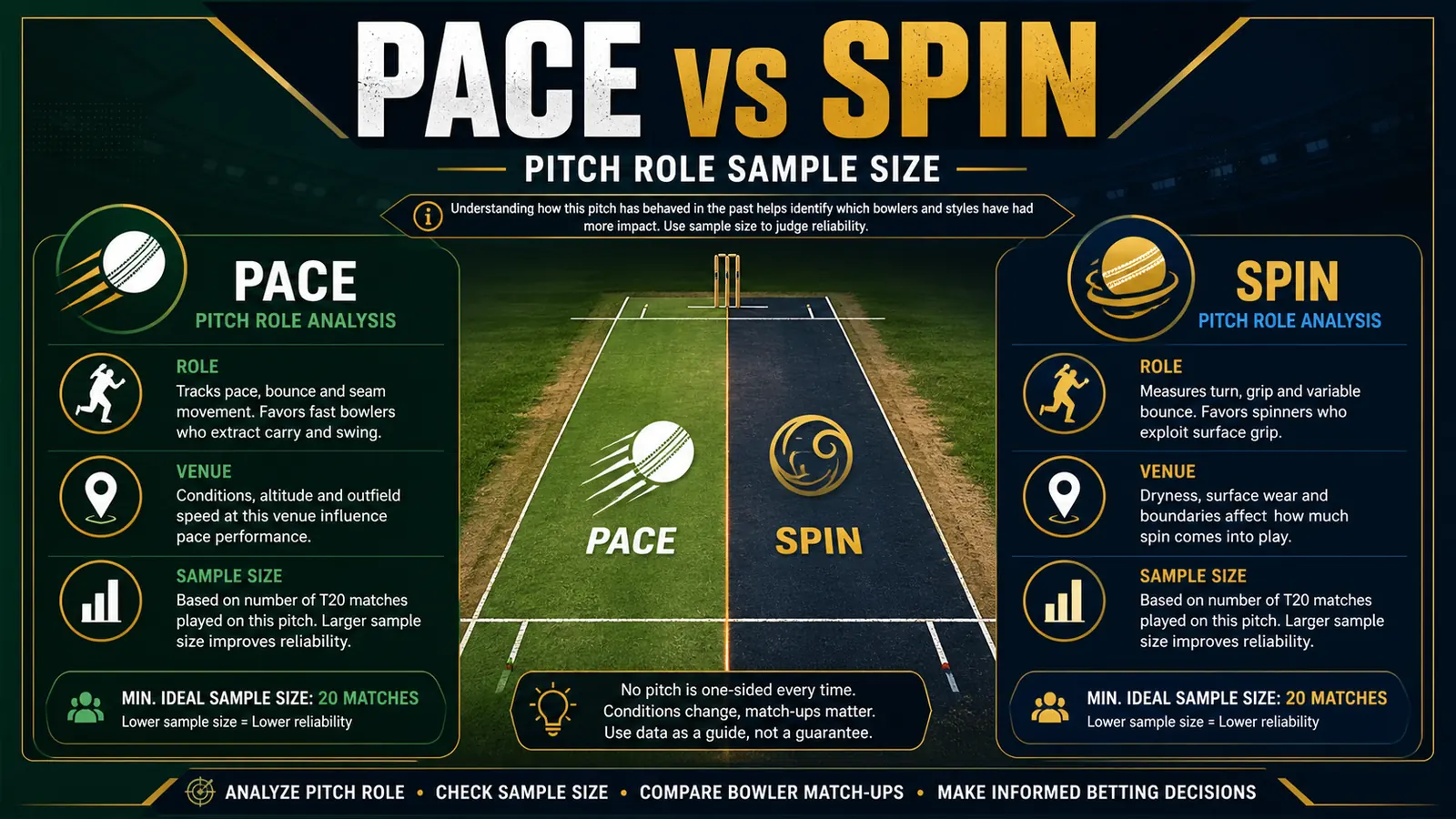
Pace versus spin is a useful starting question, but it is too broad to answer on its own. The surface, angle, length, role, batter hand, and match phase can all change the matchup.
A careful reader treats matchup numbers as clues. The goal is to connect the evidence to the current role and conditions, then keep the limits of a small sample visible.
Editorial note: Reviewed by IPL Betting Editorial Team. Last updated: August 2026. Evidence method: compare published competition rules, current match information, and the exact market terms shown by your chosen platform. Match information, team news, weather, prices, and market terms can change, so keep every decision within a planned limit.
Start With the Surface
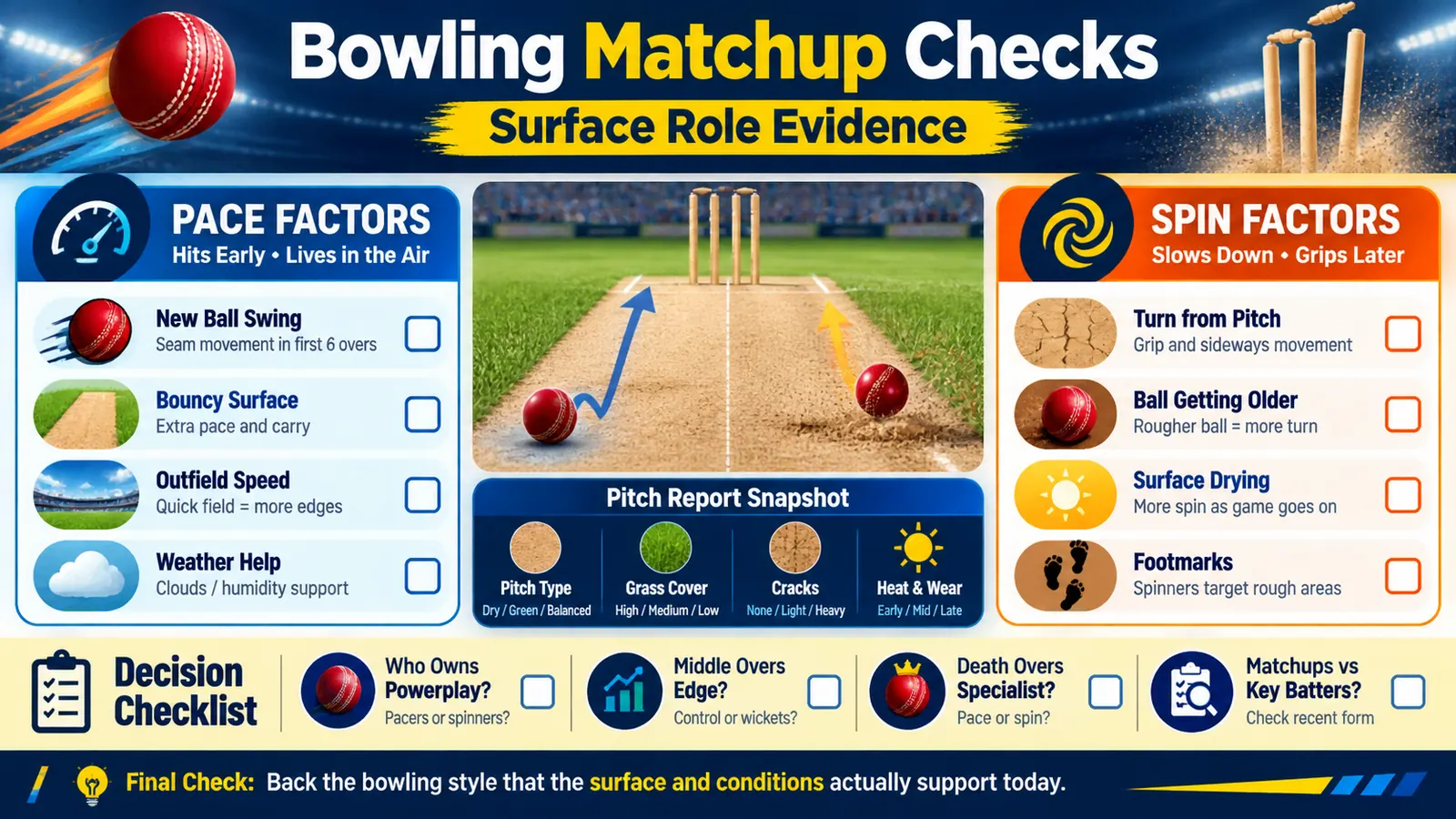
Pitch descriptions should be checked against the current match report or visible conditions. A venue known for one style can still present a different surface on another day.
Look for pace off the pitch, grip, bounce, and how easily batters can use the ground. Those observations provide more context than a broad label such as “spin venue.”
| Surface clue | What to ask | Limit |
|---|---|---|
| Pace | Does the ball come on? | One over is a small sample |
| Grip | Is the ball holding? | Conditions can change with wear |
| Bounce | Is it even or variable? | Shot choice may adjust |
| Outfield | Are singles and boundaries available? | Scoring is not only bowling style |
Match the Bowler Role
A pace bowler used in the powerplay asks a different matchup question from a pace bowler protecting a total at the end. The same applies to a spinner entering against a new pair or a set pair.
Record the phase, expected overs, and likely field. If the bowler’s usage is uncertain, the historical matchup number should not be treated as current opportunity.
| Role | Useful check | Why it matters |
|---|---|---|
| New-ball pace | Swing, movement, opening pair | Early wickets and edges |
| Middle-over spin | Grip, rotation, pair combination | Run control and matchup |
| Death pace | Length, field, finishing batters | Boundary and wicket trade-off |
| Part-time option | Whether an over is likely | Opportunity may be limited |
Use Sample Size Carefully
A batter-versus-bowler record can be informative, but a small number of balls may not support a broad conclusion. Note balls faced, dismissal count, phase, venue, and whether the roles are still comparable.
A matchup can point to a question worth checking. It should not be presented as a fixed rule that overrides current lineup and conditions.
Decide What the Data Can Support
If pace and spin evidence points in different directions, keep both possibilities in the note. A balanced decision can include a condition that would change the view after the match begins.
When the sample is thin, the role is uncertain, or the pitch report is missing, pause. More numbers do not automatically make an unclear matchup clear.
FAQ
Is a pace versus spin label enough?
No. Check surface, phase, angle, role, batter hand, and the size and quality of the matchup sample.
Why does bowling phase matter?
A new-ball spell, middle-overs spell, and death spell create different opportunities and field settings.
Can a small matchup sample be useful?
It can raise a question, but it should not be treated as a stable rule without context.
What if the pitch report is unclear?
Keep the surface status unconfirmed and avoid making the matchup the main reason for a decision.
Source and update note: This evergreen guide should be checked against current official match information, published competition rules, and the exact market terms shown by your chosen platform before you act.
Related Reading
- IPL Venue Betting Guide ↗
- IPL Middle Overs Betting Guide ↗
- IPL Player Prop Betting Guide ↗
- IPL Stats for Betting Guide ↗
Take a pause when a material input is unconfirmed or a market rule is unclear. Clear information and a planned limit are more important than forcing a decision.