
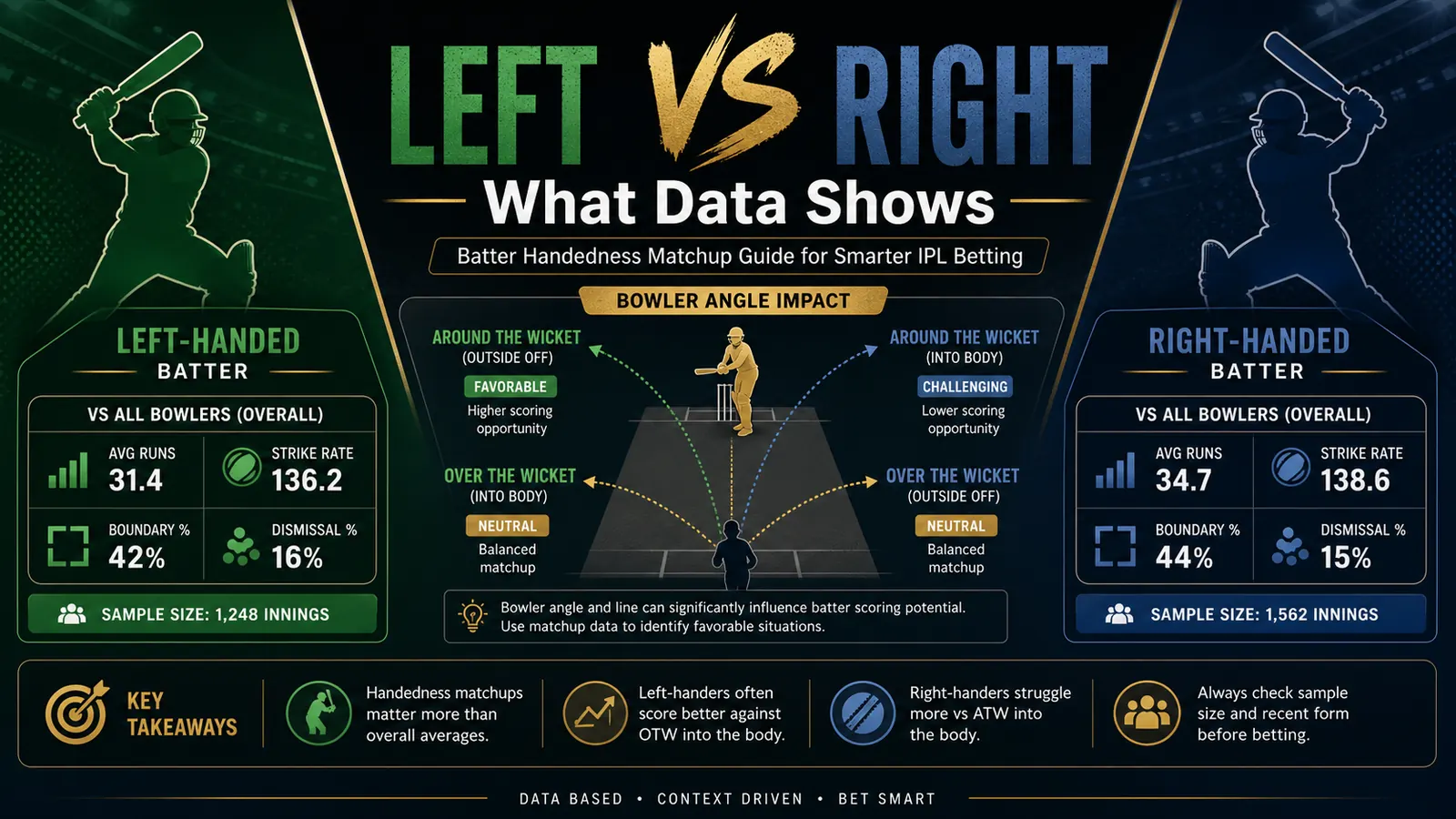
Left-hand and right-hand matchups can change field placement and bowling angles, but handedness is only one part of the picture. The bowler’s release, length, phase, and batter role still determine the actual question.
Use the split to investigate a matchup, not to label it automatically. The stronger note explains how the angle meets the current batter and what evidence is still missing.
Editorial note: Reviewed by IPL Betting Editorial Team. Last updated: August 2026. Evidence method: compare published competition rules, current match information, and the exact market terms shown by your chosen platform. Match information, team news, weather, prices, and market terms can change, so keep every decision within a planned limit.
Describe the Angle
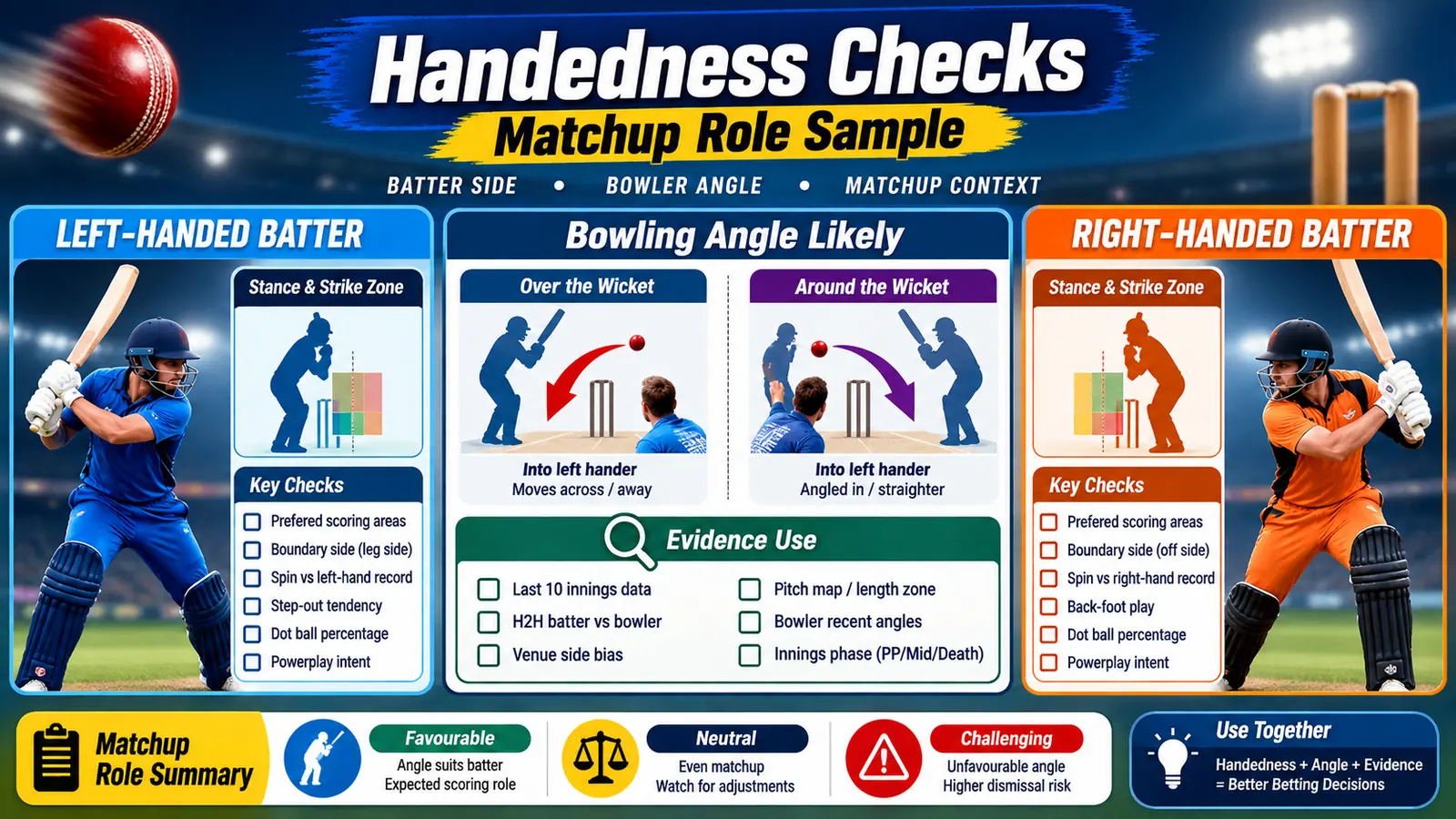
Start with the bowler’s angle and the batter’s stance. Around-the-wicket and over-the-wicket lines can create different scoring areas, while pace and spin may use the angle in different ways.
Then add length and field. A theoretical advantage may disappear if the bowler cannot land the intended area or if the field gives the batter a simple single.
| Matchup field | Question | Why it matters |
|---|---|---|
| Batter hand | Left or right? | Shapes the angle |
| Bowler angle | Over or around the wicket? | Changes release line |
| Style | Pace, spin, or variation? | Creates different movement |
| Phase | When does the matchup occur? | Field and risk change |
Check Role and Opportunity
A batter may face only a few balls before a new phase or a dismissal. A bowler may be used for one over rather than a full spell. That opportunity is more important than a split that ignores usage.
Write down where the player usually appears and what the match situation requires. The same handedness matchup can be low relevance if the players do not meet in the expected phase.
| Opportunity check | What to record | Caution |
|---|---|---|
| Balls faced | Expected time at the crease | Role can change |
| Overs bowled | Expected matchup exposure | Not every bowler is next |
| Score state | Attack or control requirement | Pressure changes shot choice |
| Field plan | Boundary riders and singles | Angle is not the full plan |
Do Not Overread Split Statistics
Handedness splits can be distorted by a small sample, different venues, changing roles, and the quality of the opponents. Record the sample size and the time period before using a number as context.
A split is strongest when it matches a live tactical reason. It is weakest when it appears alone as a neat statistic with no explanation of the current matchup.
Keep the Conclusion Conditional
A good matchup note might say that the angle is worth watching if the bowler is used in the expected phase and the field supports the plan. That is more honest than turning a handedness split into a fixed outcome.
If the role, phase, or sample is unclear, keep the matchup in the “watch” column and wait for better evidence.
FAQ
Does left-hand versus right-hand always create an advantage?
No. Handedness changes angles and field questions, but role, length, phase, and execution still matter.
Why is bowling angle important?
The release line and ball path can change the batter’s scoring areas and the fielding plan.
How large should a split sample be?
There is no single universal cutoff; record the size, context, and whether the roles remain comparable.
What should be checked before using a handedness matchup?
Check the likely meeting phase, expected balls or overs, angle, field, and the quality of the available data.
Source and update note: This evergreen guide should be checked against current official match information, published competition rules, and the exact market terms shown by your chosen platform before you act.
Related Reading
- IPL Pace vs Spin Matchup Guide ↗
- IPL Stats for Betting Guide ↗
- IPL Player Prop Betting Guide ↗
- IPL Middle Overs Betting Guide ↗
Take a pause when a material input is unconfirmed or a market rule is unclear. Clear information and a planned limit are more important than forcing a decision.