
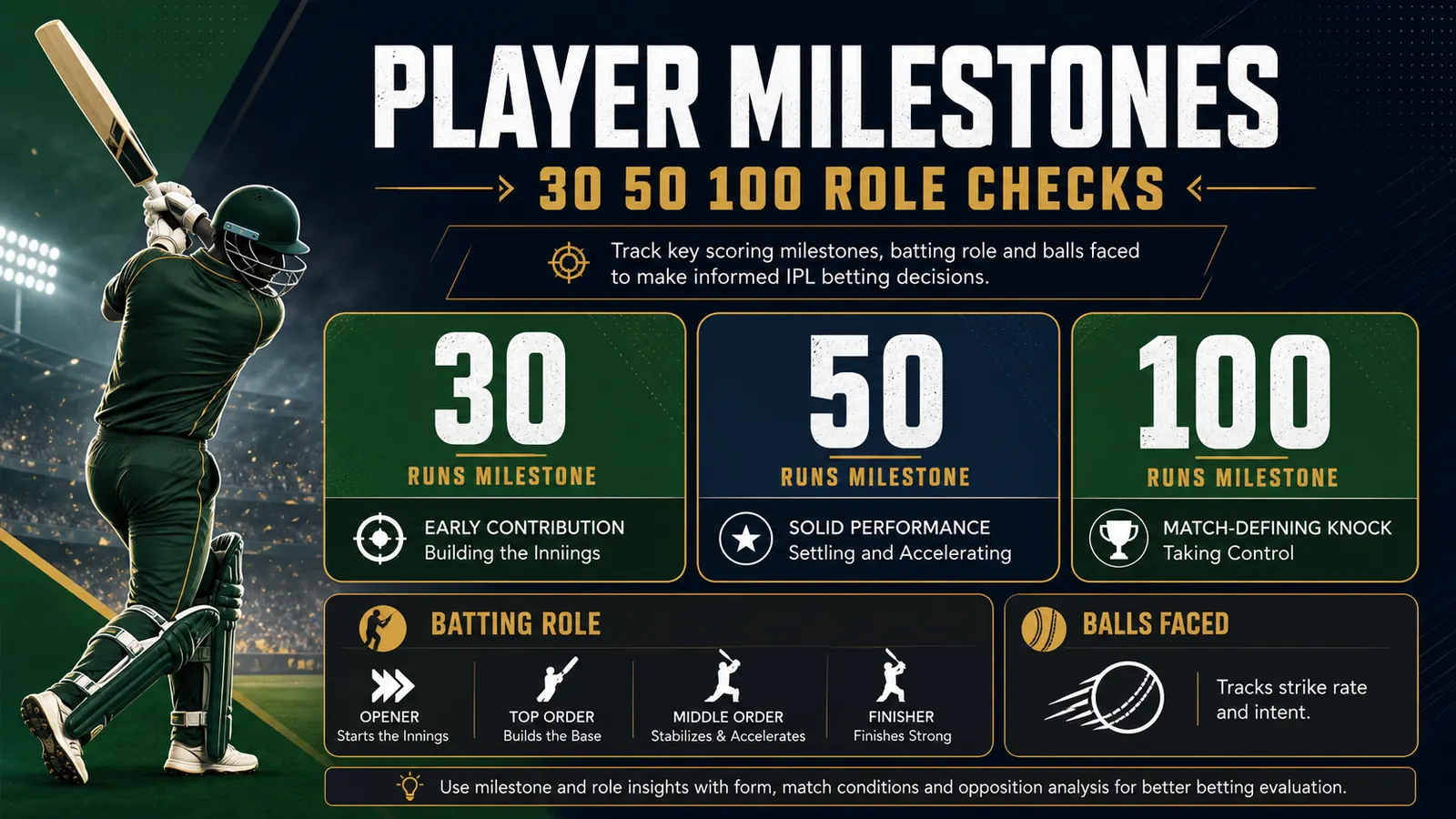
A milestone prop is a question about opportunity as much as ability. A batter needs a role, enough time at the crease, a match situation that allows scoring, and a market rule that defines the milestone clearly.
The numbers 30, 50, and 100 are easy to remember. The harder work is checking whether the player is likely to receive the balls and conditions needed to reach the line.
Editorial note: Reviewed by IPL Betting Editorial Team. Last updated: August 2026. Evidence method: compare published competition rules, current match information, and the exact market terms shown by your chosen platform. Match information, team news, weather, prices, and market terms can change, so keep every decision within a planned limit.
Start With the Batting Role
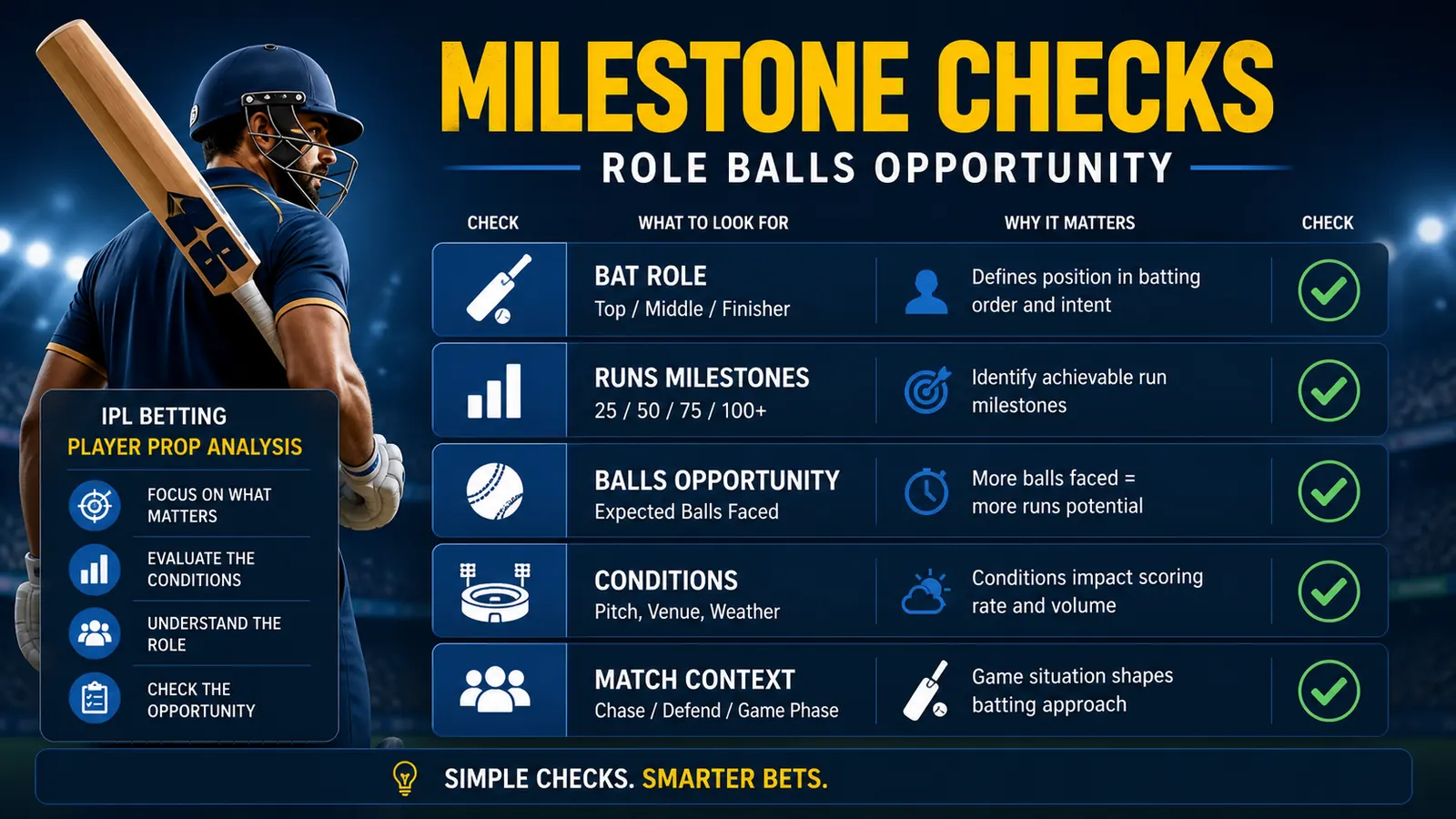
Top-order batters may have more opportunity, but their position alone does not define the market. Check opening combination, recent role, batting depth, and whether the innings could be shortened.
A lower-order batter may have a strong scoring rate but a smaller chance to face enough balls. Role should be written before form.
| Milestone check | Question | Why it matters |
|---|---|---|
| Position | Where is the batter expected to bat? | Sets opportunity |
| Balls | How much time is available? | Milestones need deliveries |
| Depth | Who bats behind the player? | Team plan can change |
| Innings | Full length or shortened? | Available opportunity may fall |
Match the Milestone to the Situation
Thirty runs can be reached through a steady contribution, while a fifty or century usually requires more time and a different innings path. A market note should say which path is plausible rather than treating every milestone as the same.
Check the bowling matchup, surface, field, and the team’s target. A batter may take more risk in a chase or more time in a first innings, depending on the situation.
| Line | What to ask | Limit |
|---|---|---|
| 30+ | Can the player get a useful start? | Early dismissal remains possible |
| 50+ | Is there enough time and role stability? | Team plan can interrupt |
| 100+ | Can the player stay through a long innings? | Rare events need more conditions |
| Any milestone | What are the participation rules? | Terms define settlement |
Use Form as a Supporting Detail
Recent runs can show touch, but form does not create balls faced. Add form after role, lineup, venue, and matchup checks rather than starting with a highlight or average.
A short run of milestone results can also be noisy. Record the number of innings, not just the number of times a player crossed a line.
Check Prop Terms Before Comparing Prices
Player props can define whether the player must appear, face a ball, or reach the milestone in a specific innings. A late withdrawal or no participation may be handled separately from a score of zero.
If the line, participation rule, or price timestamp is unclear, leave the prop out of the decision. A clear market is more useful than a familiar number with hidden conditions.
FAQ
What is a player milestone prop?
It usually asks whether a named batter reaches a stated run milestone in the market’s defined innings and settlement terms.
Why is batting position important?
It affects the likely number of balls available and the phase in which the player may enter.
Does recent form decide a milestone?
No. Form is supporting context; role, opportunity, matchup, and participation rules matter too.
What should be checked before a 100-run line?
Check role, innings length, batting time, team situation, matchup, and the exact prop rules.
Source and update note: This evergreen guide should be checked against current official match information, published competition rules, and the exact market terms shown by your chosen platform before you act.
Related Reading
- IPL Player Prop Betting Guide ↗
- IPL Team News Verification Checklist ↗
- IPL Pace vs Spin Matchup Guide ↗
- IPL Betting Odds Comparison Checklist ↗
Take a pause when a material input is unconfirmed or a market rule is unclear. Clear information and a planned limit are more important than forcing a decision.