
Published by IPL Betting. Sources checked on 11 September 2026; examples are illustrative.
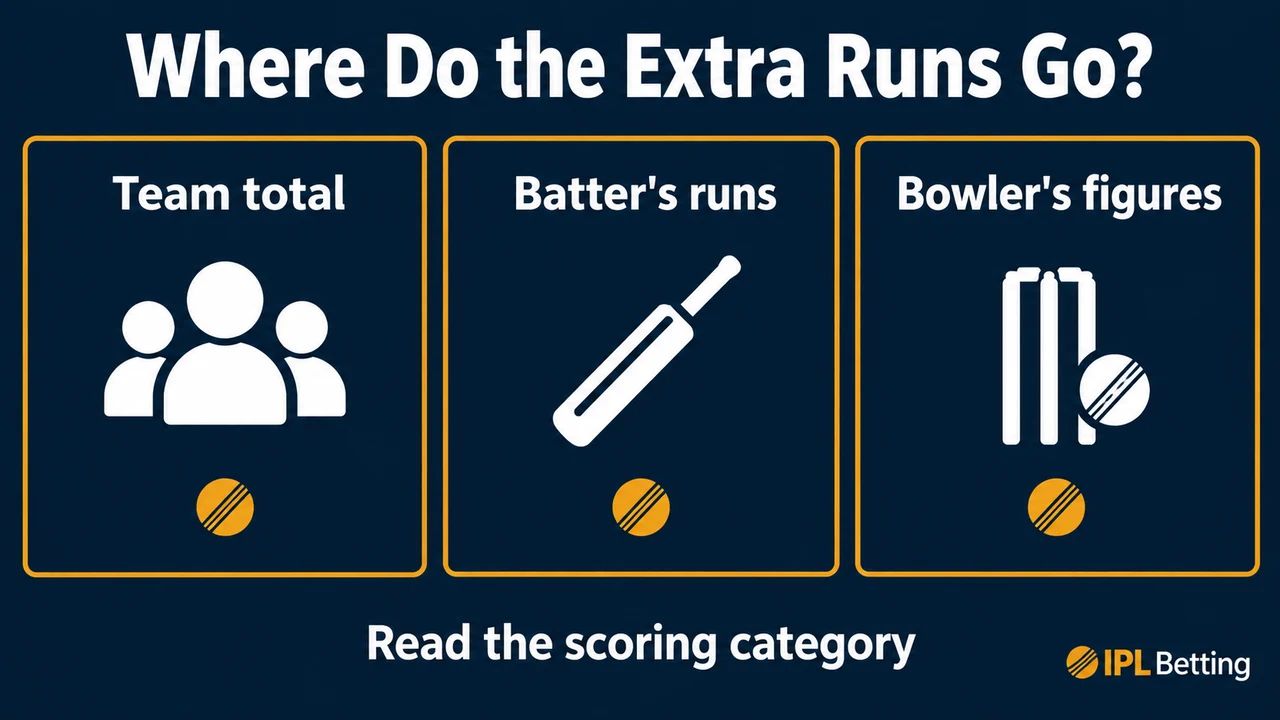
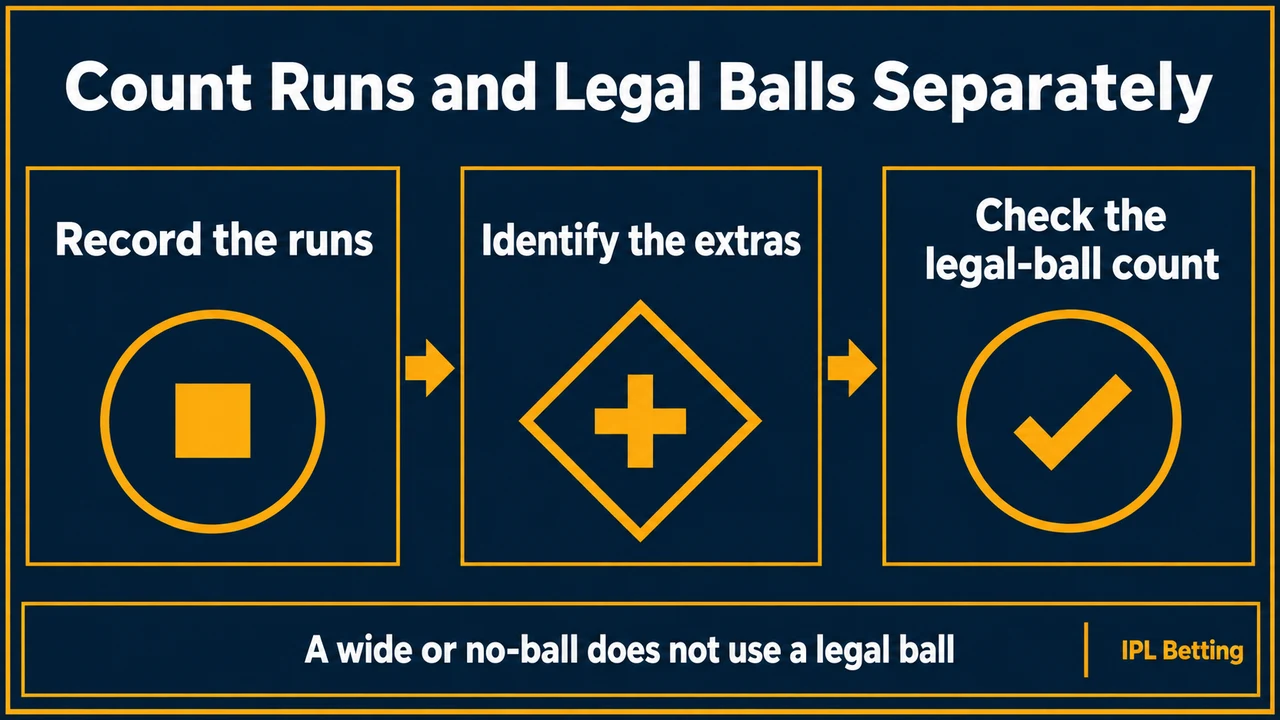
A bowler sends down a wide. The score increases, but the over does not move forward. Next, the batter hits a no-ball for four and the total rises by five. Nothing has been counted twice: the team total, the batter’s runs and the over’s legal deliveries measure different things.
Keep team runs, batter runs and valid balls in separate columns. Add the bowler’s runs conceded as a fourth column, and most apparent scoreboard contradictions become straightforward to check.
Four types of extras worth recognising
A wide adds a penalty run and does not count as a valid delivery. A no-ball also carries a one-run penalty and is not counted in the over. If both descriptions could apply, the no-ball takes precedence. See MCC Law 22 on wides and Law 21 on no-balls.
Byes are runs made when the ball passes the batter without touching bat or body, subject to the law’s conditions. Leg-byes follow body contact and require an attempt to play the ball with the bat or avoid being hit. They are not simply awarded whenever the ball touches a pad. MCC Law 23 explains that distinction.
For these examples, assume the umpires award the stated runs, there are no short runs or overthrows, and no dismissal changes the scoring. They are invented examples for reading a score, not a substitute for an official scorebook.
| Delivery | Team adds | Batter adds | Valid ball? |
|---|---|---|---|
| Wide, no running | 1 | 0 | No |
| Legal ball, two byes | 2 | 0 | Yes |
| Legal ball, one leg-bye awarded | 1 | 0 | Yes |
| No-ball hit for four | 5 | 4 | No |
| No-ball plus two byes | 3 | 0 | No |
Why the bowler’s total can be smaller
Runs from the bat, wides and no-ball extras are charged to the bowler. Byes and leg-byes are not. When a no-ball produces byes or leg-byes, the one-run no-ball penalty stays in its own category and the other runs go to the appropriate extras column. MCC Law 18.10 sets out the allocation.
Take the five rows above as a single teaching sequence. The team gains twelve runs. The batter gains four. The bowler is charged seven: one for the wide, five for the hit no-ball and one for the final no-ball. The remaining five are byes and leg-byes. Only two valid deliveries have been completed. Four different totals describe the same sequence without disagreeing.
This is why adding every batter’s score may leave you short of the team total. Look for the extras line before suspecting a mistake. Likewise, adding every bowler’s conceded runs need not reproduce the innings total. If the totals differ, identify the extras category rather than changing a number to make them match.
Free hits are a playing-condition rule
The ICC Men’s T20 World Cup 2026 playing conditions, clause 21.19, specify a free hit after any no-ball. If that free-hit delivery is itself a no-ball or wide, the free hit carries forward. The striker can be dismissed only in the circumstances available on a no-ball. See the official ICC tournament conditions. This is a named competition example; check the applicable rules before applying it to another league.
Do not attach a free hit to a wide merely because it is an extra. In the sequence “no-ball, wide, legal delivery”, the wide preserves an existing free hit; it does not independently create one. Keep a separate yes-or-no marker for whether a free hit is pending, alongside the legal-ball counter.
| Sequence after a no-ball | Free-hit status |
|---|---|
| The next delivery is a wide | Still pending for the following delivery. |
| The next delivery is another no-ball | Still pending for the following delivery. |
| The next delivery is legitimate | That delivery is the free hit. |
A free hit does not erase every dismissal
On a no-ball, the permitted dismissal categories are hit the ball twice, obstructing the field and run out. A free hit still allows some dismissals, so “cannot be out” is misleading. Law 21.18 lists the no-ball dismissal exceptions. The rules within each dismissal still have to be satisfied; a fielding appeal alone is not enough.
Imagine a batter hits a free hit into the outfield and tries for a second run. Treat the attempted catch and the subsequent running as separate events. The ordinary catch does not dismiss the striker on that free hit, but the running can still expose a batter to a valid run-out. The label does not make the ball irrelevant once it leaves the bat.
A practical check while watching
First record the umpire’s signal. Then record whether the ball touched the bat, how many runs were awarded and whether the delivery counts. Only after those steps should you update the batter and bowler figures. When an app revises its display a few seconds later, compare categories rather than assuming the newest number represents an additional delivery.
If two feeds disagree, keep their timestamps. One may be showing the original entry and another the corrected entry. Do not add both. A correction replaces a record; it is not another scoring event.
Quick questions
Can an over contain more than six deliveries? Yes. Wides and no-balls do not use up valid balls, so the physical delivery count can be higher.
Does a leg-bye increase the batter’s score? No. It is a team extra.
Is every no-ball worth exactly one run? The penalty is one run; other properly scored runs can make the delivery’s total higher.
Use the scorecard guide to connect this ledger to bowling figures. Our cricket rules introduction covers the match structure, while the fours and sixes guide explains why a boundary count is a separate statistic.