
A Test side stops batting at 410 for six, even though four wickets remain. Later, a side is asked to bat again immediately after completing its first innings. These are two decisions available to a captain: a declaration closes an innings, while the follow-on changes the usual batting order.
For someone used to T20 cricket, the key difference is the availability of two innings per side and a match lasting several days. More runs are valuable, but so is time to take the opposition’s wickets. The examples below are fictional five-day, two-innings matches with no special interruption provisions.
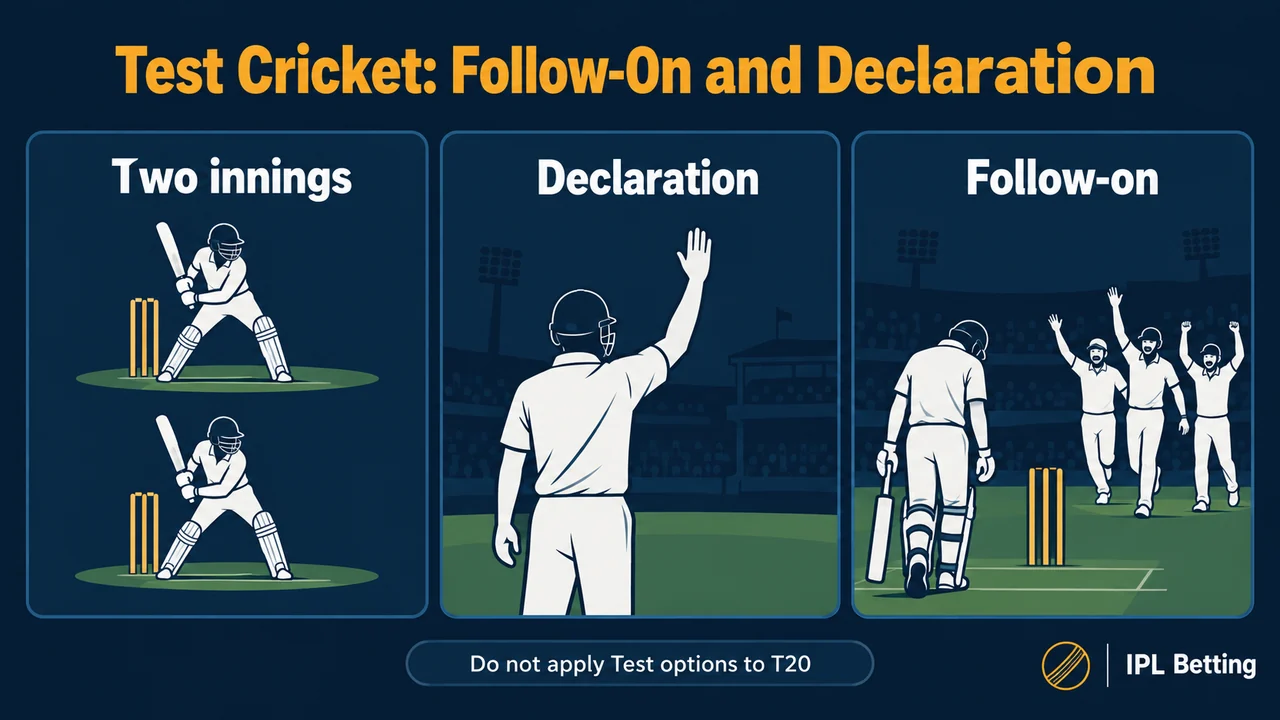
A declaration does not manufacture dismissals
Under the current MCC Law 15, a captain can declare an innings closed while the ball is dead, except in the final innings of the match. The captain must notify the opposing captain and umpires, and the decision cannot be changed after notification. A declaration completes the innings with the remaining wickets unused.
If Team A declares on 410 for six, preserve that score and its declaration label. Do not add four wickets to the bowling figures. The innings has ended through the captain’s decision rather than four additional dismissals.
The final-innings exception is part of the fourth-edition general Laws effective from 1 October 2026. Competition conditions must still be matched to the date of a real game. This article does not retroactively apply new wording to old matches or transfer a Test procedure into IPL cricket.
Work through a declaration
In an invented Test, Team A makes 360 and Team B replies with 300. Team A leads by 60 before batting again. It then reaches 180 for four and declares. Its combined total is 540, against Team B’s existing 300; Team B’s final target is 241, one more than the 240-run difference.
The declaration has preserved some time by ending Team A’s second innings. It also gives up the opportunity to add more runs. Whether that is tactically wise depends on remaining time, conditions and the opposition. The arithmetic establishes the target; it does not establish the chance of taking ten wickets.
| Stage | Team A | Team B | Meaning |
|---|---|---|---|
| First innings complete | 360 | 300 | Team A leads by 60. |
| Team A declares its second innings | 180/4 declared | — | Team A’s combined total is 540. |
| Final innings begins | — | Target 241 | Team B must exceed the 240-run aggregate deficit. |
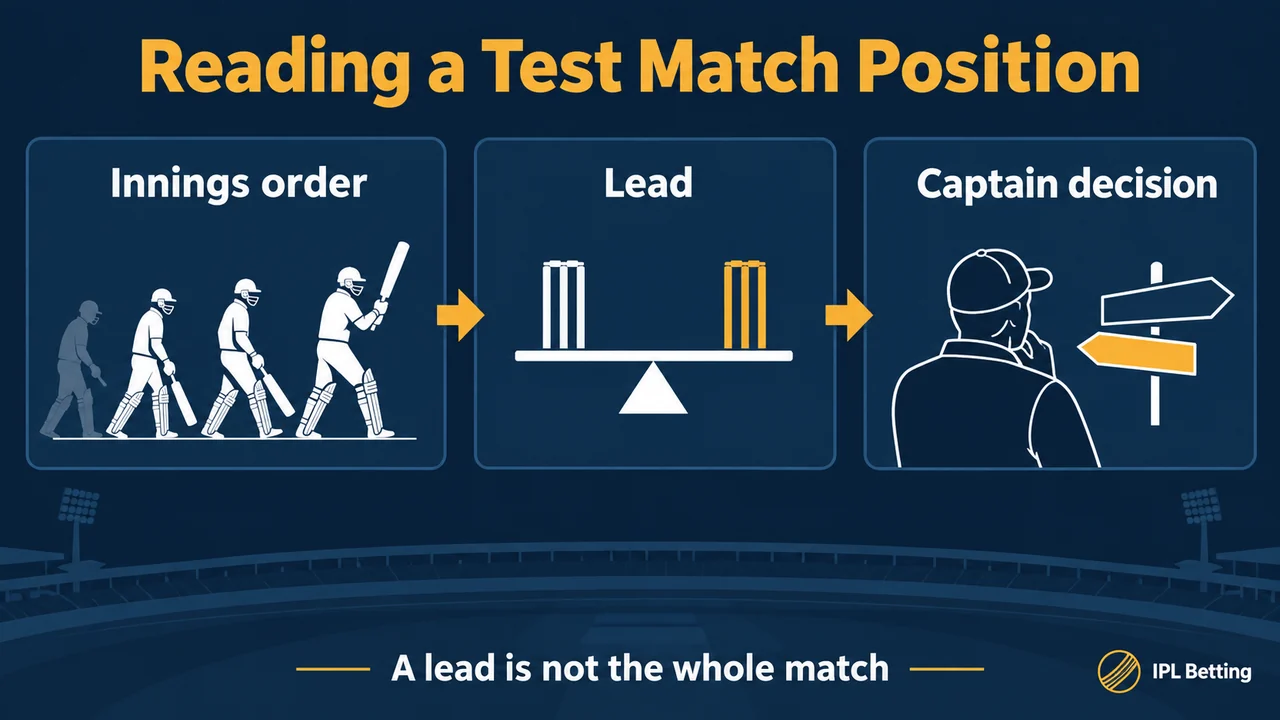
The follow-on is an option
MCC Law 14 gives the side batting first in a two-innings match of five days or more the option to require the other side to bat again when it leads by at least 200 runs after the first innings. Shorter two-innings matches have other thresholds, and first-day loss can affect the general-law calculation.
The word “option” matters. Reaching the threshold does not by itself announce that the follow-on has been enforced. Look for the captain’s decision, communicated to the opposing captain and umpires. Once notified, the general-law decision cannot be changed.
Do not treat “needs 20 to avoid the follow-on” as a target to win. It concerns a possible change in innings order. Winning the match requires a separate comparison of the completed innings and the remaining match task.
One lead, two possible orders
Consider another invented five-day match. Team A makes 420; Team B is all out for 190. The lead is 230, so the ordinary stated threshold is met. If Team A enforces the follow-on, Team B begins its second innings next. If Team A declines, Team A bats its own second innings next.
The scores at the decision point are identical. The next batting side changes because the captain chose one route rather than the other. This is why a score difference alone cannot tell you which team is walking out to bat.
If following on, Team B then completes on 210, its combined total is 400. In this simplified example Team A’s single 420 is enough for an innings-and-20-run win. Team A did not need to bat twice. If Team B instead adds enough to exceed 420, Team A may have a final chase. Follow the aggregate ledger rather than assuming the follow-on guarantees an innings victory.
Declaration, forfeiture and match concession
A declaration ends an innings already underway. Under the cited general law, a forfeiture gives up an innings before it starts, with the final innings excluded. Neither term should casually be replaced with “the team conceded the match.” They concern innings completion, while a match concession is another matter.
For viewing, use the official batting card’s label. A “d” beside a score indicates a declaration in conventional notation; it does not mean another wicket fell or that the opposition was awarded those unlost wickets.
A note for switching from T20
Keep four entries: each side’s first-innings score, the current innings, the aggregate lead or final target, and time remaining. Add “declared” or “follow-on enforced” only when announced. A quiet over may use time that a captain hopes to preserve; that trade-off is different from using up a fixed T20 delivery budget.
You do not need to judge the captain immediately to understand the match. First identify which decision occurred and rebuild the innings order. The tactical debate becomes clearer once the score and time questions are separated.
Related reading: Cricket rules introduction; T20, ODI, and Test Cricket: Why the Same Score Means Different Things; Indian Premier League Explained: Format, Teams, Match Rhythm, and the Best Starting Point for New Readers.
Prepared by IPL Betting Editorial Team. Updated 4 October 2026. The linked official materials support the rules identified in this guide. Match examples are invented exercises, and a competition’s published conditions can differ from the general Laws.