
Published by IPL Betting. Sources checked on 11 September 2026; examples are illustrative.
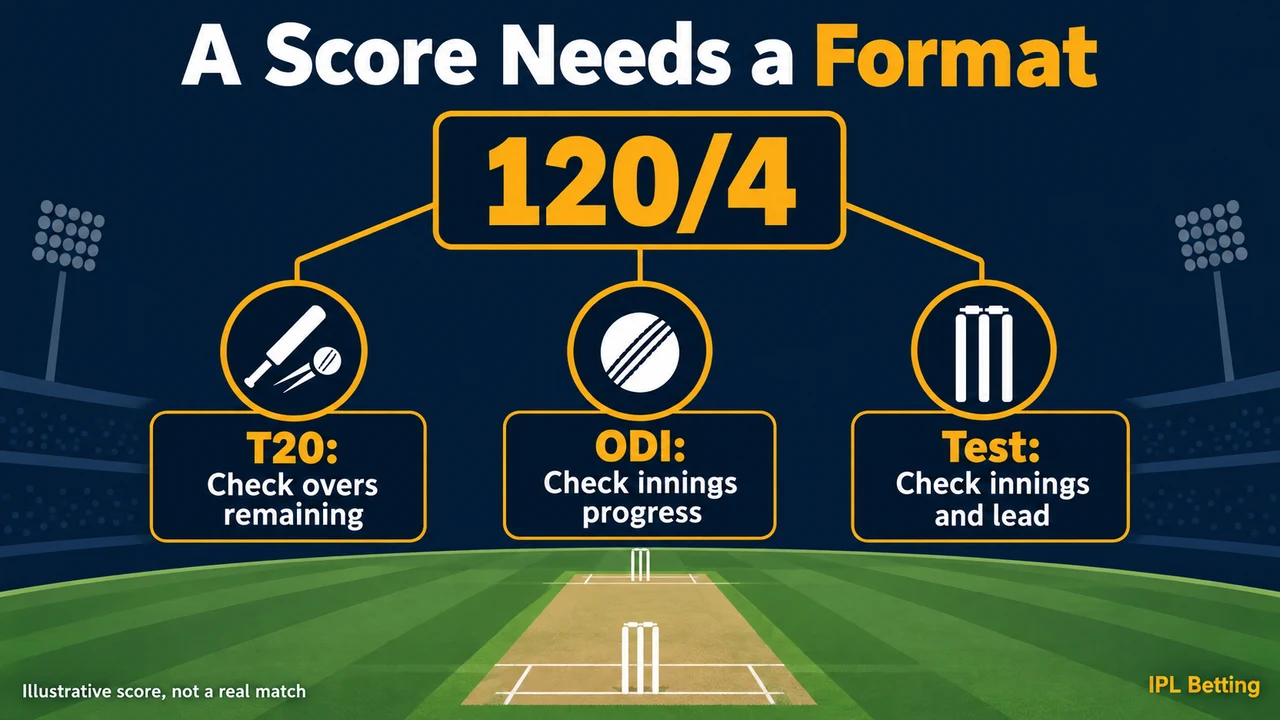
A team is 150 for 3. Is it in control? In an IPL match, the next question is how many overs have been bowled. In an ODI, you also want to know how much of the 50-over innings remains. In a Test, you may first need the other innings scores and the day of the match. The number is identical; the job still facing the batters can be completely different.
When you switch formats, check the runs, the balls or time left, and what the batting team still needs to do. Run rate alone will not tell you whether a Test team is building a lead or chasing a target. The examples below are invented to show the arithmetic, rather than historical results or suggested winning totals.
Start with the innings available
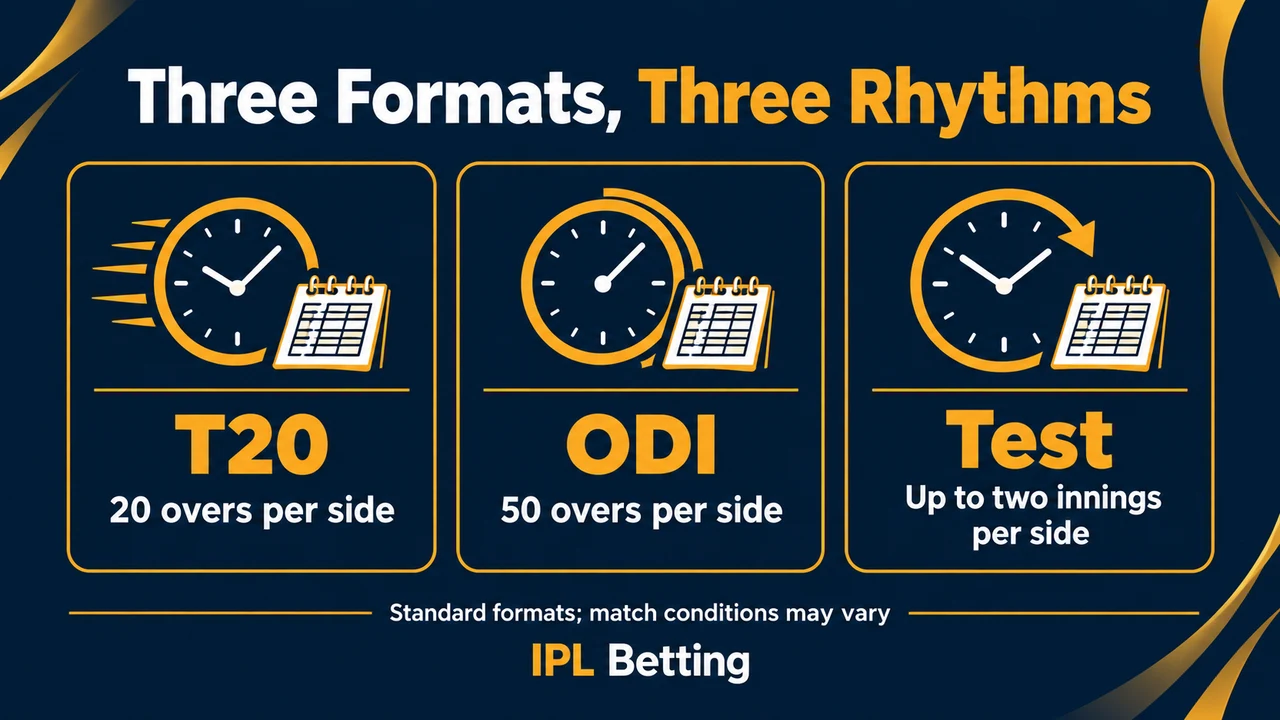
The ICC explanation of the three formats describes T20 internationals as 20 overs per side, ODIs as 50 overs per side, and the standard five-day Test as two innings per team. Those are the basic shapes of a full match. An innings may finish earlier, and interruptions can change a limited-overs allocation. Domestic T20 competitions use their own conditions.
| Format | Full-match starting point | First scoreboard question |
|---|---|---|
| T20 | One innings each, up to 20 overs | How many balls remain? |
| ODI | One innings each, up to 50 overs | Which stage of the innings is this? |
| Standard five-day Test | Up to two innings each | What is the aggregate lead, and how much time remains? |
That table explains why a T20 innings is not just a shortened Test innings. In a limited-overs first innings, the batting side has a fixed delivery budget. A Test side also has to consider how its use of time affects the chance to bowl the opposition out. Losing a wicket and using an over therefore create different trade-offs.
Read 150 for 3 in three settings
In an uninterrupted T20 first innings at 18.0 overs, 150 for 3 leaves 12 legal balls from the original allocation. Seven wickets remain, but there are few deliveries in which to use them. The total alone does not tell you whether the innings has been effective: conditions, ground dimensions, and the opposition still matter.
In an ODI at 30.0 overs, the same 150 for 3 leaves 120 legal balls in a full 50-over innings. The current rate is five runs per over. Multiplying that by 50 gives 250, but that is a constant-rate illustration, not a forecast. Batting personnel and scoring pace can change over the remaining 20 overs.
Now put 150 for 3 into a Test first innings after the opposition made 320. The batting side is still 170 behind. No target of 321 has necessarily been set: both teams may have another innings available. Calling this a chase would confuse a first-innings deficit with the final target.
A Test score needs an innings ledger
Consider a separate hypothetical Test: Team A makes 320, Team B replies with 280, and Team A then makes 160 in its second innings. Team A has scored 480 across its two innings; Team B already has 280. The target for Team B is 201, one more than the 200-run difference. You cannot calculate that target from the latest 160 alone.
If Team B reaches 150 for 3 in the final innings, it needs another 51 runs. The time remaining now becomes essential. Fifty-one runs with plenty of play left is a different problem from 51 with only a few overs likely before the close. This is why a Test broadcast keeps returning to sessions, weather, and the remaining batting order.
For detailed result and innings provisions, see section 16 of the ICC men’s Test playing conditions. A draw is distinct from a tie: unfinished play can end without either side winning, while a tie involves equal completed scores under the applicable conditions. Do not import an IPL tie-break procedure into a Test.
The ball and clothing are clues, not the full rulebook
The ICC history of the modern game records the first day-night Test using a pink ball. Ball colour can help orient a viewer, but it is not a complete definition of the format. The competition name and current playing conditions tell you which rules actually apply, including interruptions, field restrictions, and result procedures.
Even within one format, avoid carrying an old rule graphic into a new season. The ICC library separates men’s and women’s conditions and lists amendments. A television explanation might cover one competition only. Check the document title and effective date before using a technical detail to interpret another match.
Three questions when switching the channel
First, identify the format and innings. Second, work out the remaining task: a first-innings total to build, a deficit to reduce, or a final target to chase. Third, identify the limiting resource: balls, wickets, match time, or a combination. Only then decide what the current rate is telling you.
A quiet over in a Test can preserve a partnership through a difficult spell. The same six dot balls near the end of a T20 innings use a large share of the remaining opportunity to score. Neither observation makes one format easier; it explains why a shot that fits one situation may be poorly timed in another.
Questions readers ask
Does 150 for 3 tell me who is ahead?
No. Read the innings, overs, and target or aggregate lead. In a Test first innings, a side on 150 may still trail an earlier 320; in a T20 chase, the remaining target and balls are the immediate questions.
Is a Test draw the same as equal scores?
No. A tie requires equal scores with all innings completed under the cited Test conditions. A draw can occur when the match finishes without a winning result. Equal scores on a screen before play ends do not establish either outcome.
Can I project an ODI total from the current run rate?
You can calculate a constant-rate illustration, but it is not a forecast. At 150 after 30 overs, five per over would produce 250 over 50. That assumes the same rate continues and the full innings remains available.
Related reading
Indian Premier League Explained: Format, Teams, Match Rhythm, and the Best Starting Point for New Readers; Cricket Rules Made Simple for IPL Fans in the Philippines; How to Read an IPL Cricket Scorecard: Overs, Wickets, Run Rate, and Context.