
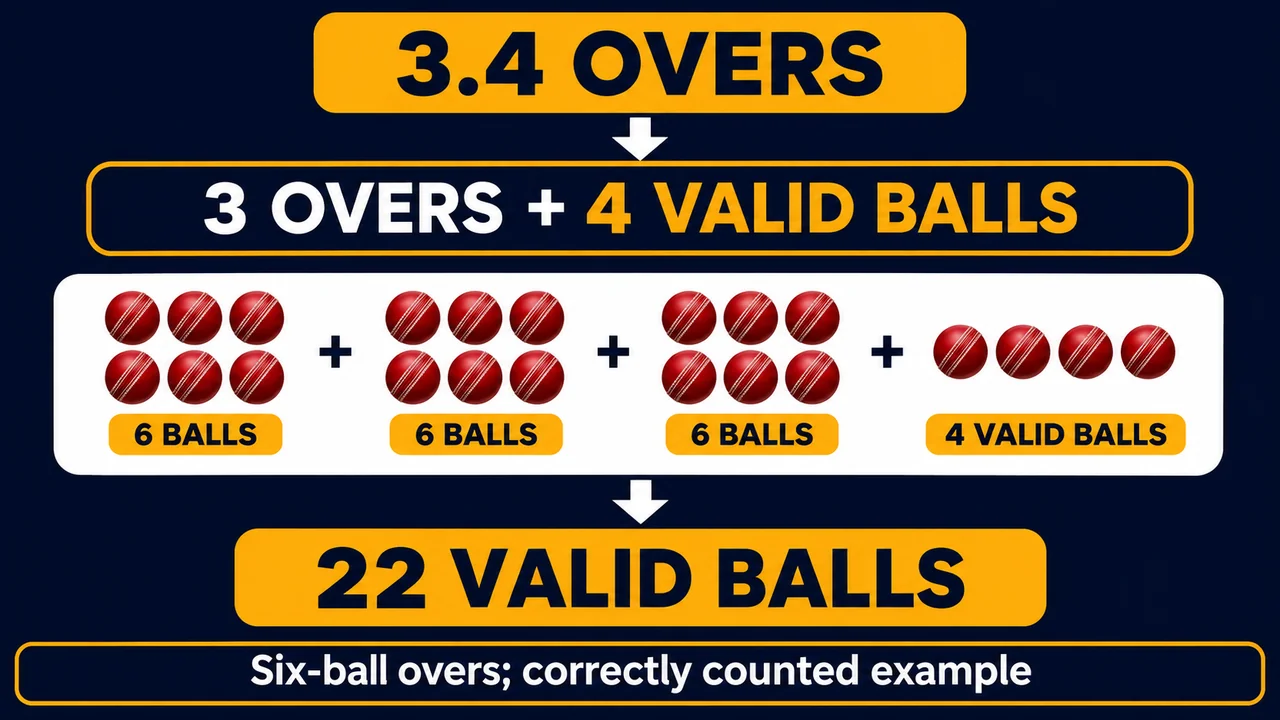
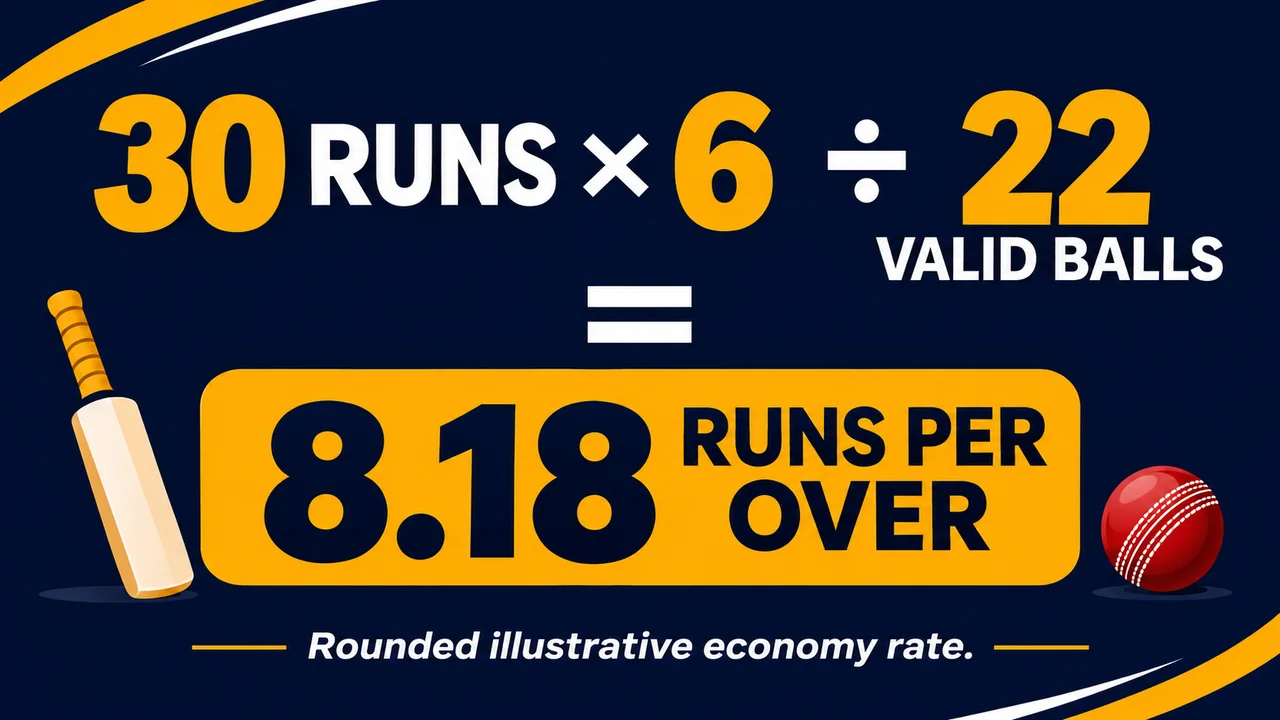
A scorecard shows a bowler has delivered 3.4 overs and conceded 30 runs. Dividing 30 by the decimal number 3.4 gives the wrong economy rate. In an ordinary, correctly counted six-ball-over match, 3.4 means three completed overs and four valid balls: 22 valid balls in all. The rate is 30 ÷ (22 ÷ 6), or approximately 8.18 runs per over. If the scorecard is incomplete or the over notation is unclear, wait for the official figures before calculating.
The examples below are invented and assume six valid balls per over. The formula follows New Zealand Cricket's scorer's companion; a particular competition's scoring conventions and official record control its published figures.
Convert the notation before dividing
In an ordinary six-ball-over scorecard, the number before the dot counts completed overs and the number after it counts valid balls in the unfinished over. It is an overs-and-balls notation, not a base-ten decimal.
For 3.4 overs:
- Three completed overs contain 3 × 6 = 18 valid balls.
- Add the four valid balls in the incomplete over: 18 + 4 = 22.
- Convert to overs for the rate: 22 ÷ 6 = 3⅔ overs.
- Divide 30 runs conceded by 3⅔ overs: approximately 8.18 runs per over.
The equivalent calculation is runs conceded × 6 ÷ valid balls. For this example, 30 × 6 ÷ 22 = 8.1818…, shown as 8.18 when rounded to two decimal places. The display's rounding may follow the score provider's convention.
Compare the same runs over different lengths
| Invented bowling figures | Valid balls | Calculation | Economy, rounded |
|---|---|---|---|
| 30 runs in 3.4 overs | 22 | 30 × 6 ÷ 22 | 8.18 |
| 30 runs in 4.0 overs | 24 | 30 × 6 ÷ 24 | 7.50 |
| 24 runs in 3.0 overs | 18 | 24 × 6 ÷ 18 | 8.00 |
The first two spells both cost 30 runs, but the second lasts two valid balls longer, so its economy is lower. In this ordinary, correctly counted six-ball example, one more valid ball after 3.5 completes the fourth over, shown as 4.0. If the official record reflects a miscounted over, follow that record.
This assumes the match is using six-ball overs and that the figures are complete. If a feed uses another display convention or the match uses different playing conditions, follow that source's documentation instead of applying the example blindly.
Use the bowler's runs, not the team's total
The numerator is the runs charged to the bowler in the scorecard, not all runs scored by the batting team during those overs. For example, byes and leg byes can add to the team's total without being charged to the bowler. Wides and the no-ball penalty are charged to the bowler; runs off the bat are also charged, while byes and leg byes are not. The precise record and applicable rules matter.
If an over's delivery-by-delivery record contains wides or no-balls, it can have more delivery events than valid balls in the over. Do not simply count every row in a feed as a valid ball. The site's ball-by-ball guide explains the difference between an event and a completed valid ball.
For a broader view, the scorecard guide shows how bowling figures sit alongside wickets, batting and team totals. If either figure is missing, check the official scorecard before calculating; the team total is not a substitute for the bowler's runs.
What the rate can and cannot tell you
Economy tells you how many runs the bowler conceded per over, based on the balls recorded so far. A lower rate can be useful, but it doesn't show everything the bowler contributed. Wickets, match phase, field restrictions, opponents and sample size can all change how a spell is understood.
One over or part of an over is a small sample. A boundary or wide can move the displayed rate sharply, and a later correction can change the numerator or denominator. The rate is not a prediction of the next delivery or the final innings score.
If a betting market uses live statistics, the broadcast and official feed may update at different speeds. Pause when the number or accepted market terms are unclear; check the official scorecard and the relevant market rules rather than treating an economy rate as a guaranteed outcome.
A quick calculation checklist
- Confirm the match's over length and the scorecard's notation.
- For ordinarily counted six-ball overs, convert completed overs and valid balls into a total; if an over was miscounted, use the official record and relevant scoring convention.
- Use the runs actually charged to that bowler.
- Calculate runs × 6 ÷ valid balls for a six-ball over; do not divide by zero.
- Round only at the end and keep the sample and match context beside the number.
Common questions
Is 3.4 overs the same as 3.4 decimal overs?
No. In an ordinarily counted six-ball match, it means three overs and four valid balls, or 22 valid balls. As a decimal number of overs, that is 3⅔, not 3.4.
Does a wide count as a valid ball in the over?
A wide does not count as one of the valid balls of the over under the ordinary Laws, although runs associated with wides are recorded. Check the official scorecard and applicable playing conditions.
Can team runs and a bowler's conceded runs differ?
Yes. Some extras, such as byes and leg byes, can increase the team score without being charged to that bowler. Use the scorecard's bowler-conceded figure for the economy calculation.
Can I calculate economy when no valid ball has been recorded?
Not using the per-over formula with a zero denominator. Wait for the official figures; a live display may use a placeholder in the meantime.
The New Zealand Cricket scorer's companion describes economy as runs conceded divided by overs, with partial overs converted appropriately. The MCC 2026 Laws explain valid balls and scoring; check the match's applicable playing conditions.
By IPL Betting. Source and review: All numbers above are invented arithmetic examples. They are not a real player's figures, a ranking or a prediction.
Promotional link. Gambling involves financial risk and may be restricted where you live. Participation is for eligible adults.