
Published by IPL Betting. Sources checked on 11 September 2026; examples are illustrative.
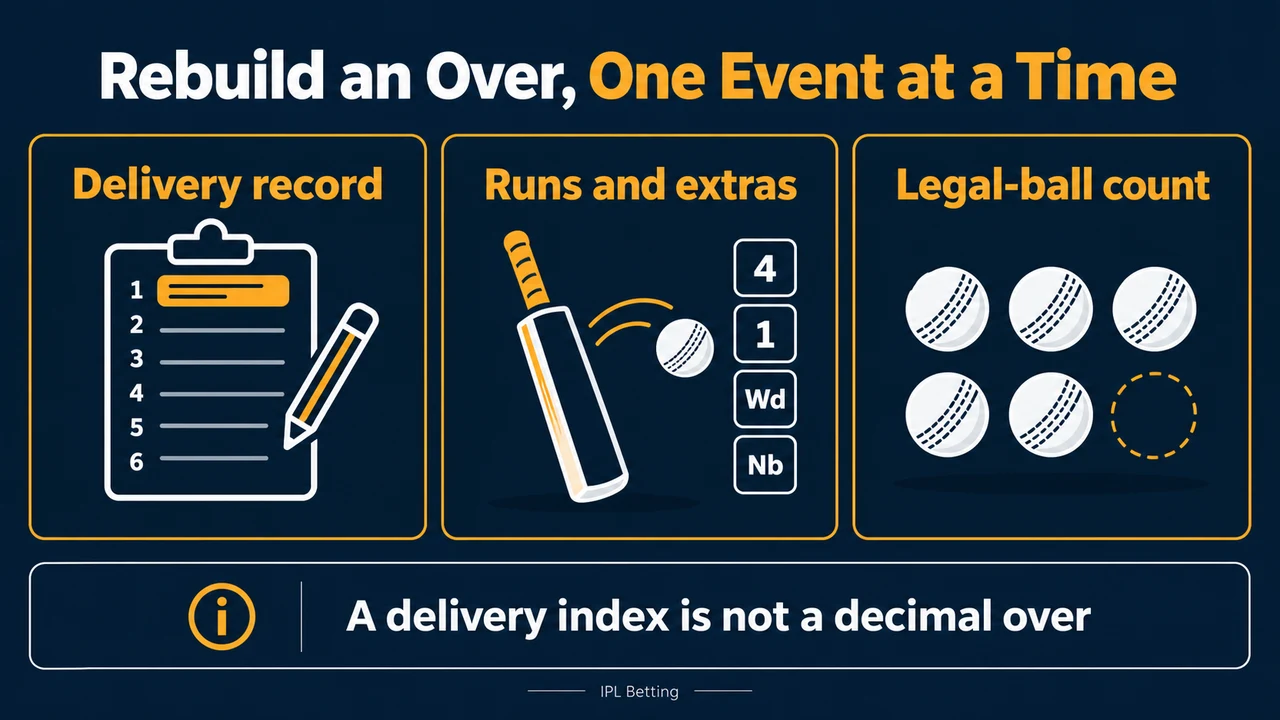
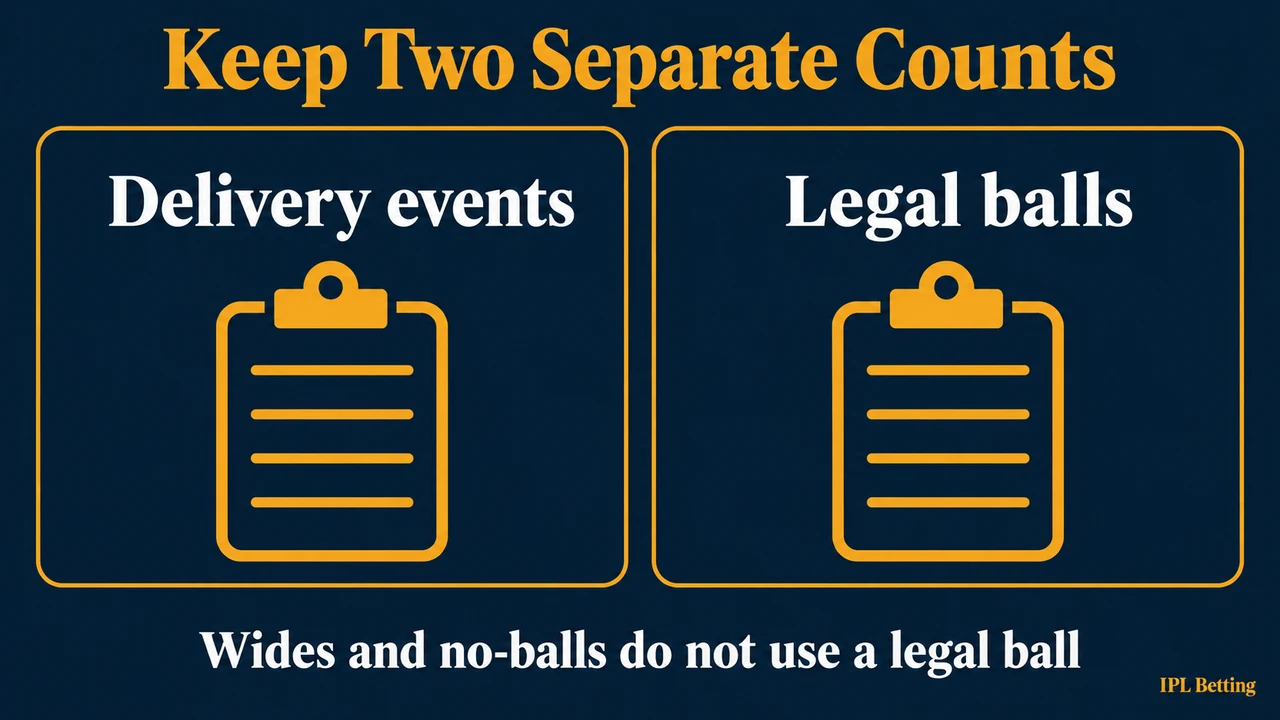
An over contains six valid balls, but a delivery file can contain more than six rows. Counting every row as a valid ball will end some overs too early. A wide creates an event to record without advancing the valid-ball count, and its run is already included in the delivery total.
To rebuild an over, keep three separate counters: events, valid balls, and runs. Do not force them to agree. The worked example below is invented for explanation; it is not a record of an IPL match.
For the legal-ball count, use MCC’s over and extras rules: an over normally contains six valid balls; no-balls and wides do not count toward that six. The worksheet below is an invented example.
Read the format before adding numbers
Cricsheet’s JSON documentation separates batter runs, extras, and the delivery total. Adding all three together would count the same runs twice. For the team score, use the delivery total; use its components when you need to explain where that total came from.
The documentation also allows innings-level penalty runs and records exceptional information such as miscounted overs. That means a complete innings check may need more than a sum of ordinary delivery rows. Read the dataset version and its field definitions rather than assuming every provider labels an event identically.
For your own worksheet, preserve the original event order and add calculated columns beside it. Keep the source fields unchanged. If a later correction appears, you will then be able to compare versions without wondering which values you edited yourself.
One fictional over, eight events
Assume an ordinary six-valid-ball over with no penalty runs outside the deliveries. The sequence is: a dot ball, a one-run wide, a single, a no-ball struck for four, another dot, two runs, another dot, and a single. The no-ball carries one extra run in this example.
The valid-ball counter moves on events one, three, five, six, seven, and eight. It does not move on the wide or no-ball. The team adds zero, one, one, five, zero, two, zero, and one: ten runs in total.
The batters collectively receive eight runs: one, four, two, and one. Extras contribute two more, from the wide and no-ball. Eight plus two equals the ten-run team increase. Eight events have produced six valid balls. Those are three different totals with three different meanings.
If your spreadsheet returns twelve runs, check whether you added extras on top of a total that already included them. If it claims the over ended after event six, check whether you treated every row as a valid ball. Each mistake has a different cause and a different fix.
Overs are a count, not a decimal measurement
A scorecard reading 4.2 overs means four complete six-ball overs and two valid balls: 26 valid balls. It does not mean 4.2 multiplied by six. For arithmetic, convert the notation to an integer ball count first.
To convert back in an ordinary six-ball format, divide the count into complete groups of six and the remainder. Twenty-nine valid balls becomes 4.5 overs. Thirty becomes 5.0. Keep the original notation for display and the integer for calculations so that sorting or rounding does not silently change the meaning.
Do not use a displayed ball label as your only unique identifier. An illegal delivery and the following delivery may share a displayed position, depending on the format. Match identifier, innings, over, and event position provide a more useful record of where the row came from.
Reconcile at small checkpoints
Check each over before comparing an entire innings. If the running total first diverges during the ninth over, investigate that section rather than rereading every delivery. A one-run discrepancy and a missing wicket may not have the same origin.
Preserve dismissal details instead of assuming that every wicket event credits the bowler. Separate a team-wicket count from a bowler-wicket count. When those differ, consult the dismissal type and the dataset definition before calling the file incorrect.
If an innings total still differs after delivery checks, inspect any documented penalty-run fields, unfinished overs, or corrections. Do not add a balancing run merely to make the final score match. An unexplained adjustment hides the issue that the reconciliation was supposed to find.
Save enough information to reproduce the result
Record the file name, download date, format version, match identifier, and any transformation you applied. A note such as “summed delivery totals, then added documented innings penalties” is clearer than “cleaned data.” It tells another reader what your total includes.
Keep a small exceptions list. For example: “Over nine differs by one run from the scorecard checked at 20:00; no manual correction applied.” An unresolved discrepancy should remain visible. Leave that over out of the comparison until you can explain the difference, and state that exclusion in your notes.
This approach is useful even without code. A short worksheet can reveal whether a number represents events, valid balls, batter runs, or team runs. Once those definitions are consistent, larger comparisons become much easier to interpret.
Questions readers ask
Does every row represent a ball faced by the batter?
No. A delivery event and a batter’s ball-faced statistic are different concepts. Use the format’s definitions and the scoring rules rather than counting rows indiscriminately.
Can I use the team total to calculate a batter’s strike rate?
No. Team totals include other batters and extras. A batter-specific calculation needs that batter’s credited runs and the appropriate balls-faced count.
Should I overwrite a file when a correction appears?
Keep the earlier version and label the replacement. Comparing them shows exactly what changed and prevents an old calculation from appearing to use the newest data.
Sources checked on 11 September 2026: Cricsheet JSON format.
Related reading: How to Read an IPL Cricket Scorecard: Overs, Wickets, Run Rate, and Context; IPL Betting Trend vs Noise Guide: How Many Matches Make a Statistic Useful?; Cricket Rules Made Simple for IPL Fans in the Philippines.