
The IPL document titled IPL 2026 Playing Conditions lists 3.4 Powerplay overs for a 12-over innings: three complete overs and four valid balls of the fourth, in ordinary six-ball notation. During that restricted phase it says no more than two fielders may be outside the marked restriction area at the instant of delivery.
There is an important qualification before applying that answer to a match. The published IPL PDF has “effective 1 March 2026” on its cover, but its introduction refers to 1 March 2024. We can explain what this document says; we cannot confirm from those conflicting dates that it governs a particular match. Check the match’s applicable conditions and official announcements.
Reading the reduced-innings table
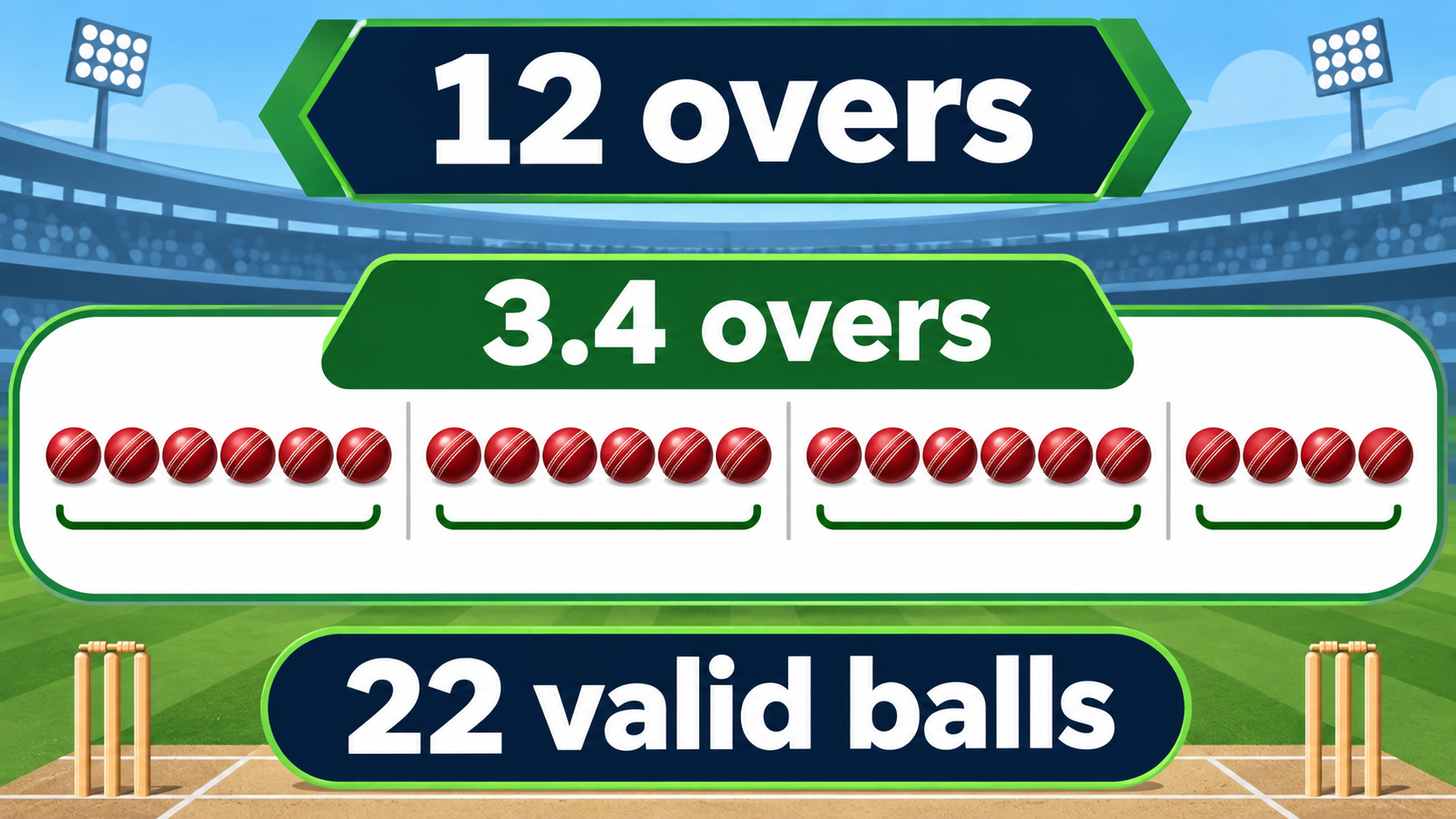
Clause 28.7.6 gives an allocation for each reduced innings length and says the table applies to both the first and second innings. It is the length allocated to the batting team’s innings that selects the row, not the number of overs remaining when you look at the score.
| Allocated innings | Restricted Powerplay in the document |
|---|---|
| 10 overs | 3.0 overs |
| 11 overs | 3.2 overs |
| 12 overs | 3.4 overs |
| 13 overs | 3.5 overs |
| 14 overs | 4.1 overs |
For 12 overs, read 3.4 as three overs plus four valid balls, not 3.4 in decimal arithmetic. With normally counted six-ball overs, that is 18 plus four, or 22 valid balls. The next valid ball is in the same fourth over, but follows the allocated Powerplay once the 22 have been completed. Wides and no-balls can mean more deliveries are bowled than the valid-ball count; the official record and umpire’s count matter.
This table is a lookup from the named document, not a formula for every competition. The row for 13 overs is 3.5, for example, so assuming a simple decimal percentage can produce the wrong boundary. In an uninterrupted match, clause 28.7.2 describes the first six overs as the Powerplay, subject to the reduced-innings provision.
Does 3.4 mean three point four overs?
No. It is overs-and-balls notation in the example: three completed overs and four valid balls. It is not three overs plus four tenths of an over.
What changes when play resumes mid-over
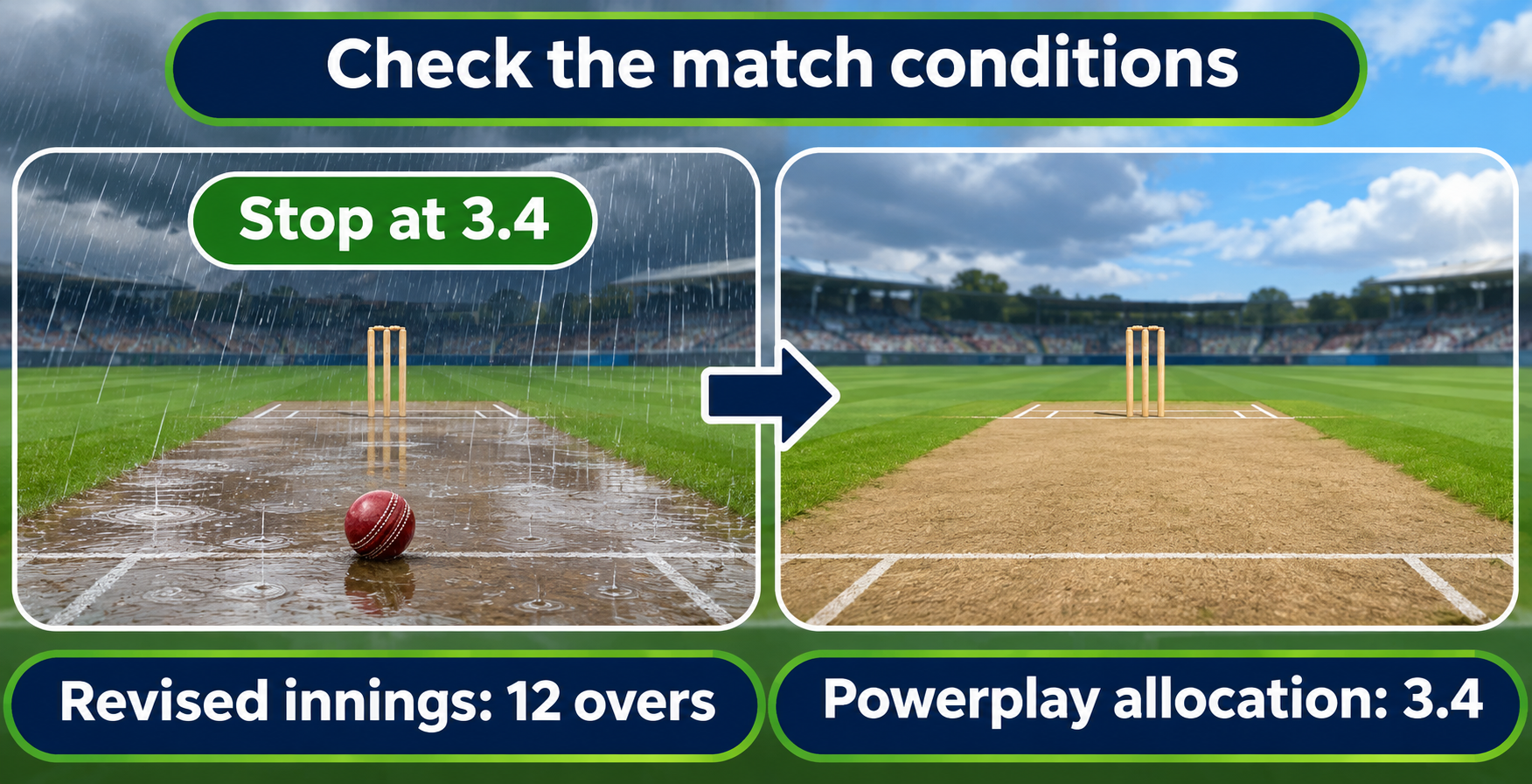
Clause 28.7.7 addresses a particular situation: an interruption occurs during an over, the batting side’s allocation is reduced, and by resumption the required number of Powerplay overs under the reduced allocation has already been bowled. In that case, the remaining deliveries needed to complete that over are not subject to the Powerplay fielding restrictions.
Imagine an innings is stopped after 3.4 overs and is then reduced to 12 overs. On the document’s table, the revised Powerplay allocation is also 3.4. Assuming an ordinarily counted over and that the official count is 3.4 at resumption, the remaining valid balls of that over are no longer under the Powerplay restriction. The captain does not have to wait for the over to finish before that particular restriction ends.
Change one detail: if play stopped at 3.2 and the allocation becomes 12 overs, the table’s 3.4 threshold has not yet been reached. The exception described above has not been triggered merely because an interruption happened. Two further valid balls would bring the count to 3.4 in this illustrative, normally counted example. Any further reduction or official correction requires the situation to be checked again.
These are illustrations of the text, not reports of real matches. A restart announcement, the official overs count and the conditions actually in force are needed before deciding how a live situation is governed. The rule does not say every interruption ends the Powerplay.
Does a shortened innings always end the restriction immediately?
No. The provision requires the revised Powerplay allocation already to have been bowled at resumption. Compare the revised innings row with the official count; do not infer the answer just from the rain delay.
Counting fielders outside the area
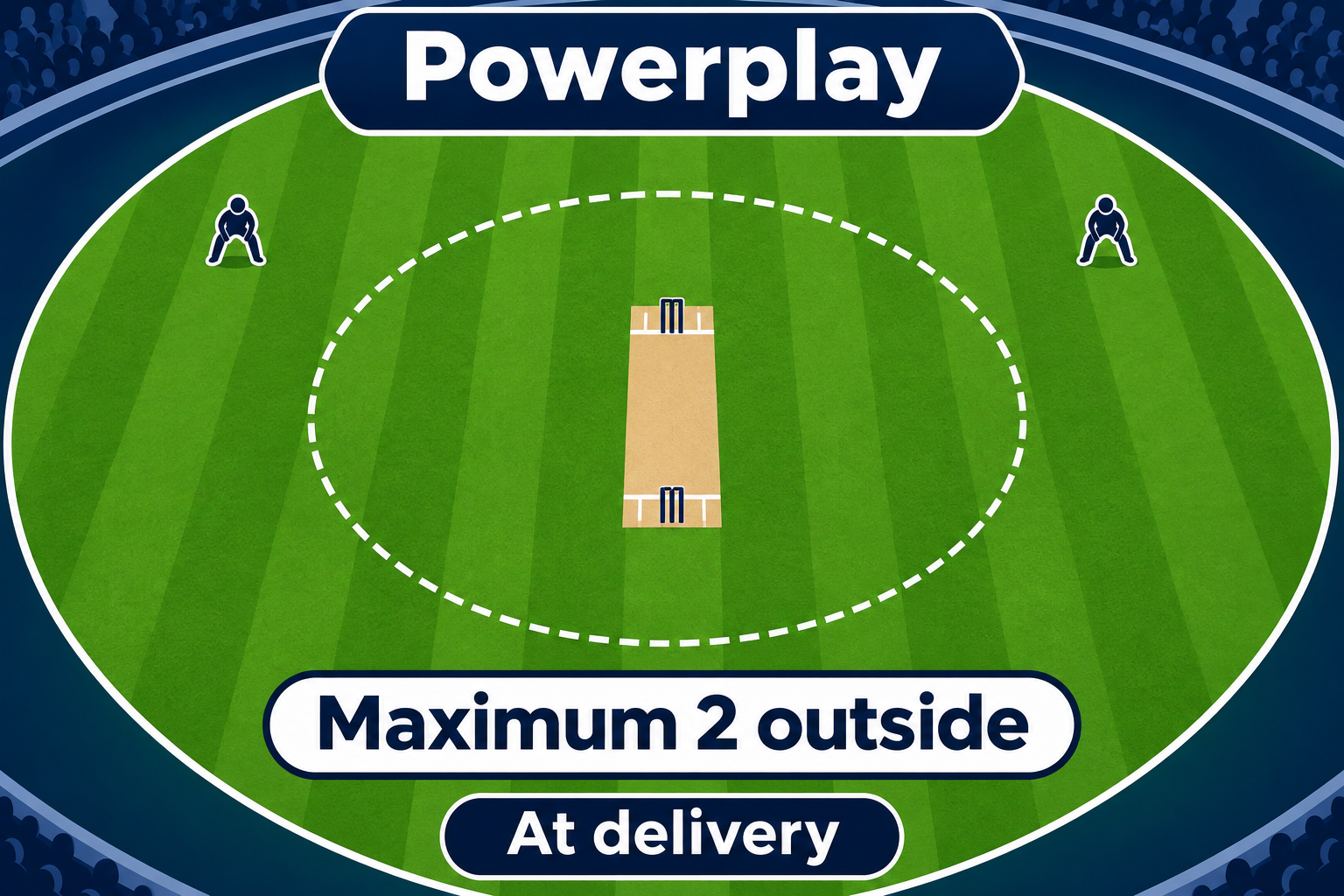
The document’s clause 28.7.3 describes a restriction area made from two 30-yard semicircles centred on the middle stumps and joined by straight lines. During Powerplay overs, clause 28.7.4 sets the limit at two fielders outside that area at the instant of delivery. The timing matters: a camera view after the ball has been hit cannot by itself establish where everyone stood when it was delivered.
Clause 28.7.5 generally allows no more than five outside during non-Powerplay overs. That is not an unconditional promise that five are allowed in every later situation: the same document contains other provisions, including an over-rate penalty in clause 13.8, which may alter the limit when its conditions are met. Clause 28.7.8 says an infringement of the stated fielding restrictions leads the striker’s-end umpire to call and signal no ball.
For the names and orientation of positions, see the cricket field positions guide. A position name and the fielding restriction answer different questions: first locate the fielder, then consider whether that fielder is outside the marked area at delivery.
Can a broadcast angle settle a suspected infringement?
Not necessarily. A cropped shot may omit fielders or make the line hard to judge. The umpire’s call and the applicable match conditions are better references than an incomplete camera angle.
Check the document before applying the example
The date discrepancy is visible in the source itself: the cover says 2026, while the introduction says 2024. The title and a table alone do not resolve which version or amendments governed a particular fixture. To use the example responsibly:
- Find the playing conditions and any amendments identified for the match.
- Confirm the revised allocation for the innings concerned, and whether it changed again.
- Read the Powerplay row in that applicable version and compare it with the official count at resumption.
- Check match officials’ announcements and any other applicable fielding restrictions.
If the governing version or the revised count is unavailable, the 12-over calculation remains a reading of the linked document, not a confirmed ruling on that match. For the separate questions of revised targets and match status, see the rain-delay and DLS guide. For ordinary full-innings context, the first-six-over Powerplay guide discusses that phase; its six-over framing should not be substituted for a reduced-innings table.
Is this proof of the rule for every IPL 2026 match?
No. It is a reading of the linked document, whose cover and introduction give different effective years. Match-specific applicability remains unconfirmed; check the governing version and announcements.
Source: IPL, IPL 2026 Playing Conditions, cover, introduction and clauses 28.7.2–28.7.8, with clause 13.8 for the over-rate qualification. Accessed 20 November 2026.