
Published by IPL Betting. Sources checked on 11 September 2026; examples are illustrative.
“Deep square leg comes in; cover goes back.” The camera follows two moving shirts, and the field suddenly looks different. To understand the change, you need a reference point that stays useful when the television camera switches ends: the batter facing the ball.
Field-position names describe areas rather than fixed painted spots. First identify off or leg side, then whether the fielder is forward or behind square, and finally how far they are from the bat. You can then follow a captain’s adjustment without remembering every traditional name at once. This is a guide to field geography and watching habits, not a list of IPL fielding restrictions.
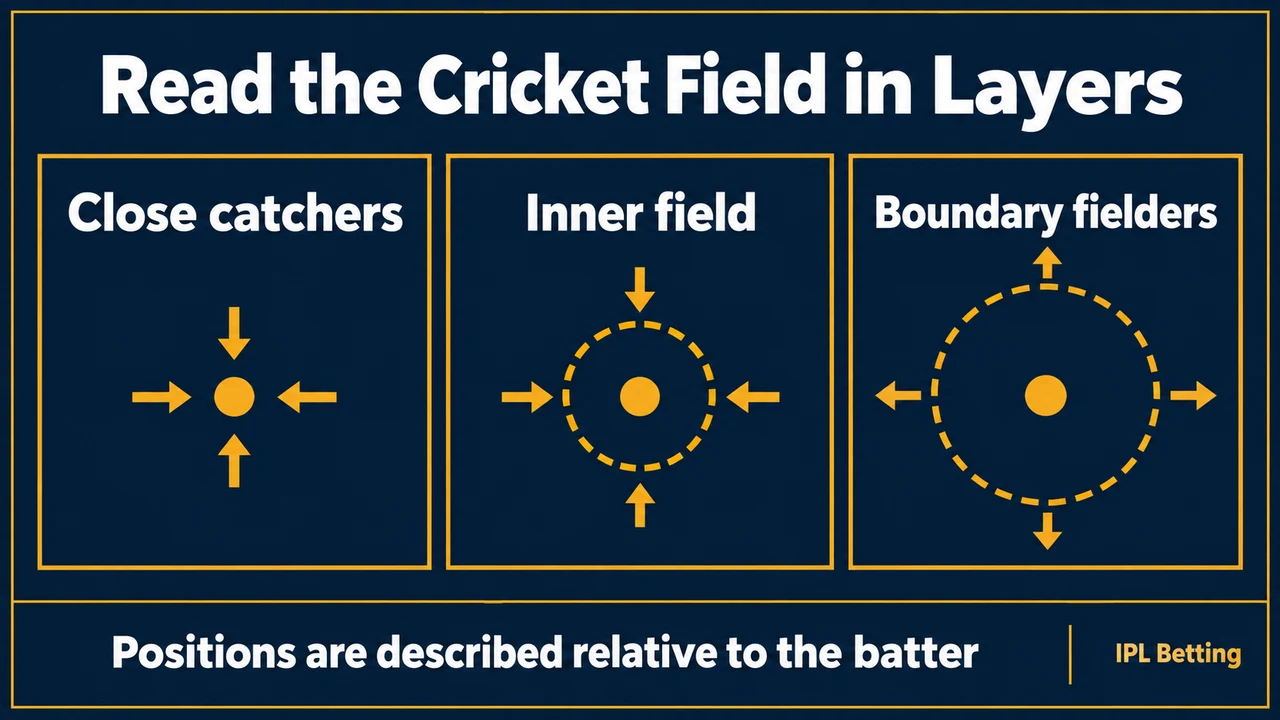
Use the batter as your compass
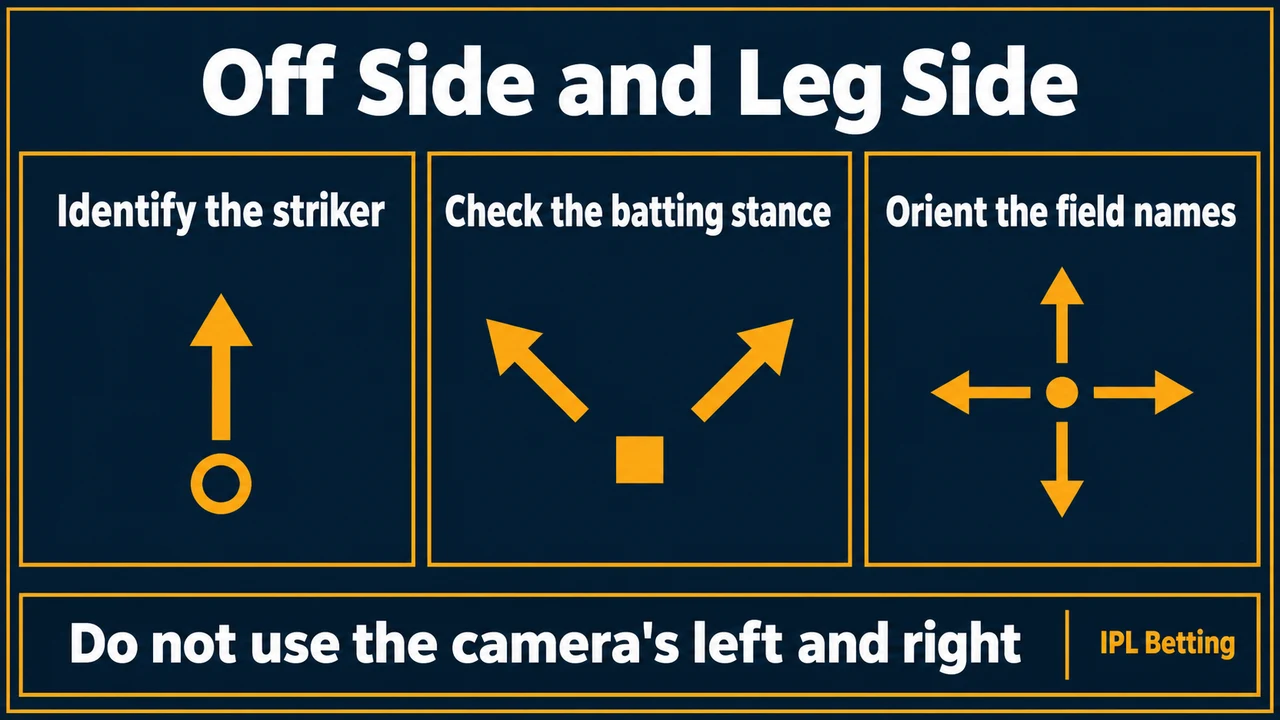
The official MCC definitions and diagrams establish the striker’s and bowler’s ends and the field’s orientation. For a conventional right-handed stance, the off side is the side in front of the batter’s body; the leg side is behind it. A left-hander reverses those sides. The television screen’s left and right are unreliable labels because camera angles change.
Before each ball, find the striker, then locate the bowler. Imagine a line along the pitch and a second line across the striker. The second line gives you square: roughly sideways from the batter. Positions forward of square lie towards the bowler’s end; positions behind square lie towards the keeper’s end. Treat this as a reading aid, not a measured placement plan.
Learn the main families first
As a visual reference, the field-position illustration reproduced in Harry Ricketts’ fielding diagram, filed with New Zealand’s EPA groups close catchers, midfield and outfield positions. It is an illustration from a book, not a rule issued by a cricket governing body, and assumes a right-handed batter. The names below are a compact orientation guide, not exact coordinates.
| Area | Names to recognise | Basic location |
|---|---|---|
| Behind the batter, off side | Slips and gully | Catching area beside the keeper and farther square. |
| Square on the off side | Point | Sideways from the striker. |
| Forward on the off side | Cover, extra cover, mid-off | Between point and the straight direction. |
| Forward on the leg side | Mid-on and midwicket | Leg-side area towards the bowler. |
| Square on the leg side | Square leg | Sideways on the leg side. |
| Deep and fairly straight | Long-off and long-on | Outfield extensions on either side of the pitch. |
Choose just one family for your first over of practice. Find the off-side fielders, then notice which one is closest to the straight line down the pitch. It is easier to build a reliable map gradually than to attach a name to every player during a fast camera pan.
Depth explains why a small move matters
A player close to the bat has little reaction time and may be placed for a catching chance. A player farther out can cover a different patch of ground. A boundary rider is deeper again. A wide view helps you see those distances; a tightly cropped broadcast may hide a deep fielder until the ball travels towards them.
The words “deep” and “short” help describe that distance. “Backward” and “forward” help describe an angle relative to square. Do not read “backward” as “closer to the boundary”: a fielder can move behind square without moving much farther from the batter. When commentary mentions a move, ask which of the two dimensions changed.
Two ways to read a field change
The following situations are invented viewing exercises. They describe possible intentions, not certain predictions about the next delivery or claims that a complete field meets a particular competition’s restrictions.
| Visible adjustment | A useful question |
|---|---|
| A slip disappears and another player is visible in the off-side outfield. | Has the captain exchanged close catching coverage for protection farther from the bat? |
| A leg-side boundary fielder moves several steps behind square. | Has the angle changed to cover a different route, even though the depth is similar? |
Follow the next few deliveries rather than declaring the plan after one ball. A bowler can miss the intended line, a batter can improvise, or the captain can make another adjustment immediately. A field offers clues about coverage. It cannot tell you the outcome before the ball is delivered.
For a broader visual introduction, the ICC’s fielding explainer is a useful companion. Watch it with the basic three-part question in mind: which side, which angle, how deep? That question remains usable even before you know the commentator’s preferred name for the spot.
What changes when a left-hander takes strike?
Rebuild the map from the new batter’s stance. The off and leg sides switch in physical space, so a fielder who stays in roughly the same place can now occupy a different named area. The camera may also reverse its view at the end of an over. Those two changes together are a common reason a beginner’s mental map breaks.
Use a quick reset: identify the striker, identify the bowler, label off and leg, then look for the deepest players. Avoid trying to rotate your old television screenshot in your head. Start again from the batter now facing the ball.
Questions from the commentary box
Is point always exactly level with the batter? Think of it as a general area. Commentary may add backward or forward to describe a more precise position.
Are long-off and long-on the same side? No. Their names distinguish the off-side and leg-side outfield areas near the straight direction.
Can I count deep fielders to decide whether a field is legal? Only with the applicable playing conditions, innings phase and a complete view. This geography guide does not establish that allowance.
If you need the basic match structure, begin with cricket rules made simple. Our left- and right-hand matchup guide adds context to stance changes, and the powerplay guide discusses the opening phase separately.