
A player can return to the outfield and still be unavailable to bowl. In the document currently linked by the IPL, an absence of more than eight minutes can create Penalty Time, unless an exemption applies. The player must serve the outstanding time before bowling, with the unserved balance capped at 40 minutes. Batting has a separate restriction, including an exception once the team has lost five wickets.
The useful question is therefore not simply, “Is he back on the ground?” It is, “Has the umpire allowed him back, and how much Penalty Time remains?” A substitute appearing, an innings ending or rain interrupting play does not answer both questions.
This guide uses the 2026 document currently linked from the official IPL playing-conditions page. The cover gives 1 March 2026 and the introduction gives 1 March 2024. The guide explains the clauses in that published PDF, checked on 20 November 2026. For a disputed match, confirm the conditions used for that fixture. The examples below are invented to explain the conditions, not reconstructions of a player’s treatment, an umpire’s decision or a particular match.
More than eight minutes: count the absence, not just the excess
Clauses 24.2.3 and 24.3.3 distinguish an absence exceeding eight minutes from one lasting eight minutes or less. Where Penalty Time applies, the bowling restriction is based on the playing time missed. Eight minutes is not an amount to subtract before starting the calculation.
For example, assume a player misses nine minutes during uninterrupted play, has no existing balance and has no applicable exemption. The starting restriction is nine minutes, not one minute. He does not receive eight free minutes followed by a one-minute wait.
The following comparisons all assume continuous play, no existing unserved time and no exemption. Interruptions and repeat absences need their own treatment, covered below.
| Hypothetical absence | Penalty Time arising | What the number means |
|---|---|---|
| Exactly 8 minutes | None under the short-absence exemption | Eight minutes or less is exempt |
| 9 minutes | 9 minutes | Do not subtract eight |
| 18 minutes | 18 minutes | The absence, rather than its excess over eight, supplies the starting time |
| 50 minutes | 40-minute unserved balance | The outstanding balance is capped at 40 minutes |
Briefly crossing the boundary while performing fielding duties is not automatically an absence under this rule. Clause 24.2.1 expressly separates that ordinary fielding activity from leaving the field. A television shot of a player retrieving the ball beyond the rope is not enough to start a Penalty Time calculation.
Returning to field does not clear the bowling restriction
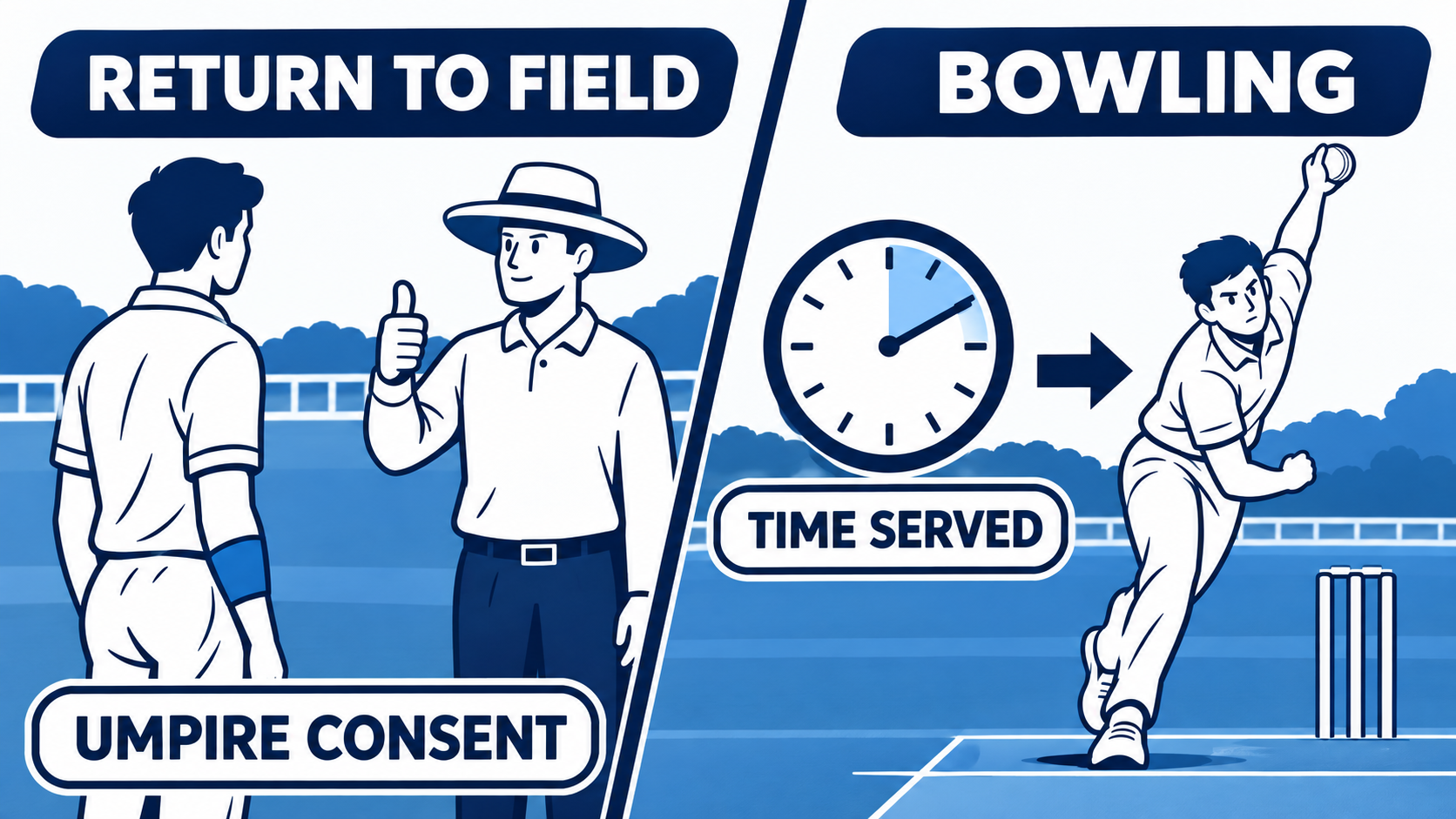
The umpire must be told why a player is absent. Returning during a session also requires the umpire’s consent. Those requirements are separate from completing Penalty Time: permission to rejoin the field does not, by itself, make the player immediately eligible to bowl.
Under clause 24.2.3.1, time spent fielding after the return can discharge the restriction. Time during which the player’s team is subsequently batting can also serve it. Once the outstanding balance has been served, this particular bowling restriction ends; other eligibility rules still apply.
A temporary substitute does not serve the absent player’s time on his behalf. Nor does seeing a substitute take a catch establish that the absent player can deliver the next over. Our guide to substitute fielders and approved replacements explains why those roles are different. This article deals with the nominated player’s absence and return, not the separate approval of a concussion replacement or an Impact Player.
The practical distinction is simple: a returning player may be permitted to field while he waits to become eligible to bowl. Treat “back on the field” and “available for the next over” as different statements.
A second absence adds to the unserved balance
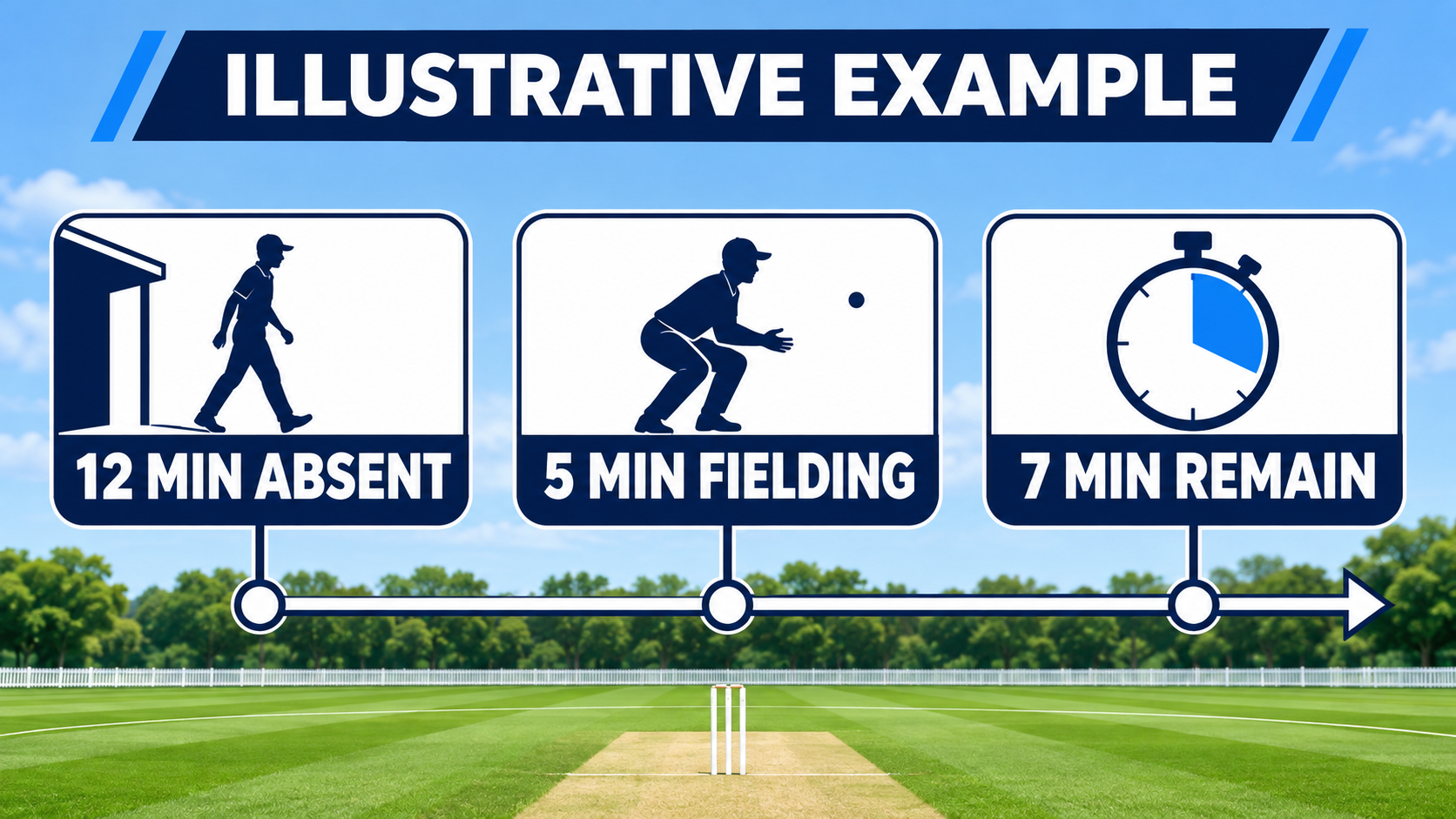
Leaving again does not reset the account. Clauses 24.2.4 and 24.2.5 preserve unserved time and add further chargeable playing time missed, subject to the cumulative 40-minute cap.
Consider this complete hypothetical sequence. Both absences occur during uninterrupted play, neither qualifies for an exemption, and the player has no other restriction.
| Stage | Calculation | Unserved balance |
|---|---|---|
| Misses 12 minutes | Start with 12 minutes | 12 minutes |
| Returns and fields for 5 minutes | 12 minus 5 | 7 minutes |
| Leaves again for 10 minutes | 7 plus 10 | 17 minutes |
| Returns and fields for another 17 minutes | 17 minus 17 | Zero |
After the second absence, the answer is neither ten minutes nor 22 minutes. Ten would discard the seven minutes still owed. Twenty-two would add the two absences without allowing for the five minutes already served. The balance follows both additions and eligible reductions.
For a separate cap example, suppose 17 minutes remain and another chargeable absence adds 30. The sum is 47, but the unserved balance is limited to 40. That ceiling does not mean every absence produces a fresh 40-minute penalty, or that the time already served is ignored.
These are time calculations, not over calculations. Four overs do not have a fixed duration in minutes, and waiting through a certain number of deliveries is not a substitute for the officials’ time record.
An innings break does not count, but the batting innings can
Clause 24.2.6 defines the playing time used for these restrictions and excludes the scheduled intervals listed in clause 11.1.1. Those intervals include the innings interval, Time-Outs and other agreed intervals.
Suppose a player finishes the fielding innings with seven minutes still unserved. A 20-minute innings interval does not automatically clear those seven minutes. Once his team’s batting innings is in progress, eligible playing time can run down the balance. With no other complication, seven such minutes would discharge it.
This is why adding departure and return times from a broadcast clock can give the wrong answer. A long real-world interval may contain time that does not count. Conversely, a qualifying unscheduled interruption may count even though no delivery is being bowled. The type of break matters, not simply its length.
The conditions also specify that Penalty Time continues to expire after a player is dismissed, for the remainder of his team’s batting innings. It is not a clock that stops merely because that individual is no longer batting.
Rain can count, but an already-absent player must notify the umpire
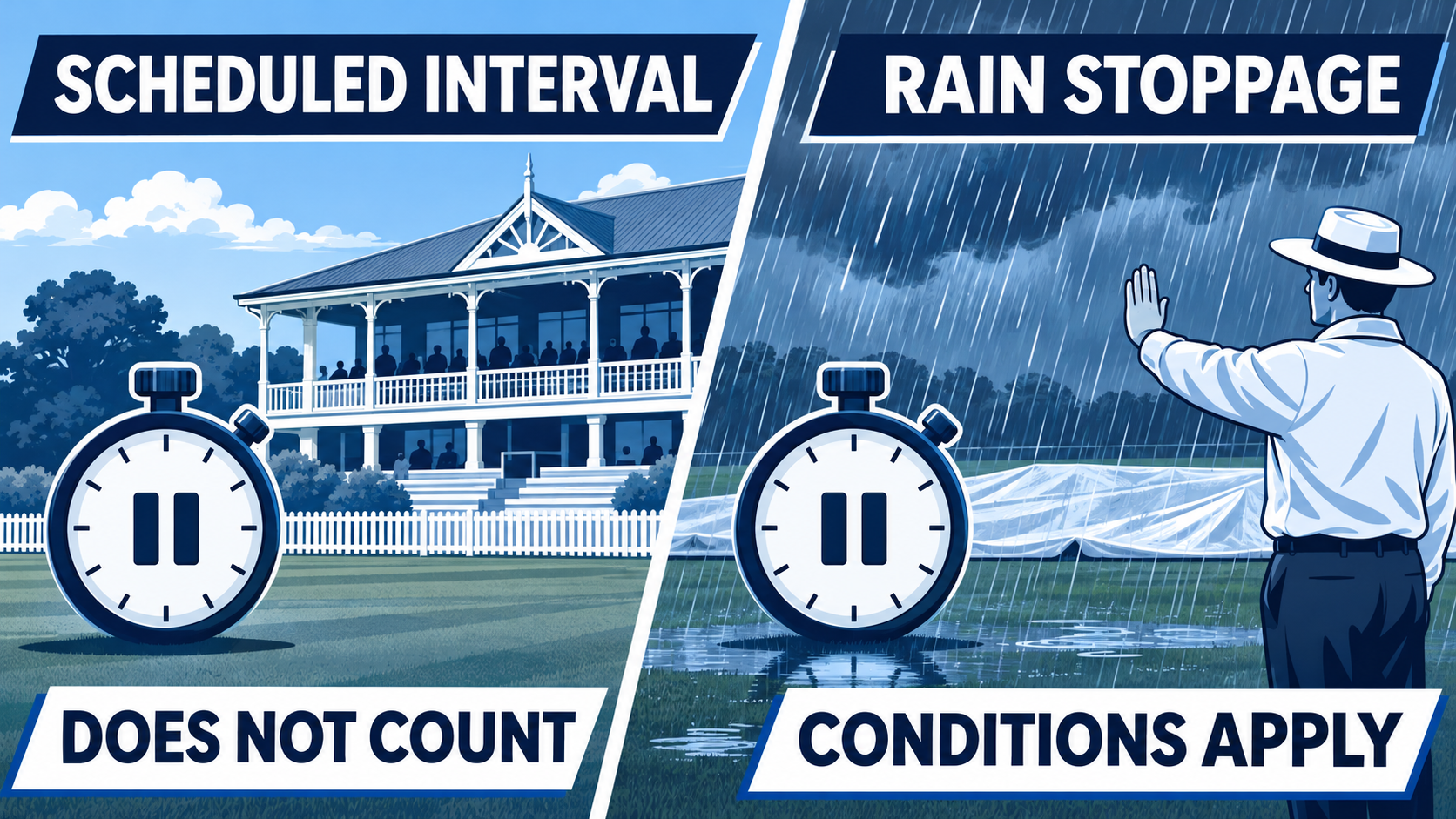
Clause 24.2.7 provides an exception for an unscheduled break. It distinguishes a player who was on the field when the break began from one who was already off it.
For a player on the field at the start, the stoppage can count if he takes the field when play resumes, or his side is now batting. Do not turn that into a blanket statement that every rain delay clears everyone’s balance, regardless of whether the conditions are met.
For a player already off the field, there is an additional requirement: he must notify an umpire in person when he is able to participate. Time before that notification does not count towards the unserved balance. He must also take the field on resumption, or his side must now be batting.
Take an invented example with 20 minutes outstanding and a 12-minute unscheduled stoppage. The player was already absent when it began. He becomes able to participate and notifies the umpire three minutes into the stoppage, then returns when play resumes. The eligible stoppage is nine minutes, so the remaining balance is 20 minus 9, or 11 minutes. Counting all 12 would incorrectly credit the period before notification.
The batting provision in clause 25.3.2 likewise makes personal notification important during an unscheduled stoppage. It does not give a viewer permission to assume that “he looks ready in the dressing room” has the same effect. Readiness, notification and the relevant return-to-play condition are separate facts.
Five wickets allow batting, not an automatic wipe of the balance
When an unserved balance carries into the team’s batting innings, the normal rule is that the player must wait for the corresponding playing time. Clauses 24.2.3.2 and 25.3.1 make an important exception: once the side has lost five wickets, he may bat immediately even if time remains.
For example, imagine seven minutes carry into the batting innings. Only three eligible minutes have elapsed when the fifth wicket falls. Four minutes remain, but the five-wicket exception permits him to bat. The exception is not an instruction to remove those four minutes from the time record.
The conditions preserve any balance still unserved at the end of an innings. Clause 24.2.8 also carries unserved time into a Super Over where applicable; Appendix F, paragraph 8, repeats that requirement. Do not assume a tie-break starts with a clean slate. Super Over participation has other eligibility conditions as well, so clearing Penalty Time is not a complete selection decision.
The same distinction applies to bowling quotas. A player might have an unused over but still be time-restricted, or have served all his time but already used his permitted quota. Our bowling-over limits guide explains quota arithmetic using its named ICC competition; it is a separate question, and its competition-specific figures should not be substituted for IPL regulations.
Not every injury-related absence incurs Penalty Time
Clause 24.3 exempts a nominated player who has justifiably left, or cannot take the field, because of an external blow suffered during the match. It also allows other wholly acceptable reasons in the umpires’ opinion, but expressly excludes illness and internal injury from that latter category. An absence of eight minutes or less has its own exemption.
Therefore, “he is receiving treatment” is not enough information to decide the issue. An external blow and an internal injury are not interchangeable descriptions in this provision. Neither a replay nor the presence of medical staff tells a viewer which exemption the umpires have accepted.
It is equally wrong to say that every justified medical absence automatically avoids the restriction. The relevant reason and the officials’ application of the condition matter. This article explains the eligibility rule; it does not diagnose a player or classify an unseen injury.
Keep Penalty Time separate from runs, over rates and selection
Penalty Time is a restriction on a player’s participation. It is not itself a deduction of runs or the fielding restriction imposed for a team’s slow over rate. Our slow-over-rate explanation discusses the different team-level clock under its named ICC conditions, rather than providing an IPL fine schedule.
There is also a separate consequence for an unauthorised return. Under clause 24.4, if a player returns contrary to the permission requirement and touches the ball while it is live, the ball becomes dead and five penalty runs are awarded to the batting side, with the further scoring treatment specified there. That is not the same as saying every early return automatically costs five runs: the condition includes contact with the live ball.
Even when a player is eligible, the captain need not select him to bowl next. A player warming up is not an official announcement, and a scorecard alone does not reveal all absence notifications. To understand a disputed return, the relevant facts are the reason for absence, chargeable time missed, time already served and the officials’ permission—not just a glimpse of the player near the boundary.
Frequently asked questions
Is a nine-minute absence only one minute over the allowance?
For the Penalty Time calculation, do not deduct eight minutes. If no exemption applies and those nine minutes are chargeable playing time, the starting balance is nine minutes. The short-absence exemption applies to eight minutes or less.
Does any rain delay count as time served?
No blanket answer applies. For a player already absent, time before personal notification to an umpire does not count. The return-at-resumption or now-batting condition must also be satisfied. Scheduled intervals are treated separately and do not become eligible simply because they last a long time.
Can a player bat after the fifth wicket but remain restricted for bowling?
Yes. Five wickets provide a batting exception, not an automatic cancellation of unserved Penalty Time. The remaining balance continues under the applicable timing rules and can carry into a Super Over. Bowling availability and batting permission must be checked separately.
Sources
- Official IPL playing-conditions page, checked on 20 November 2026.
- IPL 2026 Match Playing Conditions, the PDF linked by that page: clauses 11.1.1, 24.1–24.4 and 25.3; Appendix F, paragraph 8. Examples in this article are hypothetical.