
Published by IPL Betting. Sources checked on 11 September 2026; examples are illustrative.
A fast bowler has delivered three overs, and the captain still has several overs to defend. Can that bowler bowl twice more? In a normal 20-over innings under the ICC Men’s T20 World Cup 2026 conditions, the answer is no: the individual limit is four overs. But once rain shortens an innings, “four each” can stop being the right calculation.
The examples here use that named competition’s rules. They explain how to read a quota, not the current regulations of every T20 league. For an IPL match, use the IPL conditions for the relevant season before carrying these limits across.
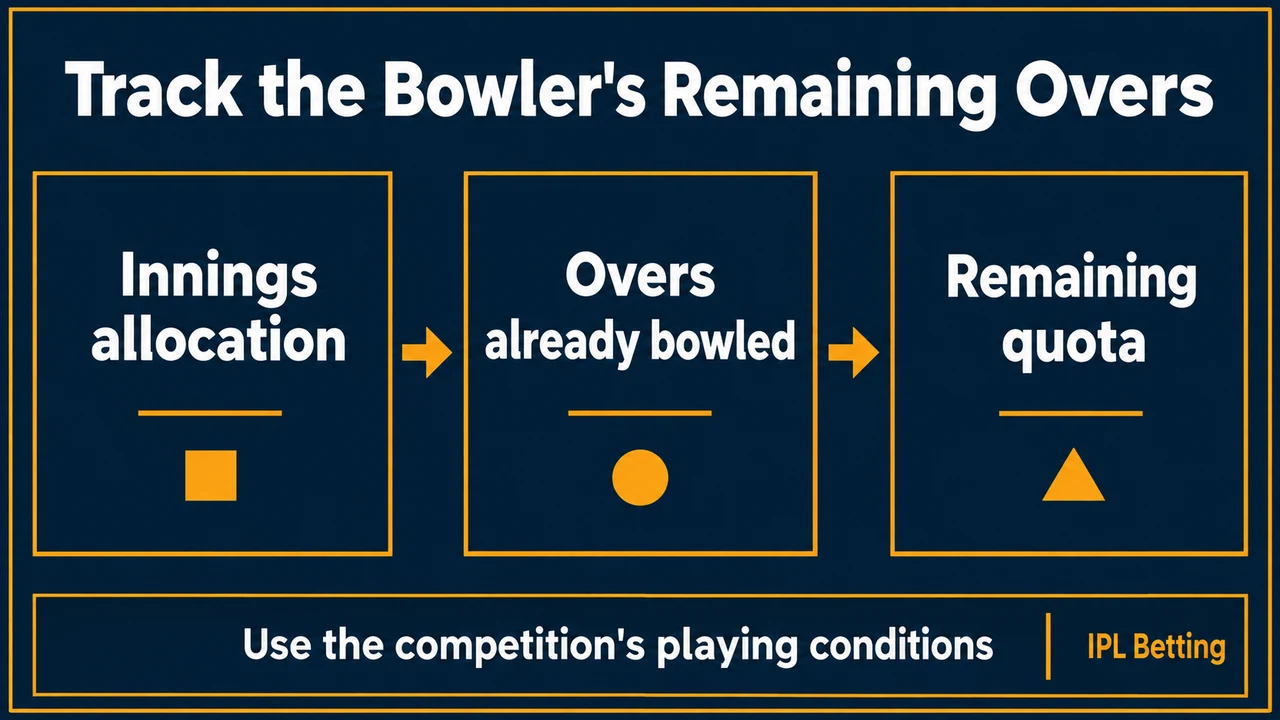
Keep innings overs and bowling quotas separate
Clause 13.9 of the ICC Men’s T20 World Cup 2026 conditions sets the full-innings limit at four overs per bowler. In reduced innings of at least ten overs, the limit follows one-fifth of the allocation, with extra overs distributed when necessary. For a rescheduled innings of five to nine overs, the stated individual maximum is two.
A team allocation answers “how long can this innings last?” A player’s quota answers “how much of it can this bowler deliver?” The remaining team overs do not give the captain permission to exceed the player limit. Likewise, a player with unused quota is not guaranteed to bowl again; the captain still chooses who bowls, subject to the rules.
| Innings allocation | Illustrative distribution across five bowlers |
|---|---|
| 20 overs | 4 + 4 + 4 + 4 + 4 |
| 18 overs | 4 + 4 + 4 + 3 + 3 |
| 16 overs | 4 + 3 + 3 + 3 + 3 |
| 12 overs | 3 + 3 + 2 + 2 + 2 |
| 10 overs | 2 + 2 + 2 + 2 + 2 |
These are possible quota distributions, not mandatory bowling plans. The 18-over row has a base of three overs for each of five bowlers, leaving three extra overs. Three bowlers can receive one of those extras. The example uses all eighteen overs and does not grant four overs to all five players.
Work out who can bowl the extra overs
For a fresh 17-over innings, divide seventeen by five. The whole-number part is three and the remainder is two. Five lots of three account for fifteen overs; two additional overs complete the allocation. A sample plan is therefore 4, 4, 3, 3 and 3. You do not round every player’s share up to four.
Now give the bowlers anonymous labels A to E. If A and B have already bowled four overs each, they have used the two larger allocations in this plan. Write down which bowlers have already used four overs so you do not allocate either extra over twice.
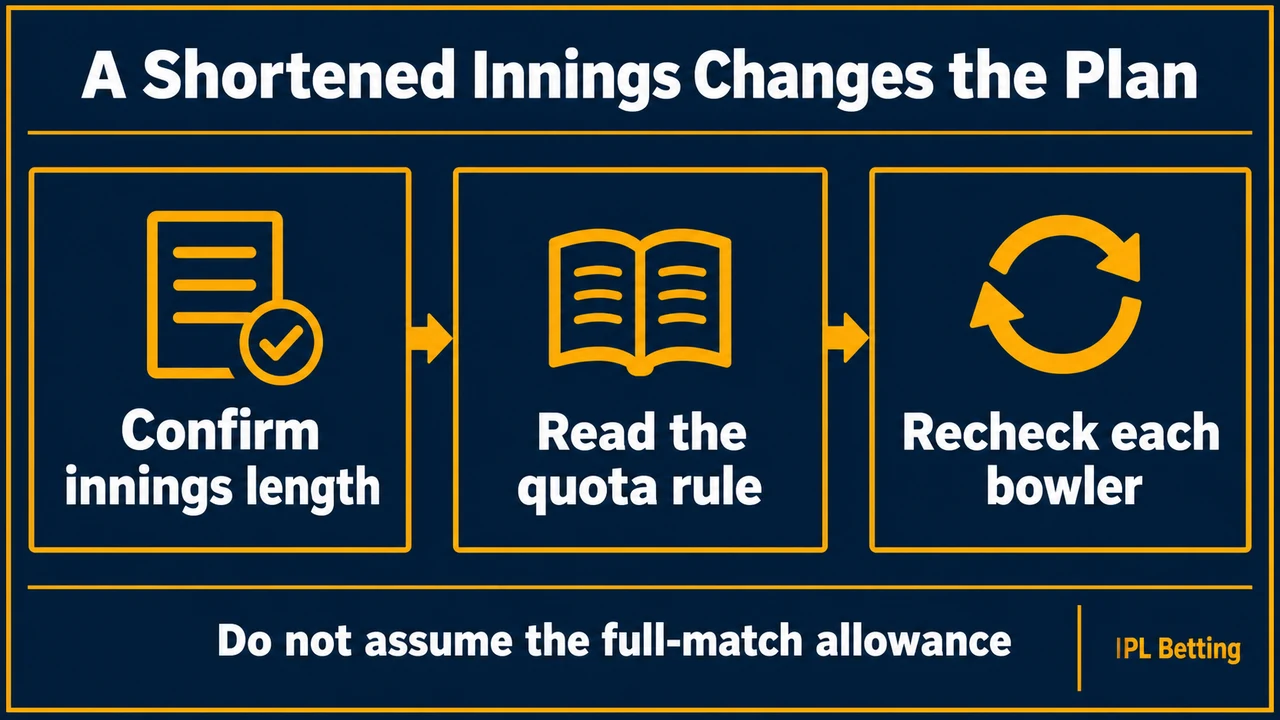
Short innings have their own provision
The five-to-nine-over provision in the named ICC document is a separate rule. Do not extend the one-fifth calculation into that range without reading it. For an eight-over innings, four bowlers could supply two overs each; other distributions may use more players. The maximum is a ceiling, not a requirement to give each chosen bowler two.
| Hypothetical eight-over plan | What the arithmetic says |
|---|---|
| A 2, B 2, C 2, D 2 | Eight overs; nobody exceeds two. |
| A 2, B 2, C 1, D 1, E 2 | Also eight overs; five players used. |
| A 3, B 2, C 2, D 1 | Totals eight, but A exceeds the named competition’s limit. |
The last row shows why checking the total alone is insufficient. A bowling plan can add up perfectly and still breach an individual restriction. Check both the sum of the column and every player’s entry.
Part overs need careful handling
An over ordinarily consists of six valid balls, and wides and no-balls do not count towards that six. MCC Law 17 also addresses a bowler who cannot finish an over and the restriction on consecutive overs. In the named ICC conditions, clause 13.9.3 treats a shared part-over as a full over for each involved bowler’s limit.
That quota treatment is not the same as changing the bowling analysis to say both players delivered six valid balls. Imagine A delivers two balls before being unable to continue, and B completes the other four. The actual delivery counts remain two and four; the quota rule addresses eligibility for further overs. Keep those two records separate.
A mid-innings reduction deserves the same care. Start from what has actually been bowled and the revised allocation announced by the officials. Do not invent a new clean-sheet plan that ignores overs already completed. If the display does not show the revised individual availability, wait for clarification rather than calculating from an old total.
Unused quota does not guarantee another over
Unused quota is only one part of a captain’s decision. Availability, an unfinished over and the match situation can also matter. Nor should a regulation-innings quota be used by itself to decide Super Over eligibility: a tie-break has its own conditions. Treat it as a separate procedure and consult the relevant appendix.
Quick answers
Does 3.4 mean three point four overs? No. In cricket notation it means three overs and four valid balls.
Can every bowler receive the rounded-up share? No. The worked distributions show why the remainder must be allocated, not multiplied.
Does remaining quota mean a player will bowl at the death? No. It shows a possible resource, not a selection announcement.
For surrounding match context, read our death-overs guide, rain-interruption guide and basic cricket rules.