
Published by IPL Betting. Sources checked on 11 September 2026; examples are illustrative.
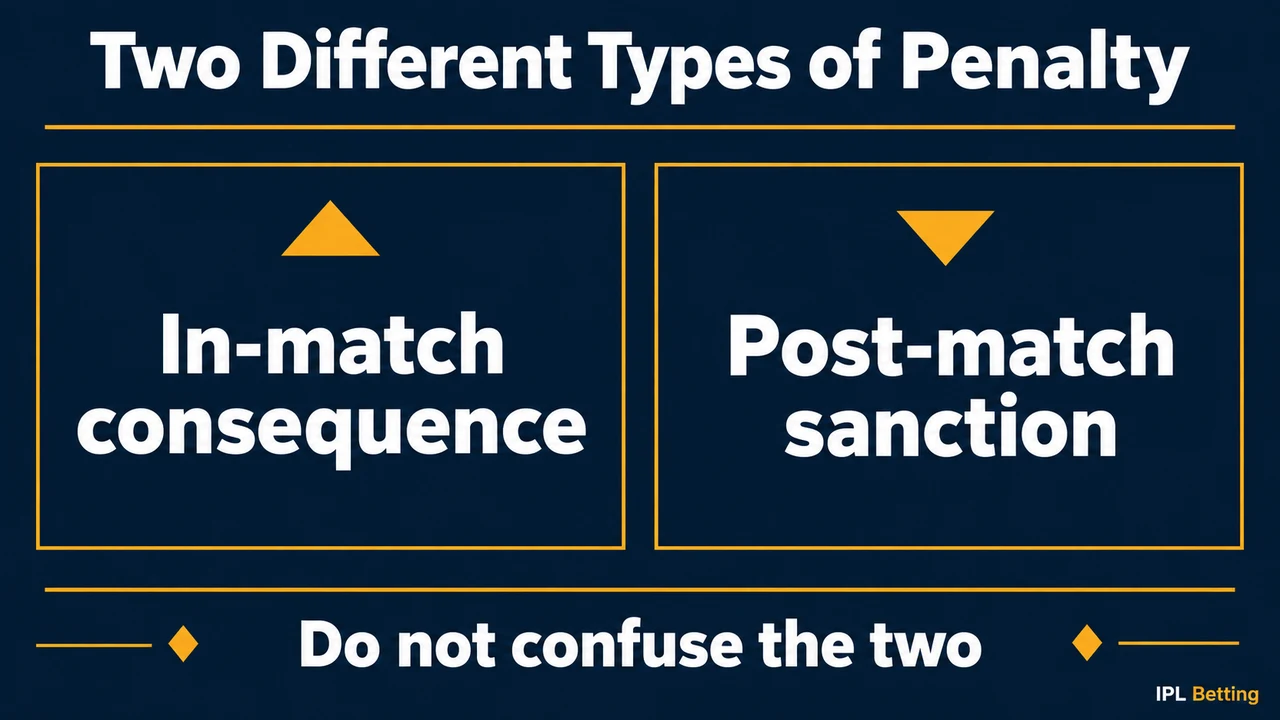
The captain sends a boundary fielder into the circle and looks unhappy about it. A few hours later, a separate disciplinary notice appears. These can be two consequences of a slow over rate, but they are not the same penalty. One changes the field during the innings; the other belongs to the competition’s conduct process.
The worked explanation below is tied to the ICC Men’s T20 World Cup 2026 conditions. It is not an IPL fine schedule or a universal T20 rule. Naming the competition matters because the deadline, allowances, exceptions and disciplinary consequences must all come from the right document.
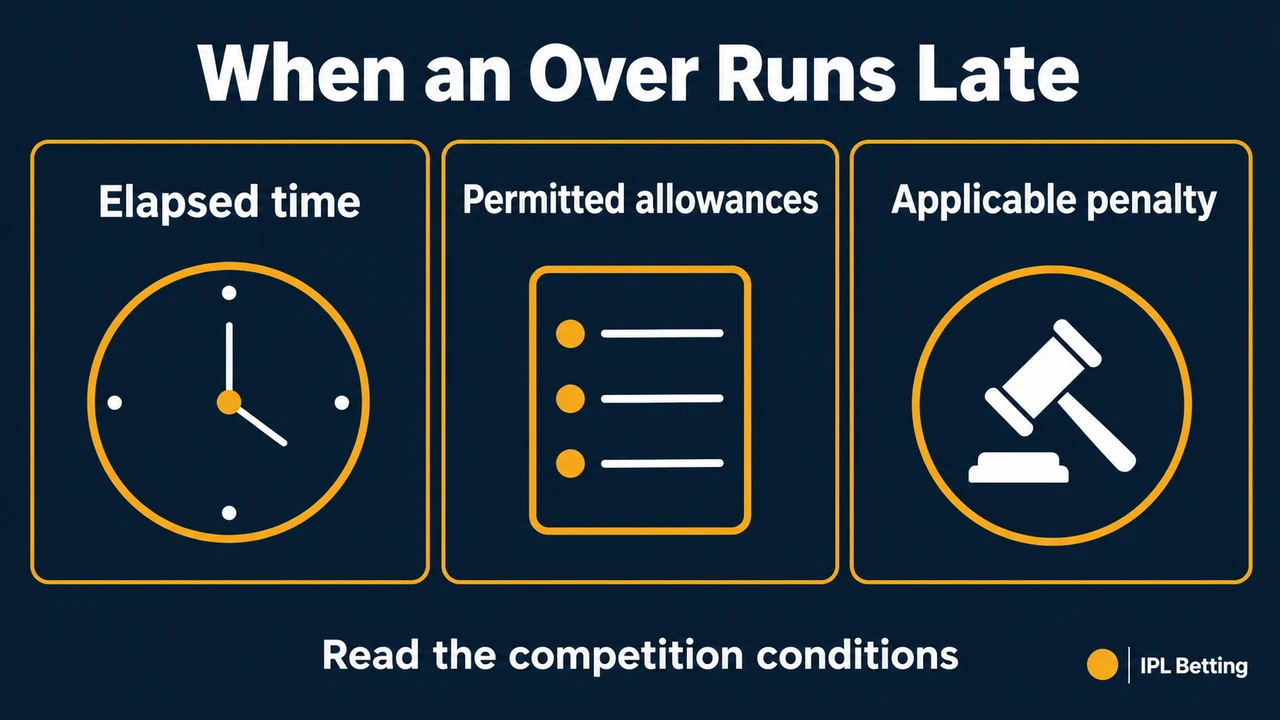
Why your stopwatch may differ from the official clock
Clause 13.8 of the ICC Men’s T20 World Cup 2026 conditions requires the fielding team to be ready for the first ball of the final over by the scheduled or revised cessation time. Where an interruption reduces the allocation by three or more overs, it specifies the penultimate over instead. It also states exceptions for certain shortened or already completed innings.
A viewer starting a phone timer at the first ball cannot automatically reproduce that assessment. The official deadline can be revised, and some lost time receives an allowance. A match can look slow on television without every minute being chargeable to the fielding side.
| Thing you see | What it can establish |
|---|---|
| The wall clock | Elapsed real-world time. |
| An official revised deadline | The new reference time for the innings. |
| An announced allowance | Time treated according to the relevant condition. |
| A formal penalty signal or announcement | That officials have applied the consequence. |
Keep those four items separate. A commentator saying the side is “behind the rate” may describe a developing situation. It is not necessarily an announcement that a penalty has already begun. Note the wording and the over at which the officials act.
The fielding consequence changes available coverage
Under the named tournament’s clause 13.8, the consequence limits the side to four fielders outside the restriction area from the specified next-over point for the rest of the innings. The ICC’s explanation of the 2022 India–Pakistan Asia Cup match provides a historical illustration of teams being required to bring an extra fielder inside. That example is historical, not the source of a current IPL rule.
For a viewer, the immediate question is which area loses deeper coverage. The captain still has choices about placement within the applicable limits. Do not assume that an extra fielder inside guarantees a boundary or changes the next ball’s outcome. It changes the available arrangement, not the result in advance.
Why some delays receive an allowance
The 2026 tournament document’s clause 12.8 includes allowances for authorised medical treatment, serious injury departures, referrals and reviews, batting-side time wasting and circumstances beyond the fielding side’s control. Officials apply the rules to the circumstances; a viewer should not award an arbitrary number of minutes after every pause.
Suppose your unofficial timer shows ninety minutes since the innings began. During that period there was a lengthy review and medical treatment. Without the official timing and allowances, “ninety minutes” alone cannot prove the size of an over-rate shortfall. Record the interruptions, but label your calculation provisional rather than presenting it as the umpire’s calculation.
| Situation | Useful viewing response |
|---|---|
| A review holds up play | Note the pause; wait for the official timing treatment. |
| Rain changes the innings allocation | Replace the old deadline with the announced revised one. |
| The captain moves a fielder inward | Check whether this follows a penalty or is simply a tactical move. |
| A later conduct notice is issued | Read its competition, offence and sanction separately. |
Do not confuse the between-overs clock with the innings rate
The ICC separately introduced a stop-clock mechanism for the interval between overs. Its 2025 playing-condition announcement explains the mechanism and its extension to Test cricket. That announcement is not permission to apply a five-run penalty to every slow passage of any T20 match.
The distinction is practical: a clock for getting the next over started measures a different event from completing the required progress by an innings deadline. If a broadcast mentions a warning, ask which clock or rule it belongs to. Keep the warning and penalty tied to the same rule instead of combining the two timing procedures.
A short record that prevents most confusion
Use four lines in your notes: competition and date; announced innings deadline; reported timing adjustment; official action and the over when it starts. If no official action has been announced, leave that line blank. Use the official announcement to identify the penalty; the captain’s reaction does not tell you what was imposed.
For a later report, look for the competition organiser’s own disciplinary notice. Match the team and match number, then distinguish the reason for the sanction from its amount. Do not fill a missing notice with a previous season’s fine, and do not treat a repeat-offence schedule from another league as applicable.
Questions during a delayed innings
Does any slow match bring a fielding penalty? No. The applicable conditions, allowances and exceptions control the decision.
Is a fielding restriction the same as a fine? No. They affect different things and can be handled through different provisions.
Can I apply these ICC details to an IPL match? Verify the IPL rules for that season first. This article deliberately does not supply an IPL disciplinary schedule.
For the surrounding phases, use our powerplay guide and death-overs guide. The cricket rules introduction helps place those phases within an innings.