
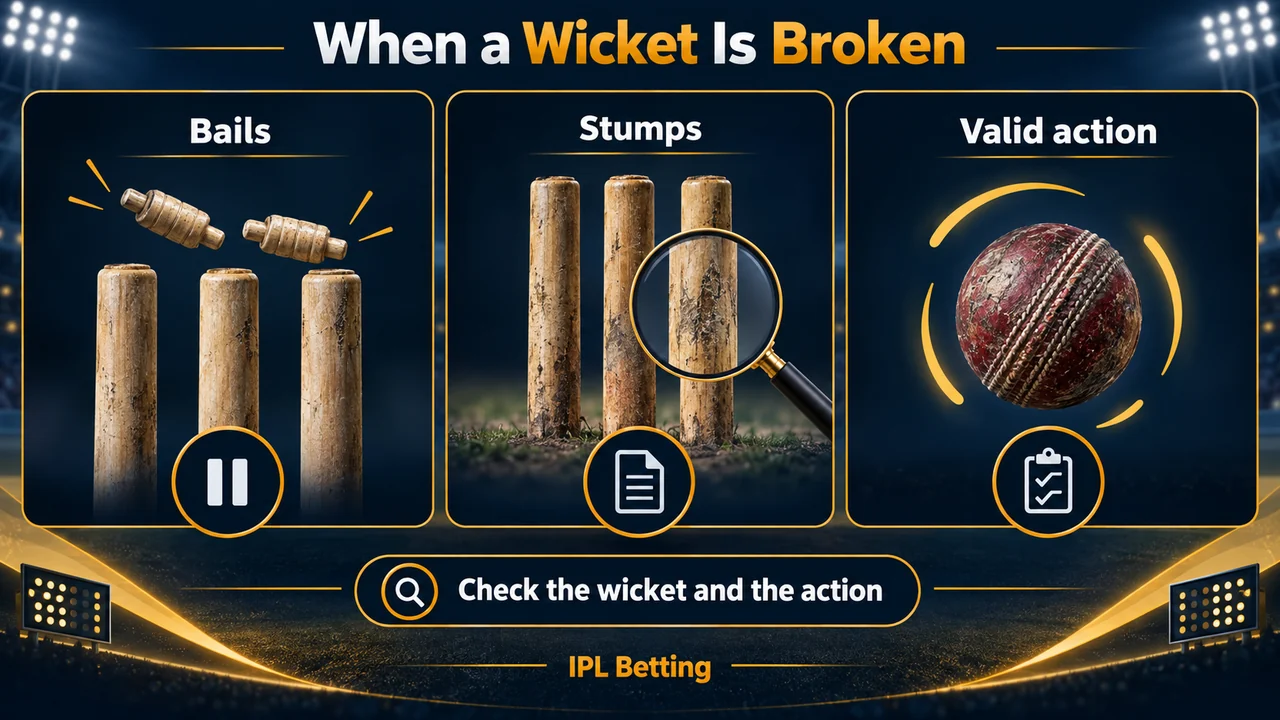
The throw hits the stumps, but the bail only wobbles. The crowd expects a run-out; the replay continues. Contact with the stumps and a wicket being broken are different facts, so watch what happens to the bails or stump before judging the batter’s position.
There are two separate questions: was the wicket fairly broken, and did the relevant dismissal conditions apply at that instant? This page follows the first. Even a direct hit still needs that physical wicket-breaking check.
Movement is not necessarily complete removal
MCC Law 29 defines breaking the wicket through complete removal of at least one bail or removal of a stump from the ground. It distinguishes disturbing a bail from fully removing it. The law also lists the permitted ways the wicket is fairly broken.
An invented replay shows a bail lifting slightly and dropping back into place. Another shows it leaving the top of the stumps entirely. Describe those observations separately before comparing them with a bat-grounding frame. “The stumps were hit” leaves out the physical fact that matters.
Do not use an electronic light alone as a complete account of the sequence. Look for the official decision and the relevant equipment conditions. The light may help locate a moment, while the replay and official ruling establish what happened at that moment.
If one bail is already off
Law 29 allows the remaining bail to be removed, or an appropriate stump to be struck or pulled out in a permitted way, when one bail is already off. A second attempt can still matter: identify what remained in place and what the fielder then removed.
| State before an attempt | What to watch | What not to assume |
|---|---|---|
| Both bails in place. | Complete removal or the relevant stump event. | Any touch is enough. |
| One bail already off. | The remaining bail or a permitted stump removal. | The wicket cannot be broken again. |
| Wicket remade by a fielder. | The new attempt as a separate sequence. | Only the first throw matters. |
| Officials agreed to play without bails. | The applicable no-bails test and ruling. | Use an ordinary bail-removal test anyway. |
Follow the hand as well as the ball
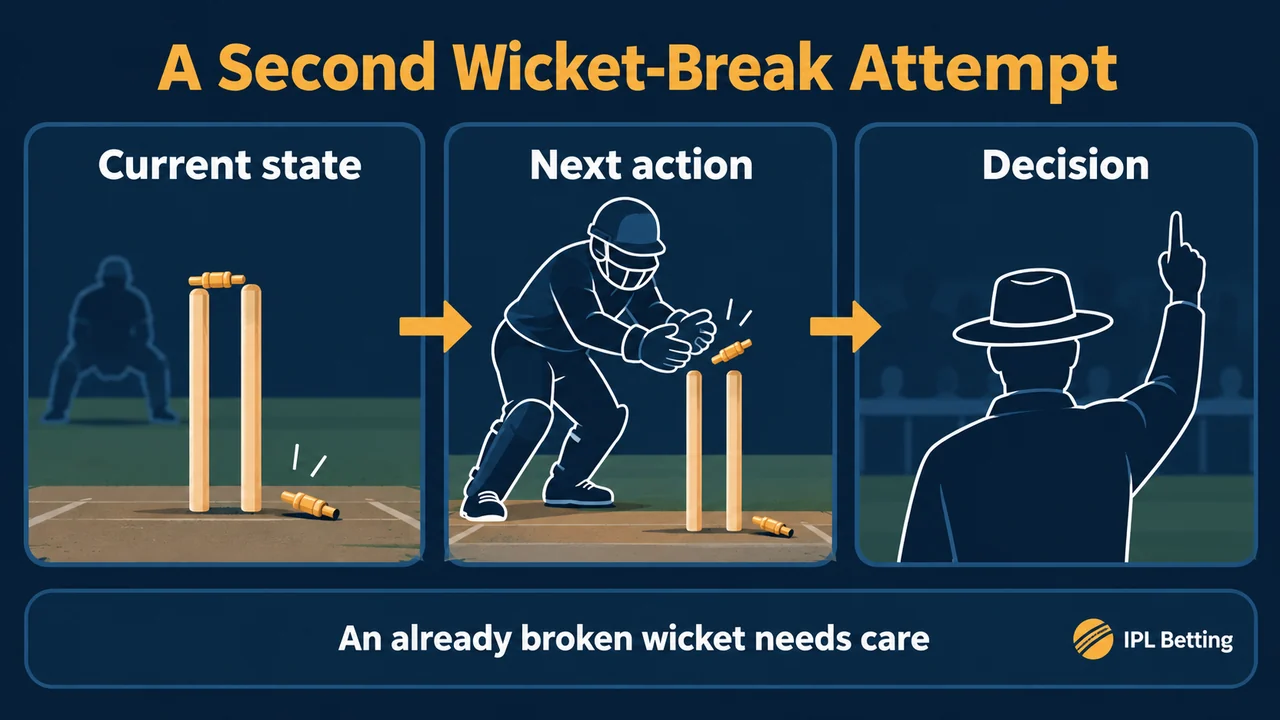
The law’s fair-breaking requirements include how a fielder uses a hand or arm holding the ball. In a close replay, identify the ball and the actual action on the wicket together. A hand pulling a stump and a ball arriving in a different hand should not be compressed into the vague description “ball at the stumps.”
For practice, pause a fictional sequence at three points: the incoming throw, the fielder’s possession, and the wicket-breaking action. Note what each frame can establish. A frame showing possession after the action cannot prove possession during it.
A remade wicket is a new checkpoint
Law 29 permits a fielder to replace bails or stumps while the ball is still in play; the umpire does not remake the wicket until the ball is dead. Keep the remake and the later attempt in chronological order.
Suppose the first throw misses the batter’s vulnerable moment, a fielder replaces the bail, and a second throw follows. Your note needs two attempt times and the intervening remake. Without that middle event, a short edited clip may make the second action seem impossible or redundant.
If the camera follows the ball into the outfield and misses the remake, leave it as a gap. Do not invent what a fielder must have done while off-screen. Look for a wider replay or the officials’ explanation.
When officials dispense with bails
The no-bails case has its own provision in Law 29 and should be treated separately. Record that agreement before interpreting later contact. A windy-day image of bare stumps does not mean equipment has been accidentally forgotten.
Our dismissal guide explains the eventual scorecard entry. The boundary-decision guide follows a different physical test. For any replay, stop if the decisive contact is hidden; celebration, crowd noise, and a cropped graphic are not substitutes for that evidence.
Source and method: Prepared by IPL Betting Editorial Team from the linked official material. The viewing exercises are invented, not match records. MCC’s 2026 Laws took effect on October 1; that date alone does not establish IPL adoption. For a specific fixture, check its season’s playing conditions.
For surrounding context: Cricket rules made simple; Four, Six, or a Catch? Cricket Boundary Decisions Explained; Cricket Dismissals Explained: Team Wickets, Bowler Credit, and Retired Batters.