
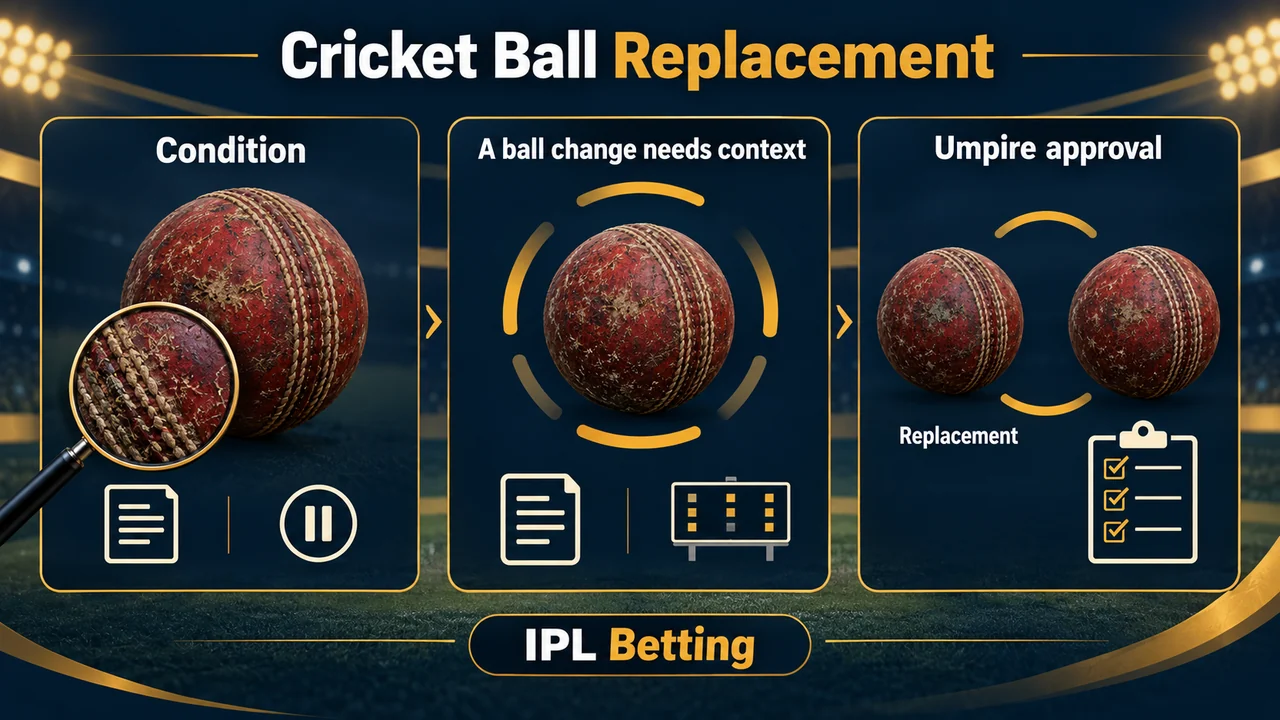
A ball disappears beyond the stands and a box of alternatives comes onto the field. The chosen replacement may be used rather than brand new. Losing the ball does not automatically restart its age or give the bowlers a fresh innings.
Write down the official reason and over of the change before discussing its possible effect. A lost ball, one judged unfit through normal use, and a new ball taken under an authorised provision are different events.
Who controls the ball?
MCC Law 4 places match balls under the umpires’ control. For a ball lost, unrecoverable, or agreed unfit through normal use, it calls for a replacement with comparable wear and notification to the batters and fielding captain.
That comparison explains why officials may inspect several balls. The viewing question is which official decision was made, not which alternative looked shinier in one camera shot. A close-up can make one seam or shiny patch more visible without establishing the whole ball’s condition.
A bowler asking for a change is not the same as officials granting one. Keep the request and the decision in separate notes. If play continues with the original ball, do not describe the request as a completed replacement.
Three entries that should not share one label
| Event | What to record | Avoid |
|---|---|---|
| Ball cannot be recovered. | Official replacement and comparable-wear explanation. | Calling it a new ball automatically. |
| Normal-use condition judged unfit. | Decision and the ball selected. | Assuming any complaint is approval. |
| Authorised new ball. | Applicable rule and the actual new-ball decision. | Borrowing a threshold from another format. |
The distinction is about the match record. It does not promise that a replacement will swing, turn, or improve a particular bowler’s figures. Material, condition, delivery, and the surface still need their own evidence.
An age label is not a factory date
Imagine an unrecoverable ball after 12.3 overs in an ordinary six-ball format. That notation represents twelve completed overs and three valid balls, not 12.3 decimal overs. A comparable-wear replacement is intended to preserve a relevant condition comparison; it does not make the match suddenly return to 0.0 overs.
For a viewing worksheet, record the over at the change, the reason announced, and whether officials described a replacement or a new ball. Do not estimate an alternative’s exact previous use from the television image. If no age-equivalent detail is given, leave that field unknown.
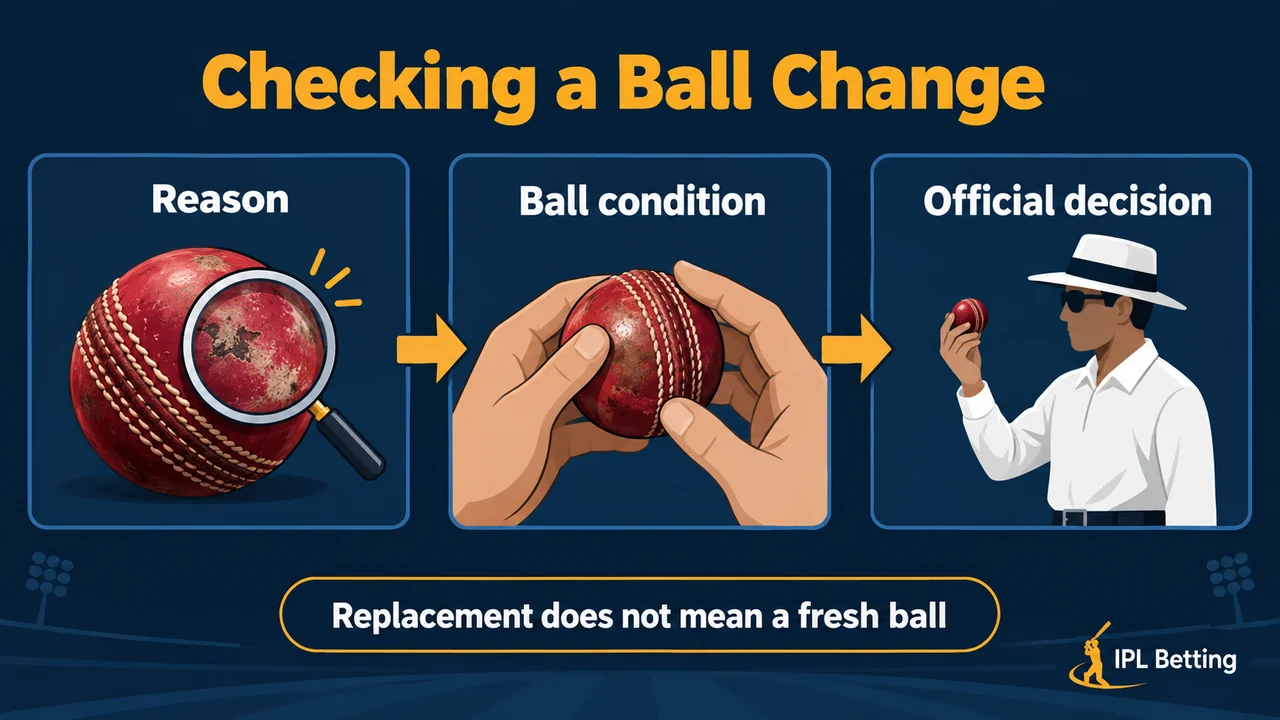
A commentator’s phrase “looks about fifteen overs old” is an observation or estimate unless linked to the official information. Preserve the wording and attribution. Turning it into “used for exactly fifteen overs” creates precision the source did not supply.
Do not import a Test threshold into a T20 innings
Law 4 contains separate new-ball provisions, including one for matches scheduled over more than one day. That is not permission to apply a multi-day threshold to an IPL innings. The format, competition, and version of the playing conditions must be identified first.
Check the document’s competition, format, and effective date before using its new-ball threshold. If a rule you found names a Test or ODI procedure, write that format beside it. A webpage about a ball change in international cricket may be accurate and still fail to answer what governed your IPL clip.
Keep a replacement note beside the scorecard
Use four columns: match and date, over, official reason, source of confirmation. Add a fifth for uncertainty if needed. This gives a later reader enough information to find the same incident without guessing which ball complaint you meant.
In an invented sequence, a request happens in the tenth over, the change in the eleventh, and a wicket in the twelfth. The sequence alone does not prove that the replacement caused the wicket. Review the delivery and batter’s action separately rather than building a causal story from adjacent timestamps.
For surrounding conditions, our pace-versus-spin guide asks about role and surface. The weather evidence guide separates a forecast from an official update. Neither should replace the ball-change record.
Can a team choose any replacement it prefers?
The ordinary replacement decision described here belongs to the umpires under the general law. Do not treat a player selecting an object from a box as the full approval process. Where a competition has an additional procedure, read that procedure before explaining the choice.
Source and method: Prepared by IPL Betting Editorial Team from the linked official material. The viewing exercises are invented, not match records. MCC’s 2026 Laws took effect on October 1; that date alone does not establish IPL adoption. For a specific fixture, check its season’s playing conditions.
For surrounding context: Cricket rules made simple; IPL Pace vs Spin Matchup Guide: Pitch, Roles, and Sample-Size Checks; IPL Venue Betting Guide: Pitch, Boundary Size, and Scoring Context; Dew Factor and Weather in IPL Betting: Night Match Checks.