
A bat is pushed through a gauge beside the pitch. The check is about whether the bat fits the permitted dimensions. It does not measure how far the next shot will travel, and it does not establish that every other material or competition requirement has been satisfied.
When a broadcast shows a bat check, separate three questions: what size the general Laws permit, which bat category the competition allows, and what anyone is claiming about performance. Each question needs its own evidence. A large-looking edge on television is not a reliable measurement of any of them.
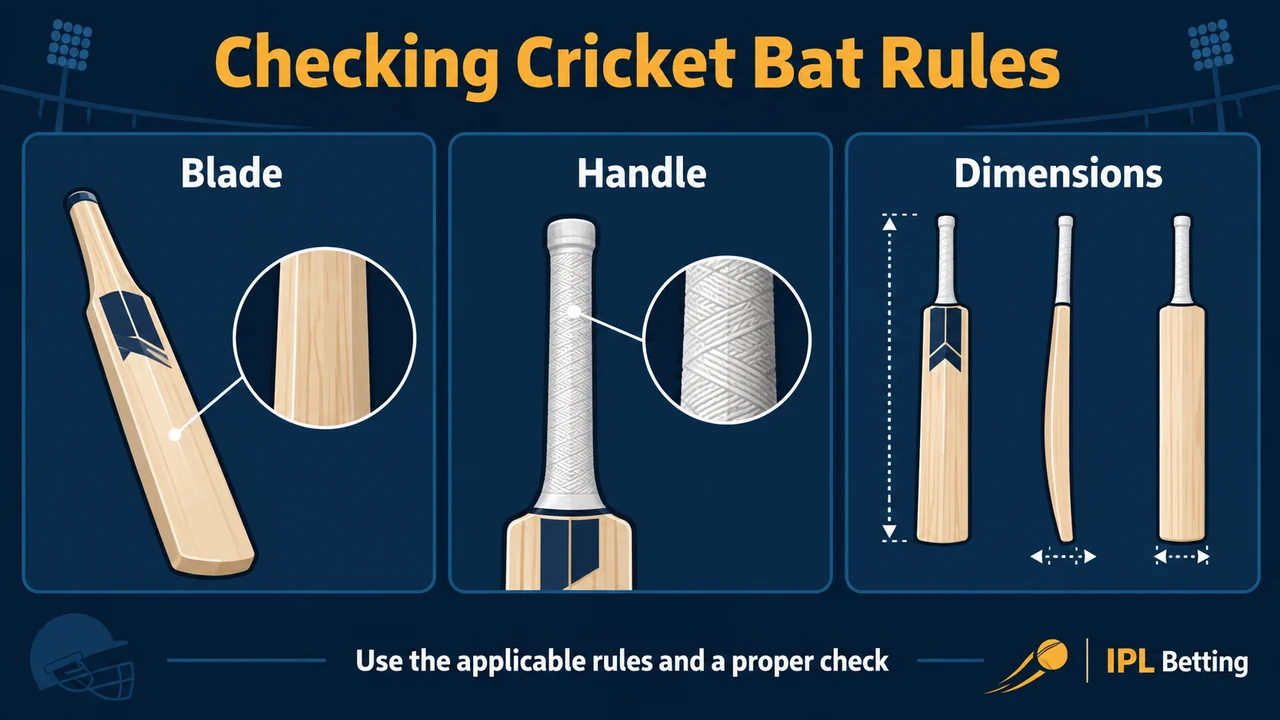
The dimensions have separate limits
MCC Law 5.7 sets the maximum overall length at 38 inches, or 96.52 cm. Its blade limits are 4.25 inches / 10.8 cm in width, 2.64 inches / 6.7 cm in depth and 1.56 inches / 4.0 cm at the edges. The bat must also pass through the gauge described in Appendix B.8.
| Measurement | General-law maximum | What a viewer should distinguish |
|---|---|---|
| Overall length | 38 in / 96.52 cm | Handle and blade together. |
| Blade width | 4.25 in / 10.8 cm | Across the face. |
| Blade depth | 2.64 in / 6.7 cm | Face-to-back depth. |
| Edge thickness | 1.56 in / 4.0 cm | The edge, not the deepest spine. |
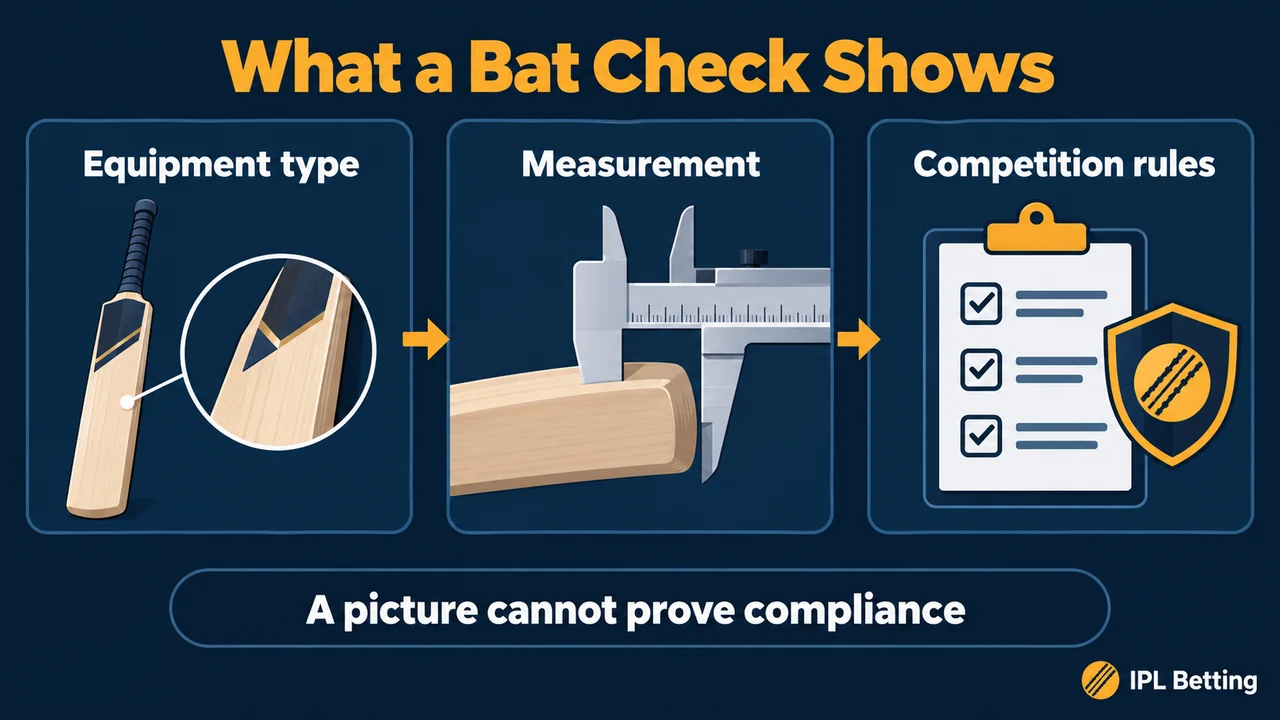
The numbers are maximum limits, not recommended dimensions for a player. A bat can be smaller. Nor do the four maxima describe a single rectangular block: real blades have shaped faces, backs and edges. The gauge supplies the specified check rather than an improvised box drawn from a television image.
What a gauge does—and does not—show
The MCC appendices describe the gauge and require the bat to pass through with any permitted protective coverings. A covering does not simply excuse a failure to fit. Use the specified equipment and procedure; a screenshot’s pixel width is not an equivalent test.
Imagine a fictional equipment review. The blade fits the gauge, but the only image available does not show the whole handle. Your note can say the displayed blade passed the check. It cannot independently establish overall length, the composition inside the blade or permission for that bat type in the match.
Conversely, a failed attempt on camera may show an awkward insertion rather than a finished ruling. Wait for the umpire’s final check or explanation before claiming that a real player used an illegal bat. This article makes no allegation about an individual bat or match.
Bat types are another question
Law 5 distinguishes Types A, B, C and D. Type A may be used at any level under the general text. The current Type D wording allows laminated and/or coloured bats only at lower levels determined by the national governing body; Types B and C also depend on governing-body level restrictions.
That classification does not mean a coloured or laminated bat is automatically permitted in an elite franchise competition. Check the specific competition’s equipment conditions. The fourth-edition general Laws, effective from 1 October 2026, are a baseline; they do not prove an IPL adoption date or override a season’s separate conditions.
Be careful with an old infographic describing Type D solely as a junior size category. A newer general-law statement and an older competition condition can coexist, because they concern different versions or permissions. Match the version to the competition rather than combining the broadest allowance from one document with the size rules from another.
A three-column equipment note
Suppose an advertisement says “maximum edges, professional power.” Write the dimension claim in one column, competition permission in a second and performance claim in a third. The first needs measurements; the second needs the appointed conditions; the third needs evidence about the claim being made.
Passing a gauge does not validate the advertisement’s performance language. A permitted maximum also does not mean the heaviest or thickest legal bat suits every player. Timing, control and contact are separate from dimensional compliance. This page is an equipment explanation, not a buying recommendation.
Read the check without filling the gaps
Use the broadcast to identify what is actually being tested. Is the bat being passed through the gauge? Is an official measuring overall length? Has an announcement identified a particular category restriction? If the clip shows only one action, limit your description to that action.
For a later report, preserve the difference between “checked” and “found non-compliant.” The first records a procedure. The second records an outcome that needs an attributable decision. You can explain why a gauge appeared on screen without making either a performance claim or an accusation.
One quick test of the terminology
If a caption says “40 mm bat,” ask which measurement it means. Forty millimetres is the stated maximum edge thickness, not a complete bat specification. A width or overall-length figure describes something else. Naming the dimension is the first step towards understanding the check.
Related reading: Cricket rules introduction; Four, Six, or a Catch? Cricket Boundary Decisions Explained; Cricket Rules Made Simple for IPL Fans in the Philippines.
Prepared by IPL Betting Editorial Team. Updated 4 October 2026. The linked official materials support the rules identified in this guide. Match examples are invented exercises, and a competition’s published conditions can differ from the general Laws.