
The wicketkeeper rises, moves towards the stumps and removes the bails. The replay freezes on the gloves, but the important question may concern a moment earlier: where was the keeper when the delivery was released, and what had happened before they moved forward?
A keeper’s work combines equipment, positioning and the order of events. Start with the ball’s progress rather than the final celebration. This guide focuses on those responsibilities; it does not decide a dismissal from a still photograph or reproduce a catalogue of all dismissal types.
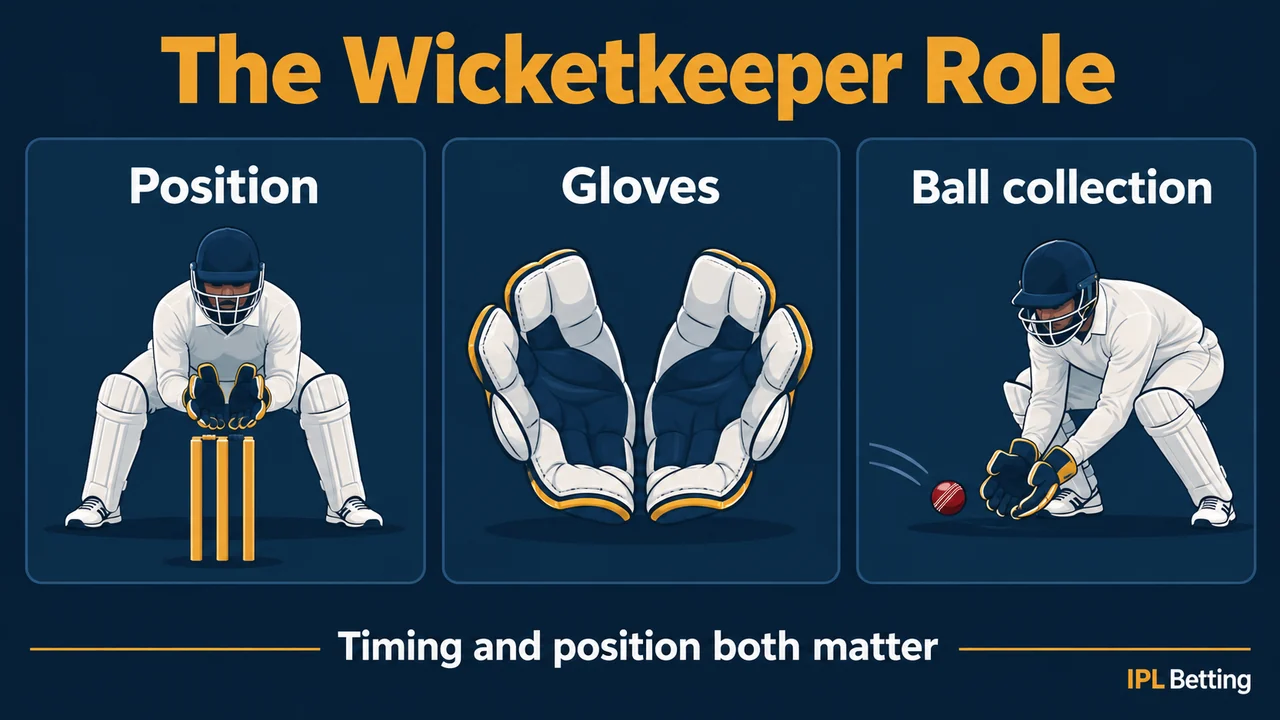
Why this fielder wears different equipment
MCC Law 27.1 gives the wicketkeeper the right to wear gloves while fielding and external leg guards, subject to the stated role conditions. These items are treated as part of the keeper’s person for the relevant fielding rule. Ordinary fielders do not gain that right by standing nearby.
Law 27 also regulates the gloves, including the permitted thumb-to-index-finger webbing. A manufacturer’s product photograph cannot prove compliance with all those details. For a viewer, the useful point is that “keeping gloves” are regulated equipment, not simply any gloves a fielder chooses to wear.
Standing back or standing up
“Standing back” means keeping farther behind the striker’s wicket. “Standing up” brings the keeper closer to it. Watch the distance before each delivery rather than assuming one position lasts for the whole spell. The choice can change with bowling pace, bounce and the team’s plan.
The distance is not the same as the legal side of the wicket. A keeper can stand close while remaining behind it, or reach forward with the gloves while their feet stay back. If you are examining a positional issue, look at the whole keeper, not only the shoe closest to the camera.
The start point changed in the 2026 general Laws
The current MCC Law 27.3 begins the wholly-behind requirement at the instant of delivery. It lasts until the ball touches the striker’s bat or person, passes the striker’s wicket, or the striker attempts a run. MCC’s explanation of the 2026 changes contrasts this with the earlier wording covering the bowler’s run-up.
The fourth-edition general Laws took effect on 1 October 2026. That does not establish when a particular IPL season adopted the wording. For an older highlight, establish the match date and appointed playing conditions before judging the run-up position under a newer text.
Read the replay as a timeline
| Checkpoint | What you need to see |
|---|---|
| Before release | The starting position, without assuming this alone decides a newer-law breach. |
| Delivery released | Whether the keeper is wholly behind the striker’s wicket. |
| Ball reaches the striker | Any contact with bat or person. |
| Ball passes the wicket or a run is attempted | Whether the restriction’s ending condition has occurred. |
| Keeper advances or collects | The order of movement and ball contact. |
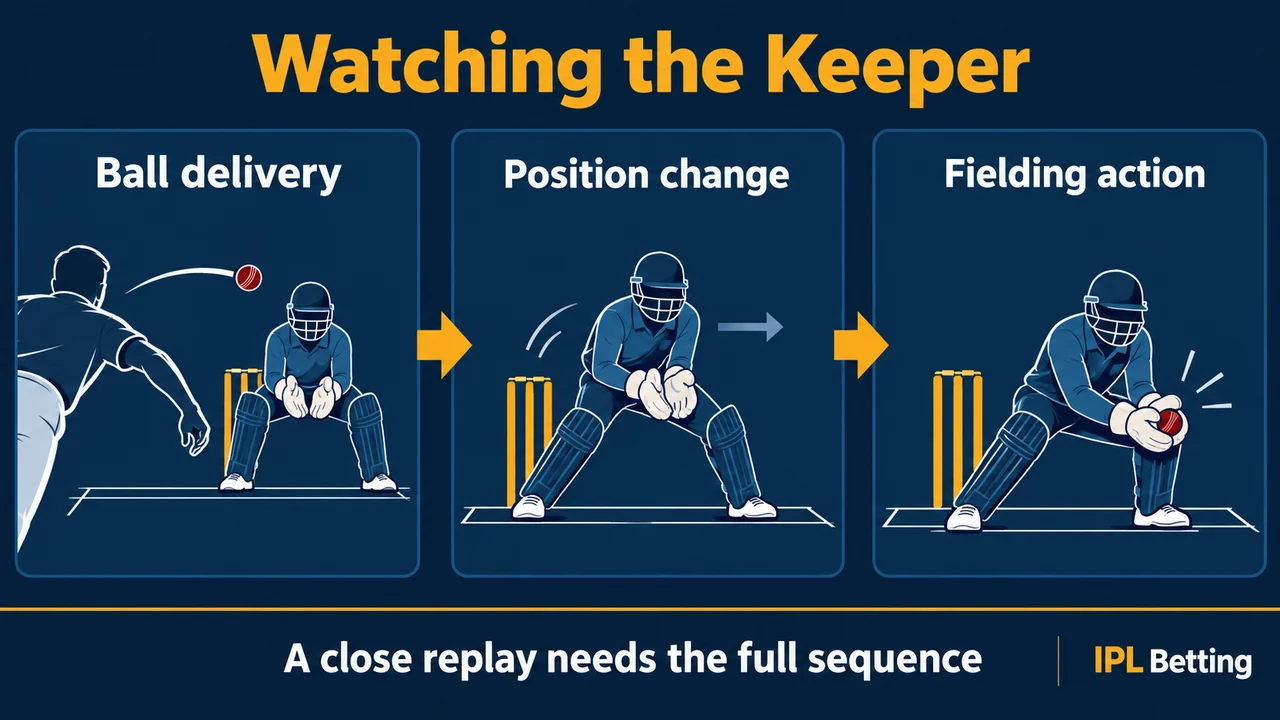
This is a viewing sequence, not an automatic ruling tool. The camera may omit one checkpoint or disguise depth. Keep the official signal alongside the replay instead of treating your own pause button as a complete measurement.
Two hypothetical collections
In version A, a keeper remains wholly behind at delivery. The ball passes the striker’s wicket untouched; the keeper then collects it and moves the gloves forward. In version B, the gloves extend ahead of the wicket before the untouched ball has passed it. The final collection can look similar, but the timing differs.
Under the general positional rule, version B raises the question of a no-ball. It is not enough to show the keeper in front after collecting the ball. You need the earlier relationship between gloves, wicket and ball, as well as the competition’s applicable wording.
Now add contact with the batter’s pad. That is another possible ending condition in the stated positional rule. A crop showing only the glove and stumps may miss it. This is why several angles can be more useful than a sharply enlarged but incomplete frame.
Collection and dismissal are separate checks
A keeper taking the ball cleanly does not by itself establish a stumping. You still need the dismissal’s requirements, including the batter’s ground and whether a run was attempted, along with the delivery’s legal status. A keeper can also participate in a run-out.
Do not infer the dismissal name from who removed the bails. Listen for the official decision and read the scorecard entry. The positional question explains whether the keeper’s action complied with the relevant rule; the dismissal question explains what happened to the batter.
What to note when the camera is incomplete
Record the missing moment: “release not shown,” “contact hidden,” or “no view of the glove relative to the wicket.” Those observations are better than declaring a breach from the final frame. You can still understand the keeper’s role while leaving the legal conclusion to the complete evidence and officials.
Related reading: Cricket rules introduction; Cricket Field Positions: Reading the Ring, Slips, and Boundary Riders; Cricket Dismissals Explained: Team Wickets, Bowler Credit, and Retired Batters.
Prepared by IPL Betting Editorial Team. Updated 4 October 2026. The linked official materials support the rules identified in this guide. Match examples are invented exercises, and a competition’s published conditions can differ from the general Laws.