
A slow-motion clip circles a bowler’s elbow and declares the action illegal. The clip may show a bend, but the ICC question concerns elbow extension during a defined part of the delivery. A bend visible in one frame is not the same as measuring that extension.
For a reader, the useful distinction is between a viewing suspicion, a formal report, an assessment and a decision. Keep those stages separate when reading a report. This guide names no player and makes no finding about an individual action.
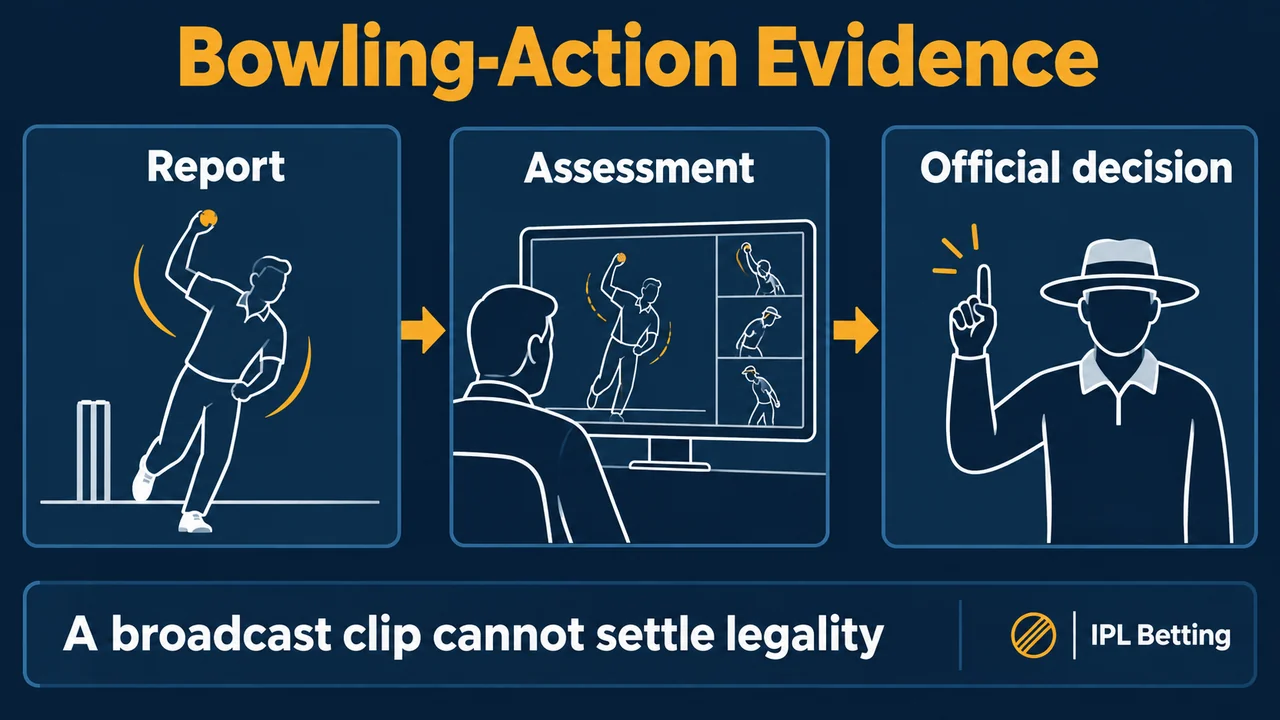
The ICC definition measures a change
The ICC’s illegal-bowling-actions explainer defines the issue as elbow extension exceeding 15 degrees between the bowling arm reaching horizontal and release. It describes officials reporting a suspected action and specialist assessment involving technology and human-movement expertise. This is the ICC’s stated international process, not an unverified domestic-league deadline.
The important word is extension. A still image might show the angle of the elbow at one moment, but it does not measure how much that angle changed during the specified phase. A straight-looking arm in the last frame also cannot establish everything that happened before release.
Follow the evidence ladder
| Evidence you have | Careful description | What it does not establish |
|---|---|---|
| A broadcast clip | A viewer is questioning the action. | A measured breach. |
| An official reporting notice | The action has been reported as suspected. | The final assessment outcome. |
| An assessment announcement | The stated test or review occurred. | More than the announcement’s actual scope. |
| An official outcome | The issuing body reached the stated decision. | A permanent status unaffected by later proceedings. |
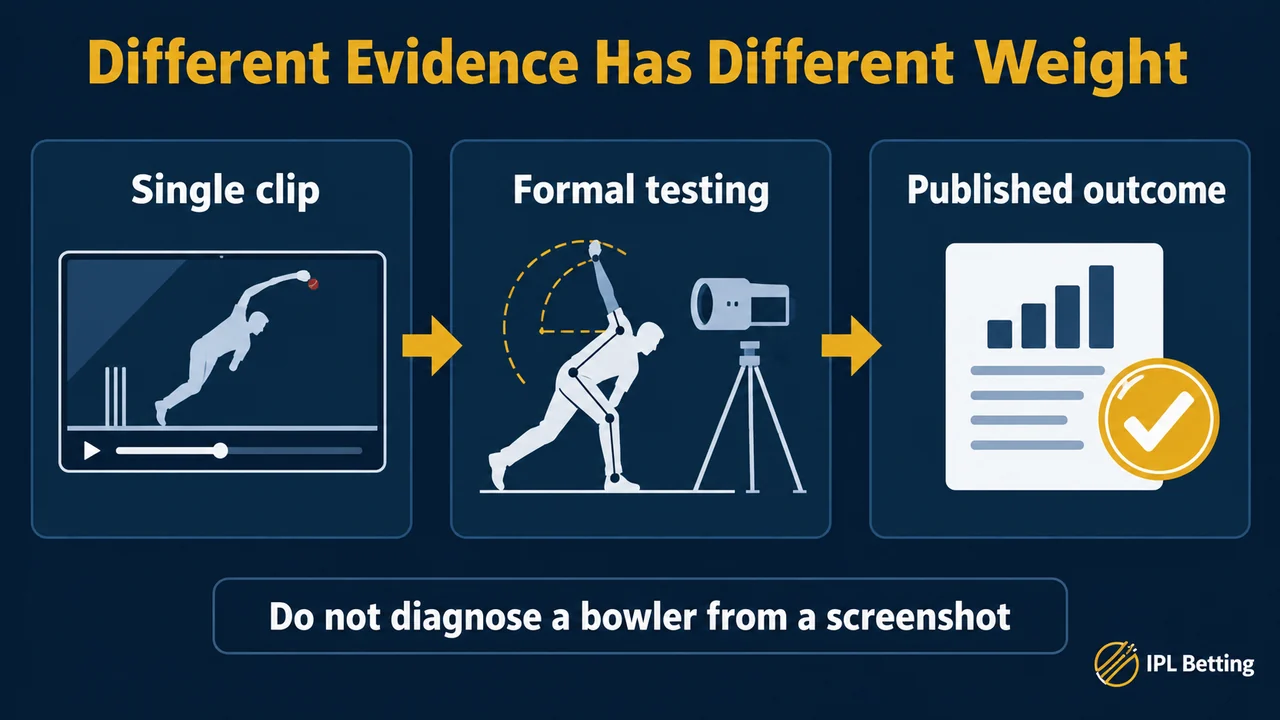
Keep the date, issuing body and wording with each stage. “Reported” should remain reported until a reliable later record says otherwise. Likewise, a historic suspension notice does not establish someone’s current eligibility after any subsequent reassessment.
Why the camera angle matters
Imagine an invented replay with the camera almost directly behind the bowler. The elbow is partly hidden by the upper arm for several frames. An annotation draws two lines over the image, but the video does not show the joint clearly throughout the required movement. The drawing has not solved the missing view.
A second example shows the arm from the side but stops just before release. It can be useful for discussing a visible motion, yet it omits one endpoint of the stated measurement. Do not treat an incomplete phase as if it were the formal assessment.
Slow motion gives you more time to look. It does not make a single camera a calibrated three-dimensional measurement system. Perspective, occlusion and the choice of frames can alter an apparent angle. This is a reason to qualify a claim, not a reason to dismiss every concern or assume every action is legal.
A no-ball call is a separate event
MCC Law 21 includes the fairness of the arm alongside other no-ball grounds, such as the bowler’s feet. A no-ball signal alone therefore does not identify a suspected bowling-action report. The camera showing the elbow immediately after the signal can be an editorial replay choice rather than the stated reason for the call.
Listen for the official explanation where available. If the broadcast identifies a front-foot no-ball, record that reason. Do not relabel it an illegal-action finding because the arm looked unusual. Equally, a formal action report need not be accompanied by a no-ball graphic in the particular highlight you are watching.
The ICC measurement framework and the MCC general wording have different roles. This page does not equate their texts or assume a domestic league uses every step of the international reporting procedure. Use the organiser’s applicable regulations for a case-specific deadline, permission to continue bowling or sanction.
An invented headline, read carefully
Suppose an official notice says a bowler has been reported after a match and will undergo assessment. A faithful headline would preserve that procedural status. “Bowler found to have illegal action” would advance to a decision the notice has not announced.
Your summary could record three lines: report date; authority issuing the notice; next step stated. If no outcome is supplied, leave the outcome pending. Do not invent a test result from comments below the video or from a previous case involving another player.
Sharing a clip without making an accusation
Describe the visible concern and ask for the relevant official record. For example: “This replay obscures the arm near release; has the organiser issued an action-report notice?” That is more accurate than naming a numerical extension you have not measured.
Avoid “everyone can see it” as evidence. A formal assessment and an official outcome answer a different question from whether a movement looks unfamiliar to viewers. You can discuss the technique while preserving that distinction and avoiding an unsupported allegation.
Related reading: Cricket rules introduction; Cricket Extras and Free Hits: Where the Runs and Deliveries Go; IPL Pace vs Spin Matchup Guide: Pitch, Roles, and Sample-Size Checks.
Prepared by IPL Betting Editorial Team. Updated 4 October 2026. The linked official materials support the rules identified in this guide. Match examples are invented exercises, and a competition’s published conditions can differ from the general Laws.