
Published by IPL Betting. Sources checked on 11 September 2026; examples are illustrative.
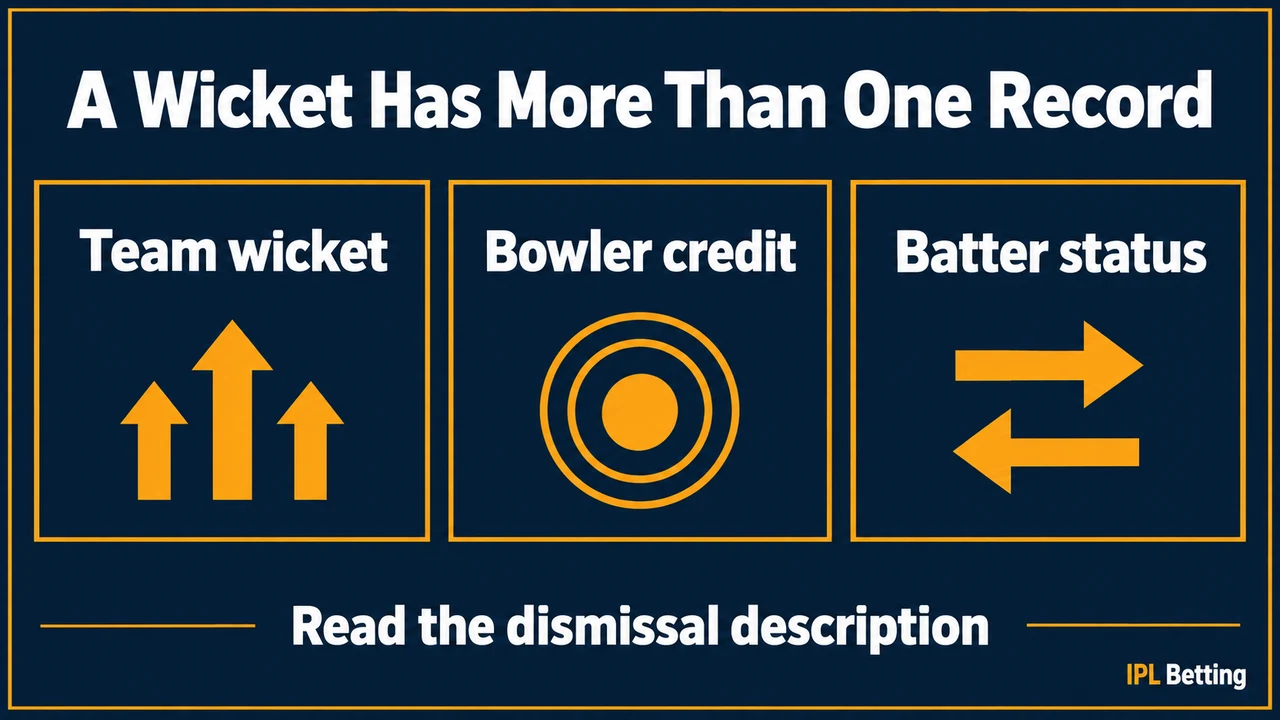
The scoreboard says 154 for seven, but the bowlers have only six wickets between them. Before looking for an error, check the dismissal column. A run-out counts against the batting team without appearing in a bowler’s wicket total. A batter walking off injured creates a different issue again: leaving the field is not automatically being out.
The dismissal entry tells you both why the batter left and whether the bowler receives a wicket. Start with three questions: has the batter been dismissed, does the dismissal count for the bowler, and can the batter return? This guide covers standard scoring and the MCC retirement law, without assuming that a particular tournament allows every provision found in the general Laws.
Which dismissals count for the bowler?
Bowled, caught, LBW, stumped and hit wicket are credited to the bowler; run-outs are not. The New Zealand scoring introduction lists these bowling-credit dismissals in its scoring-symbol table. Keep that accounting distinction separate from praise for a fielder: a brilliant catch can be decisive while the wicket still appears in the bowler’s figures.
| Dismissal | Team loses wicket? | Bowler receives wicket? |
|---|---|---|
| Bowled | Yes | Yes |
| Caught | Yes | Yes |
| LBW | Yes | Yes |
| Stumped | Yes | Yes |
| Hit wicket | Yes | Yes |
| Run out | Yes | No |
For a catch, the ball must meet the conditions for a fair catch and cannot be a no-ball. MCC Law 33 describes the dismissal. For bowled, the delivered ball fairly breaks the striker’s wicket, subject to the law’s conditions; contact with the bat or body beforehand does not itself rule it out. See Law 32 on bowled.
A useful way to read “c Lee b Patel” is to give the two names different jobs. Lee completed the catch; Patel delivered the ball that produced the dismissal. Do not add one wicket for each name. There is one team wicket, with a catch recorded for one player and a bowling wicket recorded for the other.
Why a run-out belongs in a separate column
A run-out can involve either batter and generally depends on being out of their ground when the wicket is fairly broken while the ball remains in play, with specified exceptions. MCC Law 38 supplies those conditions. The New Zealand scoring introduction explicitly reminds scorers that the bowler gets no run-out wicket credit.
That remains an accounting point even when the bowler is the fielder who makes the run-out. Picture a straight drive deflected onto the non-striker’s stumps. The bowler may have made the decisive touch, but the dismissal label controls the bowling statistic. “The bowler got the batter out” in conversation does not necessarily mean “add one to the bowling wickets”.
Stumped is not just another word for run out
A stumping has specific requirements: the striker is out of their ground, is not attempting a run, and the wicket-keeper breaks the wicket without another fielder intervening, on a delivery that is not a no-ball. MCC Law 39 also sets out exceptions. The wicket-keeper’s involvement alone does not tell you which dismissal applies.
When a replay shows a batter stranded, listen for the final dismissal description. Do not decide from the distance beyond the crease or from which player celebrates first. For scorekeeping, “stumped” and “run out” lead to different entries even though both can involve the keeper removing the bails.
Retired hurt and retired out have different consequences
Under MCC Law 25.4, a batter retiring because of illness, injury or another unavoidable cause is entitled to resume, and is recorded retired not out if they do not. Retirement for another reason requires the opposing captain’s consent to resume; if the innings is not resumed, it is recorded retired out. A permitted return takes place at a wicket or another retirement.
Do not infer the reason from a shot of the dressing room. A player can leave for treatment, leave under a tactical decision or simply walk away after a dismissal. Read the official batting entry. An injury retirement does not become a bowler’s wicket because the injury occurred during that bowler’s over.
| Batting entry | Reading consequence |
|---|---|
| Retired hurt / retired not out | Departure without a dismissal; check whether the batter resumes. |
| Retired out | An out entry, without bowler wicket credit. |
| Not out at innings end | No dismissal recorded for that batter. |
| Did not bat | The player never started a batting innings. |
Reconcile an invented innings
Suppose a side finishes 154 for seven. Its batting card lists three catches, two bowled dismissals, one stumping and one run-out. The six bowler-credit dismissals explain the six wickets across the bowling figures. The run-out explains the seventh team wicket. Now suppose another batter retired hurt and did not return: that entry does not add an eighth dismissal.
Use names as well as totals when checking this example. The totals can match even when a wicket has been assigned to the wrong bowler. Match each dismissed batter to the method, then match only the relevant dismissals to bowling figures. This catches the common error of assigning a run-out to whoever happened to be bowling.
Questions while reading the card
Does a catch give the fielder a bowling wicket? No. Catching and bowling credits are different statistics.
Can an injured batter always return immediately? No. The retirement conditions and timing of a permitted return still matter, along with the competition’s rules.
Should I add retired hurt to wickets lost? No. Read it as a departure without dismissal, unless the official record says something different.
Our scorecard guide covers the surrounding notation. The basic rules guide provides match context. If you are reading a named statistic on a betting ticket, the wicket-market guide explains why the ticket’s own wording needs separate attention.