
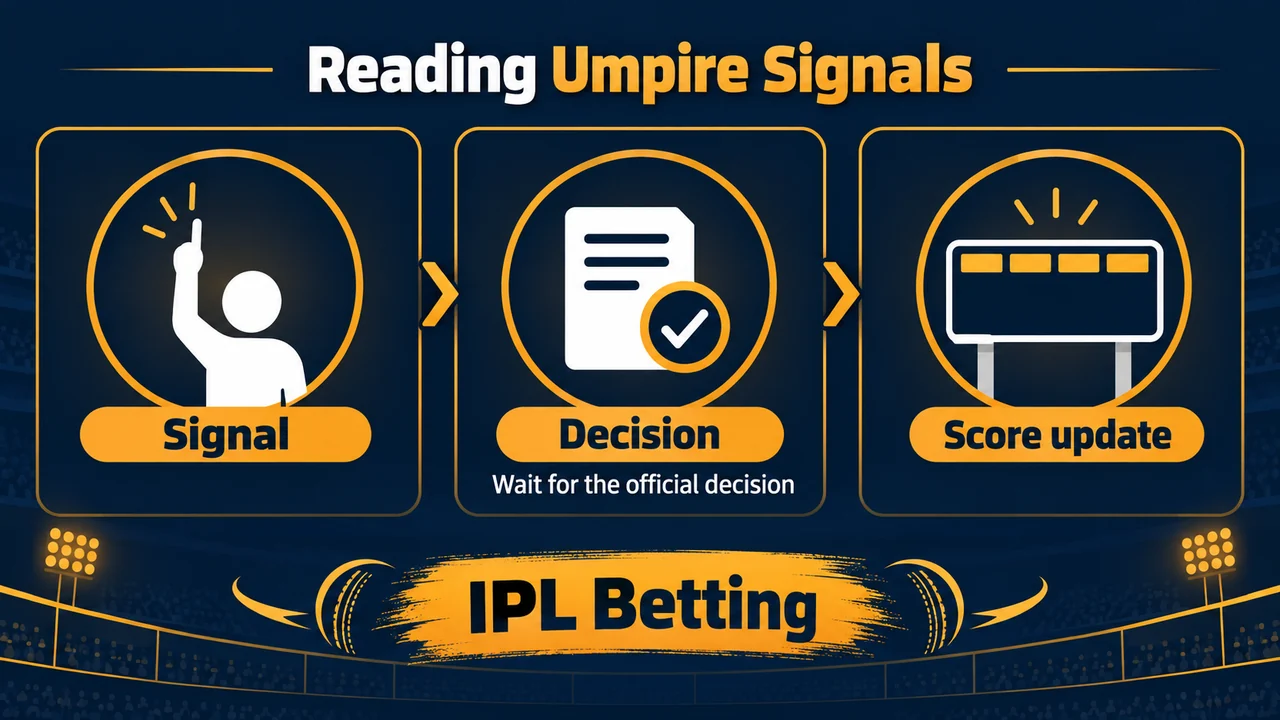
The umpire stretches one arm sideways. The television score stays unchanged, then jumps a few seconds later. That pause does not mean the call disappeared: a signal to the players and an acknowledged instruction to the scorers are parts of the same event, seen at different times.
Follow the official signal first, then compare the team total, extras, wickets, or valid-ball count that should respond. A commentator may describe an edge before the umpire signals. Keep that description separate from the official ruling. If the camera misses the gesture, wait for the announcement rather than guessing from a player’s celebration.
Two audiences, two moments
MCC Law 2.13 distinguishes signals made while the ball is in play from signals to the scorers after it is dead. Law 3 also addresses scorer acknowledgement. Some signals are repeated; the repeat is not another delivery or another penalty.
Think of a broadcast as three windows: the field, the score graphic, and the commentary. They need not update together. In an invented example, the field camera shows a no-ball, the graphic still says 80/2, and commentary begins discussing the shot. Keep the call in your notes until the scoring display catches up.
This is a guide to recognising the communication, not a replacement for the law behind every call. The general MCC Laws provide the baseline; a league’s current playing conditions may add procedures. An old match clip also belongs to the rules in force for that match.
Eight gestures to keep beside the screen
| Signal | What to recognise | What to check next |
|---|---|---|
| No-ball | One arm extended horizontally. | Extra and delivery count. |
| Wide | Both arms extended horizontally. | Wide extras and delivery count. |
| Out | Index finger raised above the head. | Final dismissal entry. |
| Dead ball | Wrists crossed and re-crossed below the waist. | Why play stopped. |
| Four | Arm waved across the body. | Awarded boundary runs. |
| Six | Both arms raised above the head. | Awarded boundary runs. |
| Bye | Open hand raised above the head. | Extras rather than batter runs. |
| Leg-bye | Hand touching a raised knee. | Leg-bye entry. |
The table is a recognition card, not a list of every possible scoring consequence. For example, seeing one arm out tells you the no-ball call; it does not by itself describe whether the batter hit the ball or completed runs. Keep the delivery’s action alongside the signal.
A correction should replace an entry
Suppose you see a boundary signal, then an official correction. Write one event with a revised decision, not two boundaries. An app that first shows four and later shows six has not necessarily added ten runs. Compare the team total before and after the corrected record.
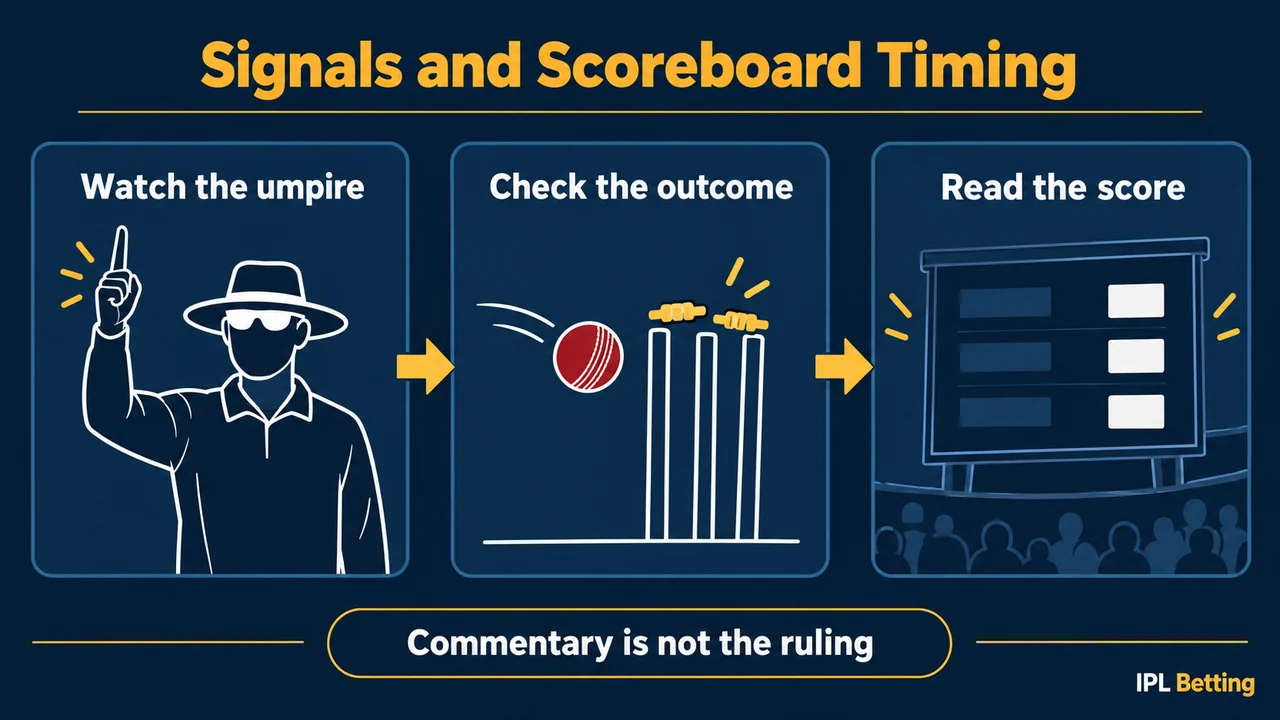
MCC’s signal list includes a way to revoke the previous signal. When that happens, wait for the replacement instruction. A still image of the first gesture can be accurate as a photograph and incomplete as a description of the final decision.
For your own viewing note, use four short fields: over or event position, initial signal, final signal, score update. If the final signal is hidden and no official announcement is available, mark the decision unconfirmed. That small gap is more honest than filling it with the answer you expected.
Watch the decision once, then the score
Practise during an ordinary over. Find the umpire after a wide, watch for the signal, and then locate the extras change. On the next legal dot ball, notice that the valid-ball count advances without a run being added. You are learning which field reacts, not trying to anticipate the next outcome.
On a replay, pause after the final announcement and read the completed scorecard. If the numbers still seem wrong, move to the extras guide for allocation. For an appeal followed by a review, the LBW and review explanation answers a different question: why the original decision stayed or changed.
Does every repeated gesture mean a new incident?
No. The same call may be communicated again to the scorers. Check whether another delivery occurred before adding another event. A camera cut alone is not a delivery marker.
Can the score graphic settle a disputed call?
Use the official decision and completed record together. A graphic may lag or be corrected. When a short clip leaves out the ruling, stop at “not enough information” and look for a fuller sequence.
Source and method: Prepared by IPL Betting Editorial Team from the linked official material. The viewing exercises are invented, not match records. MCC’s 2026 Laws took effect on October 1; that date alone does not establish IPL adoption. For a specific fixture, check its season’s playing conditions.
For surrounding context: Cricket rules made simple; Cricket Extras and Free Hits: Where the Runs and Deliveries Go; LBW and DRS Explained: Following a Cricket Review from Appeal to Decision; How to Read an IPL Cricket Scorecard: Overs, Wickets, Run Rate, and Context.