
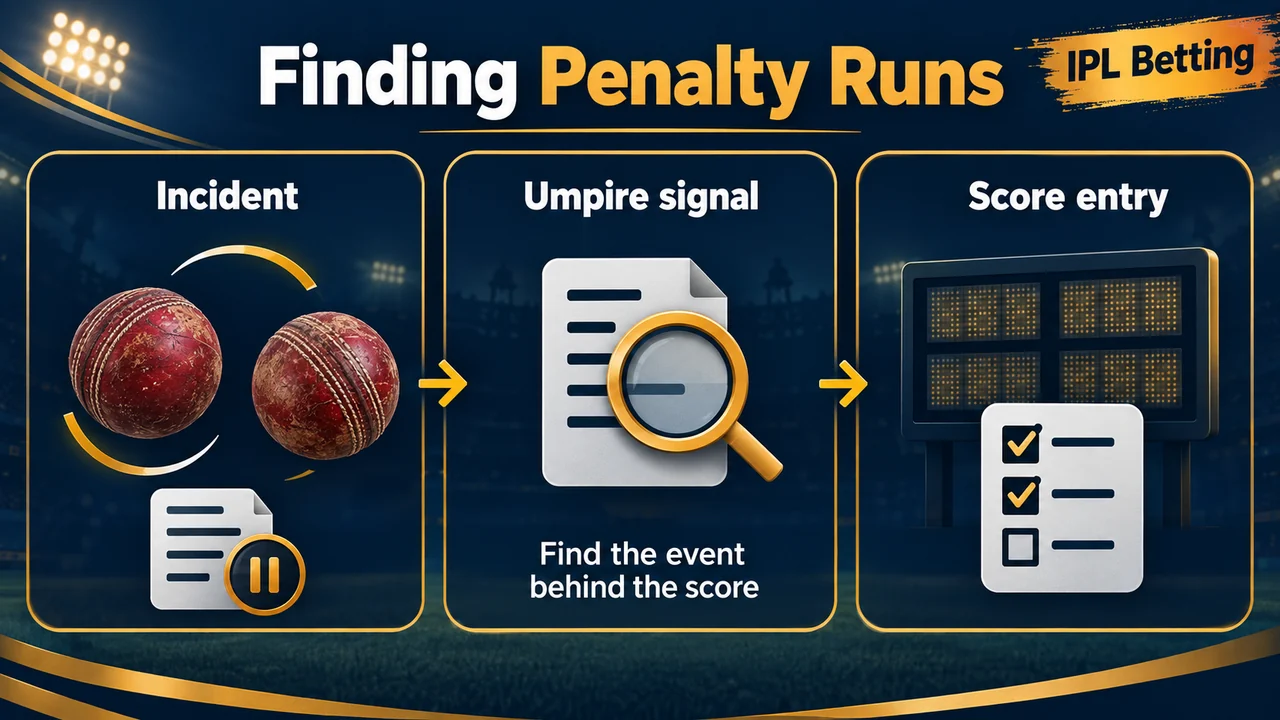
The total rises from 70 to 75, but there was no boundary shot and no five completed runs. Before calling the graphic wrong, look for a penalty award. A five-run team-score change can belong to an incident outside the ordinary batting action.
Find the reason, the side receiving the runs, and the final scoring entry. Keep the score award separate from a fine, a fielding restriction, and the runs credited to an ordinary delivery.
Start with the helmet incident
MCC Law 28.3 addresses a fielding-side protective helmet placed behind the keeper. If a ball in play strikes it, the law provides a dead-ball and five-run penalty procedure, with specified exceptions and treatment of completed runs. Not every helmet contact fits that provision.
The distinction is visible: a helmet resting on the ground behind the keeper is not the same as a helmet being worn by a fielder. First identify the object and its status. Do not import the resting-helmet consequence into every deflection near someone’s head.
In an invented replay, the camera shows a ball passing the keeper, then cuts to the scoreboard. You cannot identify helmet contact from the score jump alone. Wait for the official explanation or a wider angle showing the object.
A five-run delivery and a five-run penalty are different
| Sequence | How to describe it | What to keep separate |
|---|---|---|
| A no-ball is hit for four. | Five team runs from the stated delivery components. | Batter runs and no-ball extra. |
| Officials award five penalty runs. | A penalty entry with its own incident. | Who receives the award and why. |
| Five runs completed while running. | A running event, if officially scored. | Any short run or later adjustment. |
| A disciplinary fine is announced. | A financial sanction. | It is not automatically a score increase. |
Those are deliberately labelled teaching cases. The number five appears in each, but the number does not identify the mechanism. Check the penalty or delivery category before changing an individual batter or bowler figure.
Reconcile one invented scoreboard jump
Assume the official record for our exercise awards five penalty extras to the batting side, with no additional delivery runs. The score moves from 70/2 to 75/2. The arithmetic is five, but no batter has suddenly hit a five-run shot. Keep a separate penalty row.
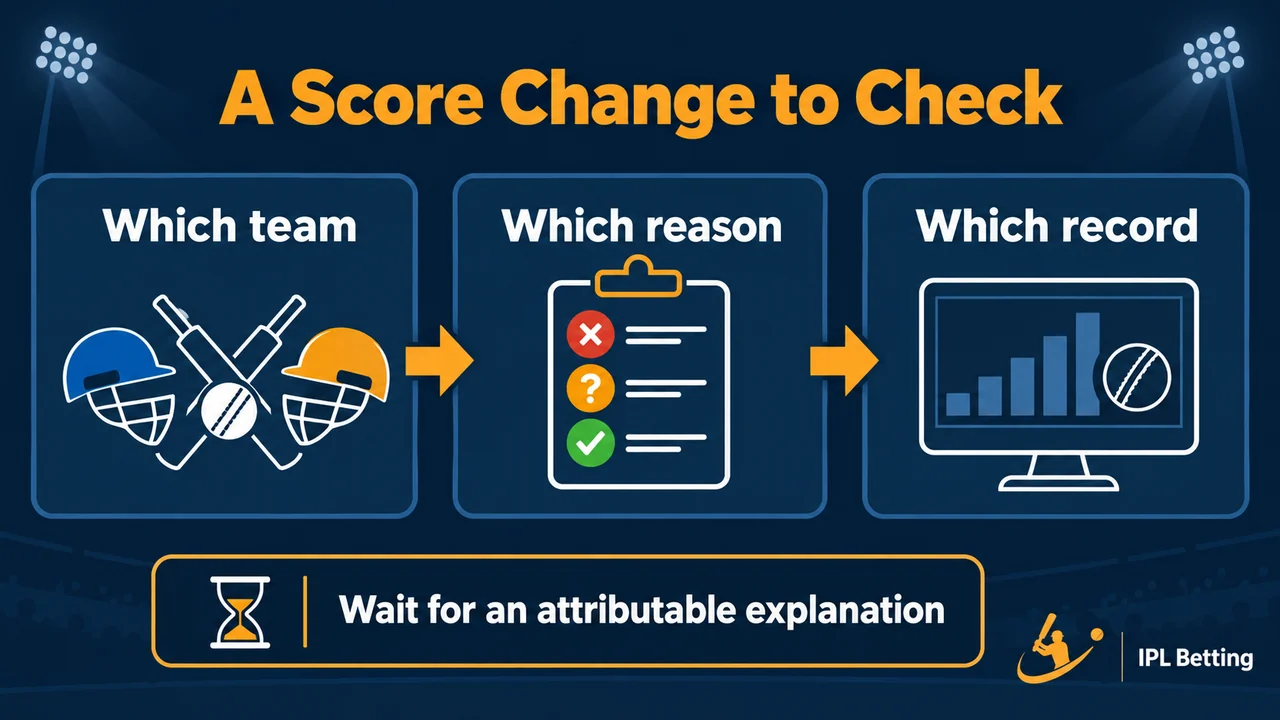
Now change the exercise: the official record awards one completed run plus five penalty extras. The team increases by six. Do not replace the six with five merely because the announcement prominently mentioned the penalty. The components need to be read together.
These assumptions are supplied for the arithmetic exercise. They do not decide how every real helmet incident should be scored. The applicable clause, its exceptions, and the officials’ ruling must supply the actual components.
Check which side was awarded the runs
A broadcast may show one innings on screen while discussing a sanction against the other side. Write “awarded to” and the team name explicitly. “Five-run penalty” without the recipient is an incomplete entry.
If the total does not change immediately, preserve the announcement time and check the official record. Do not add another five when the graphic finally catches up. A delayed entry and a second award are different events.
Our ball-by-ball reconciliation guide explains why an innings check can need more than ordinary delivery rows. The extras explanation keeps batter and bowler figures separate.
Leave the cause open when the footage is incomplete
Use a short incident record: match, over or pause, official wording, recipient, amount, and source. Leave the cause field blank until an official announcement or match record identifies the incident. “Must have been slow play” is a guess, even when the innings has felt slow.
The slow-over-rate guide distinguishes clocks, fielding restrictions, and conduct consequences. Do not borrow those details for an unrelated five-run award. For an IPL clip, verify that season’s conditions; the general MCC law and an international tournament’s procedure are not interchangeable.
Source and method: Prepared by IPL Betting Editorial Team from the linked official material. The viewing exercises are invented, not match records. MCC’s 2026 Laws took effect on October 1; that date alone does not establish IPL adoption. For a specific fixture, check its season’s playing conditions.
For surrounding context: Cricket rules made simple; Cricket Ball-by-Ball Data: Rebuilding an Over Without Double-Counting Runs; Slow Over Rates in T20 Cricket: Fielding Penalties and Match Delays; Cricket Extras and Free Hits: Where the Runs and Deliveries Go.