
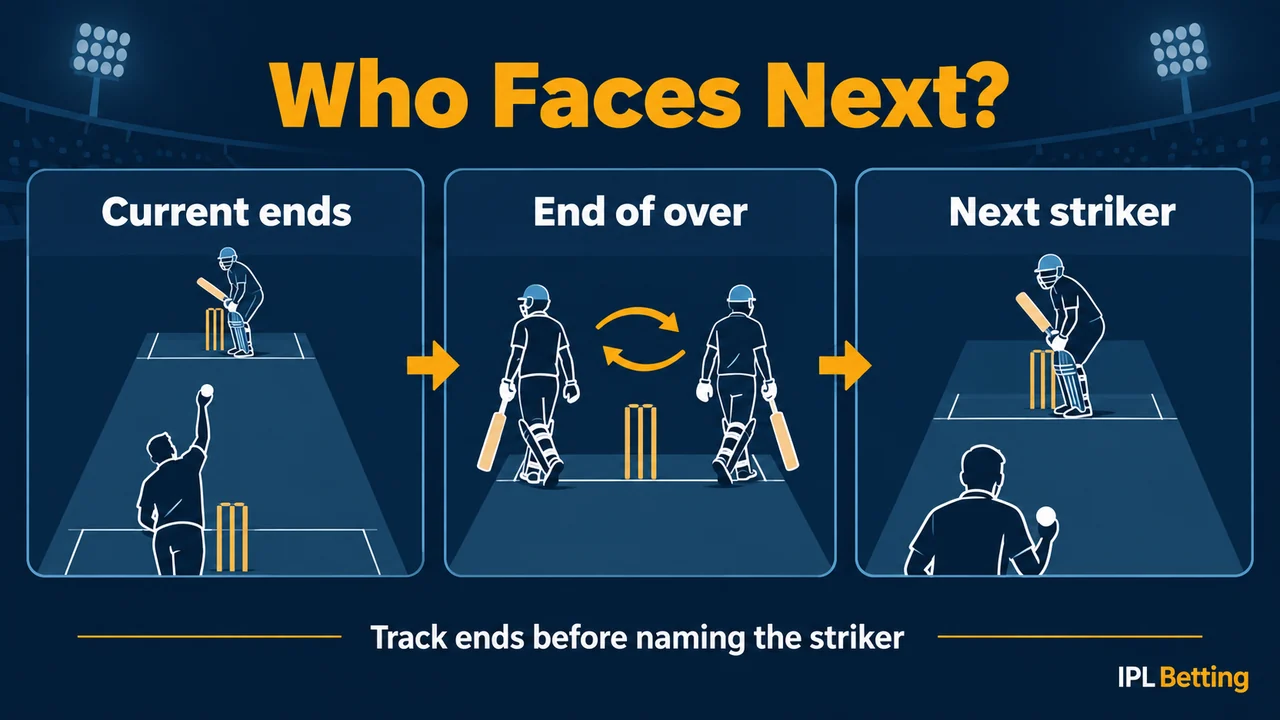
A batter takes a single from the last ball of an over, and then appears to face again. Nothing has gone wrong: the batters changed ends for the single, and the direction of bowling changes for the next over. Track the physical ends before deciding who takes strike.
Use names or initials rather than “left player” and “right player.” The television view can reverse, while the identities at the two ends are what matter. After a catch, restore the non-striker’s original end before applying any over change.
Name the ends before counting runs
Draw two boxes labelled End A and End B. Put the current striker at A and the non-striker at B, with an arrow showing the bowler delivering towards A. After an ordinary completed single, swap the names. After two completed runs, the names return to their original boxes.
This is an invented orientation exercise, assuming no boundary exception, short run, penalty, or dismissal changes the positions. It is a way to follow the sequence, not a ruling on unusual running.
| Starting pair | Ordinary result | Next delivery in the same over |
|---|---|---|
| A faces; B at the other end. | One completed run. | B faces. |
| A faces; B at the other end. | Two completed runs. | A faces. |
| A faces; B at the other end. | Dot ball. | A faces. |
The last valid ball changes the direction too
Now use the same map for the final valid ball. If A takes a single, A moves to the former non-striker’s end. The next over is delivered towards that end, so A can face again. For a last-ball single, mark both the swapped names and the reversed bowling arrow. Omitting either gives the wrong next striker.
With a dot or two ordinary runs from that final ball, B is positioned to face from the other end next over. Check that the over really ended under MCC Law 17: a displayed sixth event can be a wide or no-ball rather than the sixth valid delivery.
For a scorecard showing 8.5 overs, keep the current direction arrow. When the sixth valid ball is completed and the next over begins, reverse it. Do not reverse it merely because six event rows have appeared in an app.
A catch does not preserve an old crossing trick
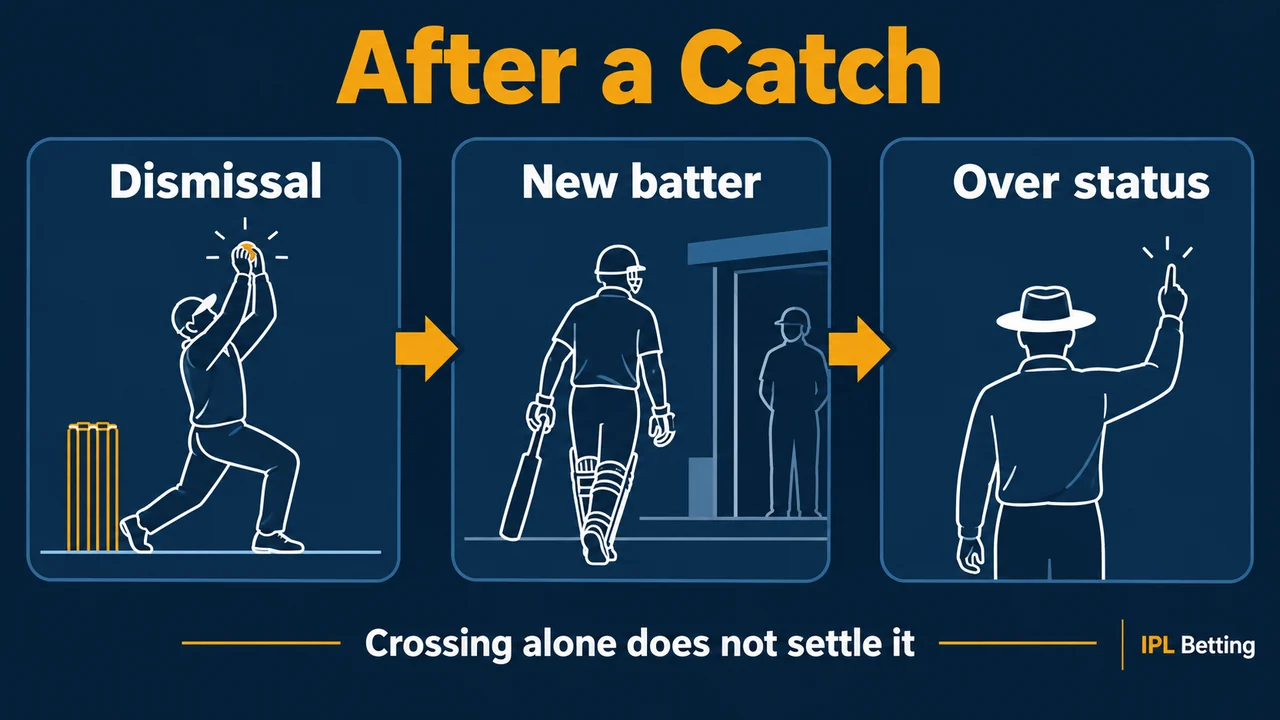
MCC Law 33.4 says completed running before a caught dismissal is not scored, while awarded penalties stand, and the non-striker returns to the original end. The ICC’s 2022 announcement also explained the new batter entering at the dismissed striker’s end regardless of crossing.
For a hypothetical catch on the third valid ball, A is dismissed while B had crossed during the ball’s flight. Restore B to the original non-striker’s end. The incoming batter C occupies A’s former end and faces the next delivery in the same over. Do not award a completed run simply because the batters had passed one another.
For a catch on the final valid ball, C still enters at the dismissed striker’s end, but the next over comes from the opposite direction. B then faces. Write C’s entry end first, then the new bowling direction; B faces the next over in this example.
Keep a wicket event in its own row
Use a worksheet with event position, striker before the ball, awarded runs, dismissal, end positions afterwards, and over completed. For the over-ending catch, write the catch first and the new-over direction second. The order prevents a mistaken swap caused by the players crossing in the air-shot sequence.
If the replay cuts away before the catch is completed, do not guess the final event from the runner’s movement. Wait for the final decision and verify the match date and applicable conditions. A newer general law edition does not silently govern every old highlight.
When the shortcut stops working
Odd-and-even counting is useful for ordinary running. It is insufficient when runs are disallowed, an unusual boundary is awarded, a batter is run out, or a special instruction determines the ends. Keep those cases outside the simple exercise until you have the relevant rule and official outcome.
Our dismissal guide explains the record after a wicket; the ball-by-ball guide explains event counts. A partnership market asks a separate settlement question. Knowing the next striker helps you follow the match, but it does not establish a betting outcome.
Source and method: Prepared by IPL Betting Editorial Team from the linked official material. The viewing exercises are invented, not match records. MCC’s 2026 Laws took effect on October 1; that date alone does not establish IPL adoption. For a specific fixture, check its season’s playing conditions.
For surrounding context: Cricket rules made simple; Cricket Ball-by-Ball Data: Rebuilding an Over Without Double-Counting Runs; Cricket Dismissals Explained: Team Wickets, Bowler Credit, and Retired Batters; IPL Partnership Markets Guide for Filipino Fans.