
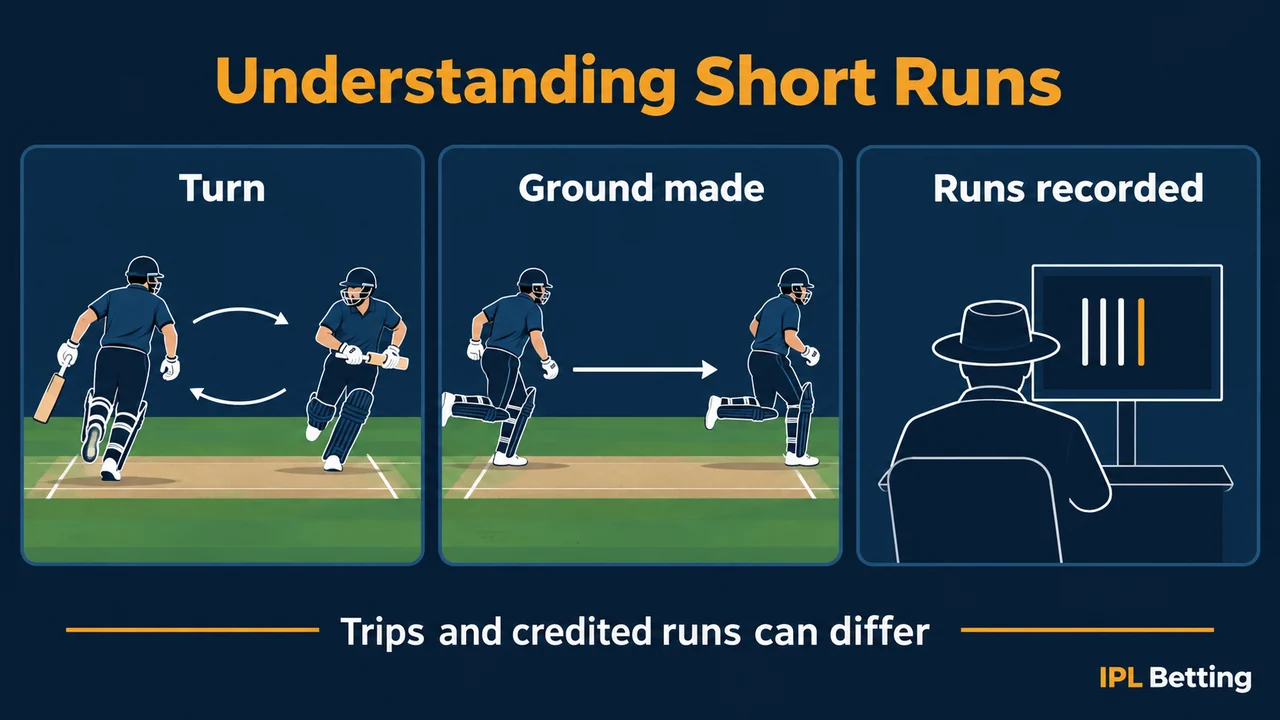
The batters run down the pitch and back, yet the score increases by only one. Compare the attempted runs with the official award; two journeys are not automatically two scored runs. A batter turning before making good their ground can make a run short even while the pair physically covers almost all the distance.
Begin at the turn: identify the relevant ground, the bat or person, and the instant the batter changes direction. If that moment is hidden, you have found the missing evidence rather than proved a short run.
One missing turn can change the count
MCC Law 18.3–18.4 defines short running and the ordinary unintentional procedure. A short first run does not automatically make the next properly completed run short. If both batters run short on the same run, it is one short run, not two separate deductions.
For an invented exercise, A and B attempt two runs. At the first turn, A fails to make good the ground; at the final end, both complete the next run correctly. Assume no boundary, penalty, overthrow, or dismissal changes the award. One of the two attempted runs is not scored, leaving one.
| Attempted sequence | Stated condition | Exercise result |
|---|---|---|
| Two runs attempted. | First short; second properly completed. | One scored run. |
| Two runs attempted. | Both batters short on the same first run; second complete. | One scored run, not zero for two separate deductions. |
| Two runs attempted. | Both separate runs called short. | Neither attempted run is scored under these assumptions. |
The table supplies its assumptions so that the arithmetic can be checked. An actual incident may have another event that changes the award. Do not use these simplified rows to decide an overthrow or a dismissal sequence.
Follow the signal after the running
The official short-run communication and the final number awarded resolve the score entry. A temporary graphic may first show the attempted count and then a correction. Treat the correction as a replacement record, not as a new negative-run delivery.
Start a worksheet at 50/1. Record the two attempted runs as provisional, then replace that entry with one awarded run after the official short-run decision in our example. The team becomes 51/1. Do not subtract a further run from 51 simply because the umpire repeats the signal to the scorers.
Keep “attempted” and “awarded” in different columns. For the 50/1 exercise, “attempted” is two and “awarded” is one. That distinction makes the correction understandable to someone who did not watch the replay.
Do not infer intent from one early turn
Deliberate short running has a separate procedure. The ICC’s June 2025 announcement described a fielding-side choice of next striker alongside the existing five-run penalty in its playing-condition changes. That announcement is not an IPL adoption notice.
An early turn shows a grounding question; the umpire’s finding establishes whether it was treated as deliberate. A player may have misjudged the line, lost balance, or acted for reasons the clip cannot show. Describe the visible contact and the official finding separately instead of assigning motive from a slow-motion frame.
A boundary introduces another branch
MCC Law 18 treats an ordinary boundary after unintentional short running separately and distinguishes overthrows. That is why the running table above explicitly assumes no boundary. Keep the boundary type and official award visible before applying a deduction.
If your clip finishes while the ball is still travelling, wait for the rest. An early turn followed by an unseen fielding event is an incomplete scoring story. A longer replay or the scorebook can resolve it; a guess cannot.
Use the correction for learning, not prediction
Practise with one incident: mark the first turn, the second completion, the umpire’s communication, and the final entry. Try explaining the result without saying only “they ran two.” The explanation should identify which part failed and which part still counted.
For the surrounding fields, use our scorecard guide. For a file containing a corrected event, use the delivery-data guide. A short run is a scoring issue; it does not by itself establish how a betting operator applies a particular market rule.
Source and method: Prepared by IPL Betting Editorial Team from the linked official material. The viewing exercises are invented, not match records. MCC’s 2026 Laws took effect on October 1; that date alone does not establish IPL adoption. For a specific fixture, check its season’s playing conditions.
For surrounding context: Cricket rules made simple; Cricket Ball-by-Ball Data: Rebuilding an Over Without Double-Counting Runs; Cricket Extras and Free Hits: Where the Runs and Deliveries Go; How to Read an IPL Cricket Scorecard: Overs, Wickets, Run Rate, and Context.