
The ball runs towards cover, but was the shot a drive or a cut? The destination is only one clue. A deflection, edge or improvised swing can send the ball into an area normally associated with another stroke.
To recognise a batting shot, watch the batter’s movement and bat path before following the ball. The four families below give you a useful starting vocabulary: drives, cuts, pulls and sweeps. They are viewing clues, not instructions that every delivery should be played with a particular shot.
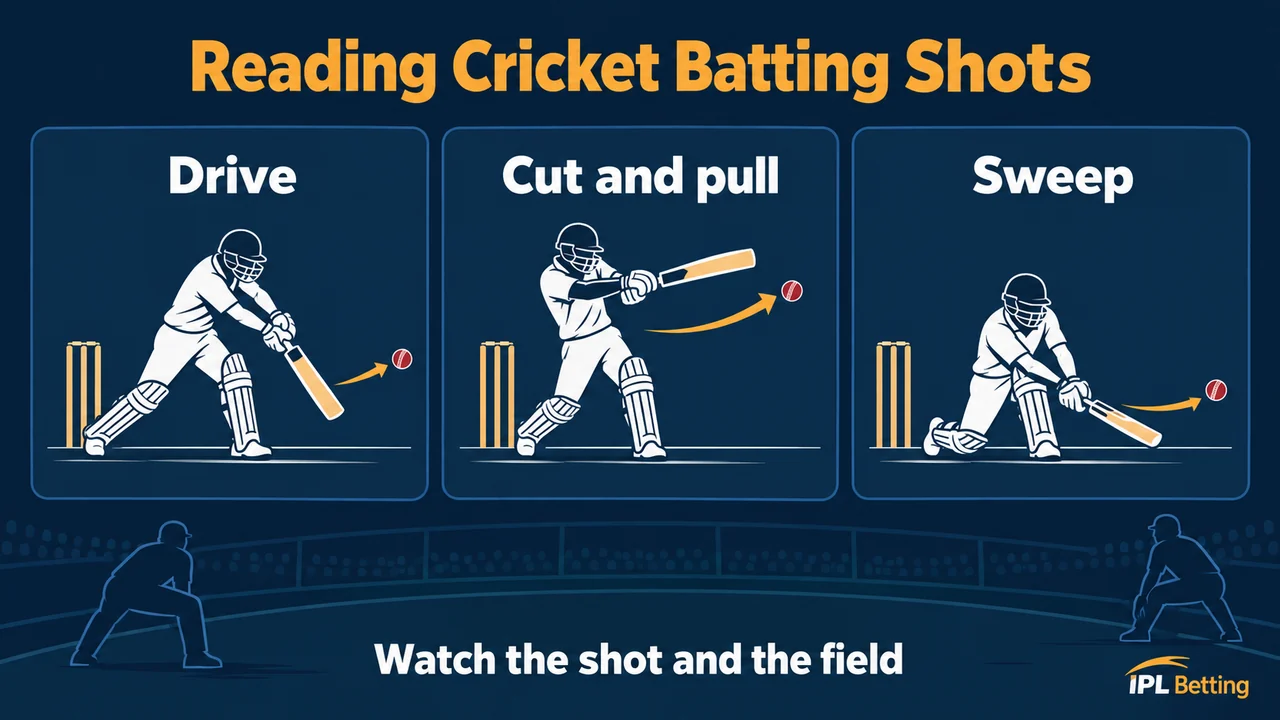
Watch contact before the camera pans
New Zealand Cricket’s sample coaching plan groups drives among vertical strokes and cuts and pulls among horizontal strokes, with sweeps included in its later skill set. Its development manual discusses footwork, bounce and turn. These are coaching references; the observations below adapt a small set of terms for someone following a broadcast.
Keep three frames in mind: the initial movement, contact and the follow-through. The first can reveal whether the batter went forward, back or across. Contact tells you the ball’s height and the bat’s route. The follow-through can support the reading but should not replace the contact frame.
Four families to recognise
| Shot family | Visible clue | Common viewing context |
|---|---|---|
| Drive | Bat travels more vertically through the ball | A fuller ball, played straight or towards an angled gap. |
| Cut | A cross-bat action directs the ball on the off side | Room outside off and a ball the batter can play from farther back. |
| Pull | Cross-bat action brings the ball towards the leg side | A shorter delivery rising into the batter’s hitting range. |
| Sweep | A low position with the bat sweeping across | Often used against spin; several variations exist. |
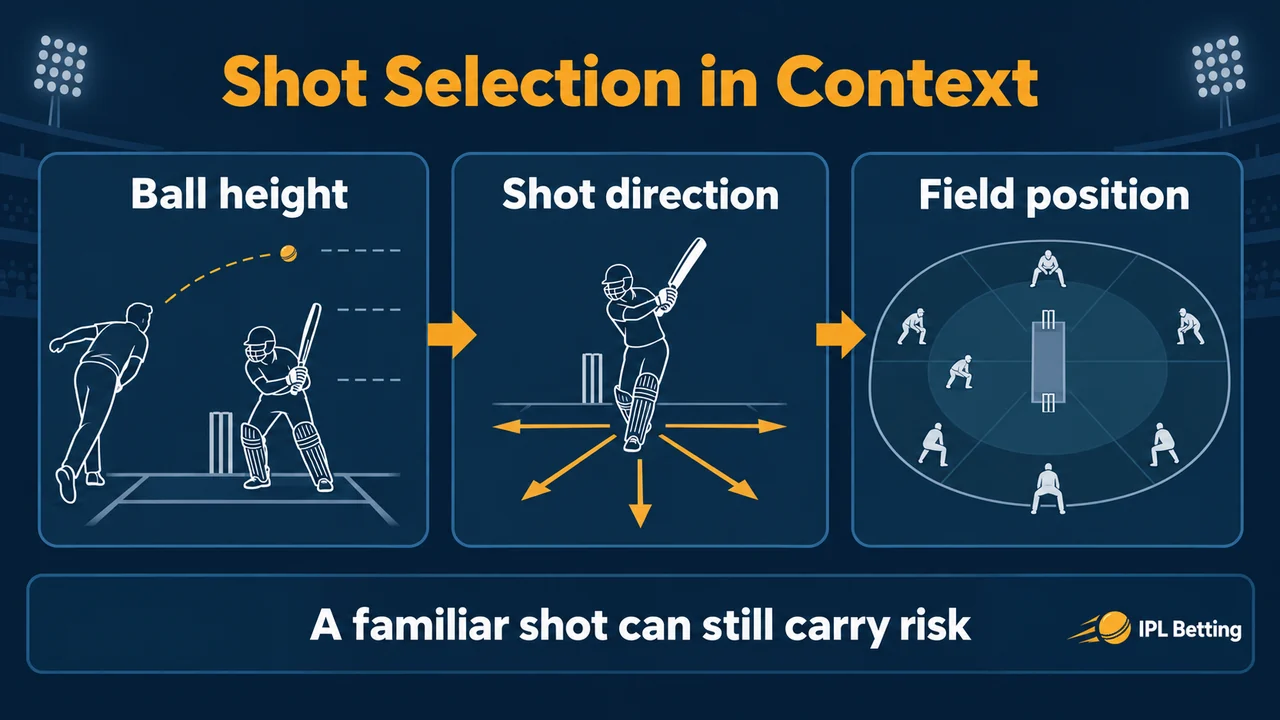
These are broad recognition aids. A drive can be played off the front or back foot; a sweep can be conventional, reverse or lofted. Do not force an improvised stroke into one label if the replay does not show enough. “Cross-bat stroke towards the off side” is a reasonable first description.
Exercise: keep the shot and its result separate
In a fictional over, the batter meets a fuller ball with a straight bat and sends it along the ground. A close fielder stops it, so no run follows. The next delivery produces a similar motion but passes the fielder for four. Both can be drives. The shot family has not changed merely because the result has.
Now consider a cross-bat stroke to a shorter ball towards square leg. One version stays low and is fielded; another is mistimed and caught. “Pull” can describe both attempts. A label should tell you what the batter did, not serve as praise for a successful result or a criticism of an unsuccessful one.
For your own note, write “stroke / route / result” as separate items. For example: “drive / towards mid-off / dot ball.” That leaves enough detail to understand the delivery without calling every boundary a great shot or every dismissal a different technique.
Distinguish a cut from a pull through the stance
Off and leg depend on the batter, not the screen. If a left-hander takes strike, reset your map. A stroke that travels to the same physical side of the field as the previous ball may now be described with a different side relative to the new batter.
Watch for room outside off on a cut and the across-body action of a pull. Footwork and arrival height help. The destination still matters, but it is one observation rather than the entire definition. If the camera only shows the outfield, wait for a replay before naming the stroke confidently.
Sweeps need a closer look
A conventional sweep commonly sends the ball towards the leg side from a lowered position. A reverse sweep changes the direction of the sweeping action. A switch hit involves an additional stance change; seeing a ball finish on the opposite side is not enough to decide which variation occurred.
Watch the hands, stance and contact sequence. If those details are hidden, say “sweep variation” rather than guessing. The example is about identification, not whether the choice was technically advisable. Bounce, turn, fielders and match situation all affect that separate question.
Do not mistake a diagram for a prediction
A shot diagram shows a possible route. It cannot promise four or six runs. A fielder may occupy the gap, the ball may lose speed, or contact may come off a different part of the bat. Ground and aerial versions also create different chances.
Choose one family to follow for an over. Notice the incoming length, the bat path and where the ball actually goes. On the next over, add another. That exercise is easier than memorising every stroke name while the live camera races from the batter to the boundary.
What if commentators use two names?
Traditional shot vocabulary contains fine distinctions and variations. Two commentators may emphasise different parts of an improvised movement. Return to what the replay shows: forward or back, vertical or cross-bat, off or leg, grounded or aerial. You can follow the cricket accurately while leaving an uncertain label open.
Related reading: Cricket rules introduction; Four, Six, or a Catch? Cricket Boundary Decisions Explained; Cricket Field Positions: Reading the Ring, Slips, and Boundary Riders.
Prepared by IPL Betting Editorial Team. Updated 4 October 2026. The linked official materials support the rules identified in this guide. Match examples are invented exercises, and a competition’s published conditions can differ from the general Laws.